By Ray Birch
SPRINGFIELD, Va.—While African-Americans are making progress in advancing to more leadership positions within credit unions, there is still much more “work to be done,” according to Lynette Smith.
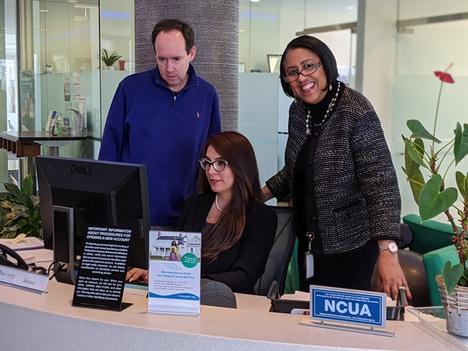
Smith, who is African-American, leads the $125-million TruEnergy Federal Credit Union in Springfield, Va. She says to gain a better understanding of her assessment, all one has to do is look at credit union members across the nation.
“I feel there has been advancement over the years, but we need a whole lot more,” said Smith, who became CEO at TruEnergy, formally Washington Gas Light FCU, in 2008. “We need to have more diversity in the industry, more diversity at the table making major decisions about the movement. I think it's important because when you look at over 118-million members, credit union CEOs need to be representative of or fields of membership. That's the key.”
In conjunction with Black History Month during February, CUToday.info is speaking with African-American leaders within the credit union community.
A ‘Discouraging Statistic’
Smith pointed not only to the disparity in the number of African-American CEOs compared to the total number of credit unions today—about 5,800 with just 165 being led by African-Americans—but also to the number of African-American women in charge of large CUs.
“What is the more discouraging statistic is in that 165, you have about 94 who are women, but only three of those to my knowledge are running credit unions over one-hundred-million dollars in assets. And I am one of them,” she said. “Overall the percentage of African-American CEOs to the total number of CU CEOs is less than 5%. I think there definitely needs to be more diversity, equity and inclusion at the CEO level.”
Smith said she is pleased NCUA over the last half-decade has sought to bring diversity, equity and inclusion (DEI) in credit unions to the forefront.
What will drive improved DEI within credit unions, said Smith, is greater diversity among credit union board members.
“I believe this starts at the top,” Smith said. “If board members are diverse, then boards will seek greater diversity at the C-Suite level.”
Progress Being Made
Smith reiterated that credit union attention to diversity, equity and inclusion has progressed since she started with CUs.
“I've been in the credit union movement for more than 30 years, and I will tell you progress has been made. I came into credit unions as a vice president,” she said. “I was an accountant when I started. I had worked at the public accounting firm Ernst & Young. That gave me a leg up, I believe, because I had the technical skills.”
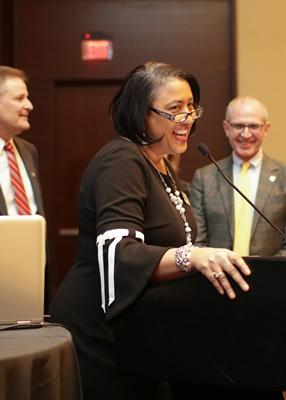
Smith started in credit unions in 1989 as a vice president of finance at Treasury Department FCU in Washington.
“From there, I became CFO a couple years later,” said Smith. “Within credit unions I have always been at the C-Suite level.”
In 2008, Smith was offered the CEO’s role at what was then Washington Gas Light FCU. The credit union rebranded in 2019.
“Since I have been here, we have grown the credit union from $70 million in assets to $125 million today,” Smith said. “I believe having a financial background has helped me to help the credit union grow. I think you have to have the education and the technical skills to run a credit union, because it is very competitive.”
The Role of the AACUC
Smith, a board member for the African American Credit Union Coalition (AACUC), has been part of that organization for more than 15 years. She said it’s a move that has also helped propel her career.
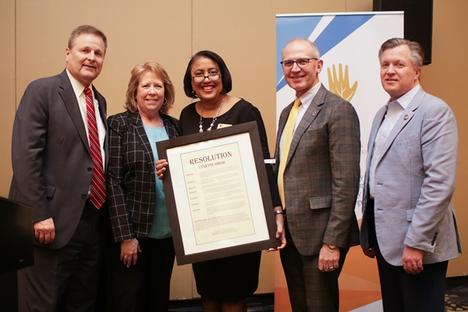
“The AACUC helped me to get where I am today,” said Smith, who also sits on the board of the Metropolitan Area Credit Union Management Association. “I have always surrounded myself with African-Americans who were running larger credit unions. They were my mentors, they helped me to develop. You have to have mentors in your life to be successful, and don’t wait to seek them out. I feel I would not be where I am today without the AACUC… I think, too, that networking is key and critical for African-Americans within credit unions. Not only through the AACUC but also through CUNA, NAFCU and CUES—belong to all of these organizations. Take advantage, too, of their professional education opportunities.”
Smith added that a “highlight” of her career was speaking at the NAFCU Management and Leadership Institute.
“I enjoyed sharing my best practices with our future credit union leaders. I believe a great deal in the power of mentorship,” she said.
African-Americans who have advanced within credit unions to C-Suite roles, Smith believes, are ones who have taken advantage of professional development opportunities.
Getting Noticed
Just as important as professional education for the advancement of African-Americans within credit unions, said Smith, is making an effort to be noticed.
“You have to stand out,” she said. “I've been in the industry for over 30 years and I didn't get here just because of who I am. I got here because I had to work harder, if not smarter, and I had to rise above all the others, all of my peers. I was prepared, and I made sure I was prepared. I had the skills to lead a credit union, I got the professional development I needed, and I went to conferences. I’d say this is even much more critical today for African-Americans because the competition is only getting greater as the number of credit unions shrinks.”