

By Ray Birch
ALEXANDRIA, Va.—As news of the discovery of long-time frauds inside credit unions continues to be reported, the NCUA said it has been taking steps to reduce internal fraud at small CUs, providing examiners with new training focused on identifying fraudulent activity earlier, and also reviewing more transactions during small shop audits.
But NCUA also said while CUToday.info has reported on what appears to be an increase in such internal fraud–such as the recent allegation by the former CFO at Clarkston Brandon Community FCU that he stole $20 million over 12 years–the actual number of fraud cases inside CUs has been relatively constant for more than a decade.
According to the agency, the effectiveness of the measures it has put in place to combat embezzlements largely depends on how well CUs adhere to proper internal controls.
In an interview with CUToday.info—which asked why internal fraud persists at small CUs and why it can go undetected for long periods—NCUA emphasized that it is not a fraud examiner, and that the responsibility for having proper internal controls, an involved board and supervisory committee, and using competent CPA firms lies primarily on the shoulders of credit unions.
NCUA Executive Director Mark Treichel pointed out that, despite perceptions, the pace of fraud at small CUs is not accelerating or slowing.
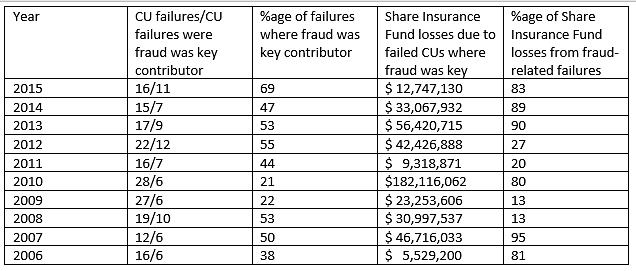
“Over the last 13 years, the average number of internal fraud cases at credit unions that have led to failure has been eight, and that figure has remained fairly steady, with annual variations not being statistically significant,” said Treichel, acknowledging that in 2015 the number of such cases was 11. “And when you are talking about a universe of 6,100 credit unions that is a small number.”
Fraud Increased In 2015
While there was a small CU fraud “uptick” in 2015, the actual losses coming from those 11 failures were less than “normal,” said Treichel.
“One might conclude that because we have changed our fraud monitoring policies and procedures that we are catching these incidents sooner in the cycle of fraud so that the losses that are incurred when fraud is finally identified is less.”
NCUA Board Member Mark McWatters has at several open board meetings publicly raised concerns over the amount of losses to the share insurance fund stemming from credit union internal fraud and what the agency is doing to address the crime.
Asked if McWatters was raising a red flag, Treichel explained that losses to the insurance fund are often a natural course of discussion at board meetings.
“Board Member McWatters took interest in the fact some of these credit unions failed due to fraud,” said Treichel. “He has a background in certified public accounting, so Mr. McWatters digs into the numbers and wants to understand why the fraud is happening and what the agency can do. I would not say he is wrong (in his concern).
“That said, whenever we have a loss at a credit union due to fraud we look for lessons learned and how we can adjust our procedures accordingly,” continued Treichel. “So if it is a new type of fraud approach we build in ways to detect it into our exam procedures so that the next time someone attempts a similar crime we can catch it sooner and hopefully prevent a failure.”
Increasing Transaction Scrutiny
Treichel said examiners now review small credit unions’ daily transaction activity more closely, looking for signs of fraud, and more carefully scrutinize internal controls. Training, he said, addresses new methods to detect the typical kinds of internal fraud that has gone on at CUs over the years, as well as the new criminal approaches the agency is witnessing.
NCUA said it could not share specifics on the new training, as that could tip off crooks.
“When people suggest an examiner ‘missed’ an instance of fraud, there are a lot of things that happen before someone hears about the fraud from a news story,” offered Treichel. “The board of directors has fiduciary responsibility to safeguard the assets. So, first and foremost, it’s important that the board establishes an environment that allows for the accounting records to be handled in a pristine manner. Then you work on the obligations of the supervisory committee, and you work out the audits. We rely on the work of the audits. The audits exist to test the internal controls.”
Treichel emphasized that the examination and supervisory programs focus on ensuring credit unions comply with NCUA’s applicable laws, regulations and operate in a safe and sound manner. The agency also looks at and tests a credit union’s internal controls on a “risk-focused basis,” he said.

Mark Treichel, NCUA
“Again, all of this first hinges on the work of the credit union,” said Treichel. “So I would not say that just because fraud occurs that an examiner missed something or did not do his job. Our examiners are out doing what we ask them to do, which is testing the internal controls.”
Large Losses Over Long Periods
When asked about internal controls at the Pontiac, Mich.-based Clarkston Brandon CFCU—controls that missed what has been alleged to be large-scale fraud for 12 years—Treichel responded that comments on that matter should come from the state of Michigan, which conducted the annual reviews for the state-chartered credit union.
Michael A. LaJoice, former CFO at Clarkston Brandon, allegedly walked into a police station and admitted to stealing $20 million over 12 years from the CU, causing the credit union to be placed into conservatorship. The institution and regulators were further embarrassed by LaJoice’s high-profile lifestyle and other warning signs that apparently went unnoticed.
But the long, ongoing fraud at Clarkston Brandon is typical of FCU’s that have been victimized by their staff, including the spectacular 2010 collapse of St. Paul Croatian FCU, the largest-ever loss to credit unions by a natural-person CU at more than $170 million—which was supposed to have served as wake-up call to regulators and auditors of the risk of embezzlement and internal fraud by employees.
In December, Jacqueline Ray, the former manager for the Ochsner Clinic FCU in Biloxi, Miss. was accused of stealing more than $1 million from 2007-2013. Also in December, the former vice president of Houston Police FCU, Cheryl Vickers, was charged with an embezzlement that lasted for nearly two decades and involved stealing $1,247,785 between.
Long, Detailed Audits Costly
Treichel explained that NCUA generally budgets a certain number of hours for each CU exam.
“As I mentioned, we do not do full CPA opinion audits and we don’t do fraud audits,” said Treichel. “I could send in three examiners for an extended period and audit every transaction, and we would catch more cases of fraud. But, that in itself, is very expensive.”
Treichel said credit unions face the same decisions.
“With the internal controls they put in place, credit unions have to balance making sure things are done in a safe and sound manner without spending too much money. You could have someone checking every accounting record, but at some point that becomes too cost prohibitive. So the credit union has to balance how much money do they spend to create these internal controls.”
Some sources have stated that small credit unions suffer more instances of fraud because they get the “B Team”—younger, newer NCUA examiners.
Treichel called that assertion a “mischaracterization,” saying that while examiners of small shops may have less field time than those reviewing larger CUs, they have just completed the latest training, which includes the new fraud direction.
“Plus, new examiners have relationships with mentor examiners and supervisory examiners, so if they spot something inside a credit union that raises a concern, they can run it up the flagpole,” said Treichel.
Like Treichel, other sources suggested to CUToday.info that much of the blame for fraud at small credit unions falls on CUs themselves, particularly supervisory committees not effectively involved in overseeing internal controls, and use of CPA firms unskilled in fraud detection and not understanding credit unions.
“I have seen really good audits, both by volunteers (supervisory committee) and by paid professionals,” said Treichel. “In any professions you will have a bell curve of the elite, good, average and those who do not have the requisite skill sets. If you hire an auditor who does not understand what he is doing, that adds to the challenge.”
But again, Treichel emphasized the critical importance of effective internal controls.
“I always come back to the credit union having good internal controls and putting them in place. That nips things right at the beginning,” he said.
Dual Controls
One problem that internal controls may not be able to address, according to Treichel and several other fraud experts: small credit unions lacking the staff to assign sufficient redundancy in duties, avoiding instances where one person—often the CEO—solely manages a business function.
When duties are segregated at a small credit union, Treichel said that places a great deal of importance on having a very engaged supervisory and audit committees.
“The supervisory committees can attack fraud by having frequent meetings, asking good questions of the staff, and looking closely at exception reports,” said Treichel. “It’s really about creating a corporate culture that views internal controls as being as important as they are.”
Treichel said that with “hindsight being 20-20” it’s easy for the credit union community to wonder why fraud cases can be missed for so long once they are uncovered, like at Clarkston Brandon. But in his discussions with boards, supervisory committee members, and staff at credit unions that have been hit by internal fraud, perspectives on potential red flags are much different once the crime is discovered.
“Like a lot of things in life, sometimes you don’t put two and two together. Say an employee appears to be living beyond his means, and when asked how he paid for his big house he says Aunt Hazel died two years ago and he got a big inheritance. You say, ‘OK, that’s how he got the money.’ But after an employee confesses to the crime you wonder why you didn’t think there was more to the story and ask more questions. After the crime you look at things through a different lens.”
Treichel said that in almost every case when fraud is detected that boards, supervisory committees and staff feel “wronged” by the lies.
“They find out they have been told a story, and then they ask themselves, ‘Why didn’t I see this? Why didn’t I ask more questions and dig deeper?’” Treichel said.
What’s The Future?
With small CU internal fraud leading to an average of eight failures annually, Treichel is hoping the new exam steps, including a greater focus on transactions at small shops, will reduce the internal fraud instances and losses.
“Despite the fact we don’t do fraud audits, we have invested resources to improve examinations in this area,” said Treichel. “Hopefully fraud will begin to trend down, as you can never get rid of it. That said, if we encounter 11 cases this year and 15 next year, I won’t be surprised. By the same token, if we have only four cases next year I won’t be surprised either. The key is detecting it earlier to reduce the impact on the credit union and the share insurance fund.”