

By Ray Birch
LAKE FOREST, Ill.—The battle for six-month CD money making some big news, and one expert is urging credit unions to recognize deposits are now much more than just a cost center.
“The battle for deposit money is shifting dynamically,” said Michael Moebs, economist and chairman at Moebs $ervices. “Do not be misguided by using old ways. It is a whole new deposit rate world.”
The true test for determining proper rates, according to Moebs, combines profitability and balances.
“This goes beyond classical economics of supply and demand. Transaction account portfolios—checking—which now comprise all savings including MMDAs, must be profitable,” he said. “This concept is totally foreign to depositories.”
Moebs $ervices provided an update on a report shared six weeks ago (see chart).
Highest Rates in Utah
The new data show the highest deposit rates for six-month CDs are in Utah.
“The median in Utah is 5.13%,” said Moebs, adding Utah FIs tend to be very efficient. “Meaning their net non-interest expenses minus fees—are very low and they know when and how to collect fees on loans and deposits, while keeping expenses low.”
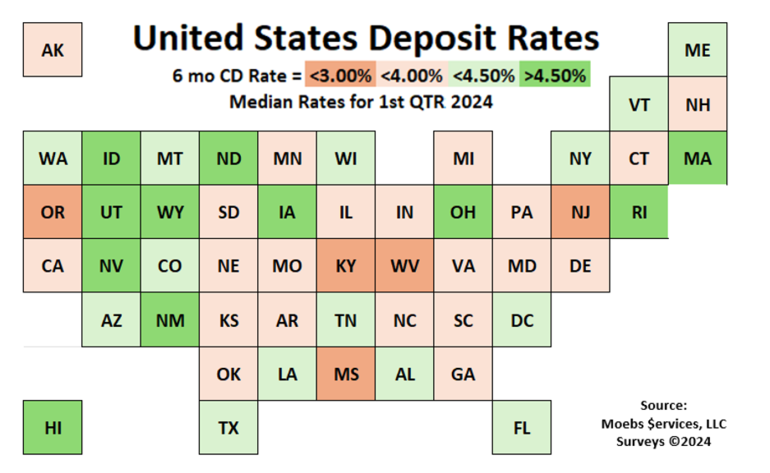
The prevailing rate in Utah is double that of Oregon, where the median six-month rate is 2.05%.
“Oregon is called the Beaver State. Beavers create dams,” Moebs said.
Moebs emphasized that in the current market the pricing of deposits has much greater variance, not only nationally and by state, but even down to the county, township, city and village levels.
“There is more variance in deposit rates than ever before. This is a very positive result, since competition can increase with just current players, leading to better returns for the basic, riskless saver,” Moebs said.
The Map Changes Color
Moebs noted that in the days prior to COVID, a map of the U.S. color-coded according to rates being paid would be nearly uniform in color. But no more.

Michael Moebs
“What has happened since COVID, instead of acting like a herd, depositories started individually responding to their markets,” he said. “Pieces of the pricing puzzle are becoming integrated into the ‘right price’ for savers.”
Moebs further stressed that credit union leaders must recognize the importance of treating loans, investments and deposits as profit centers, instead of the old concept of paying attention to the profitability of loans only, while viewing deposits as a cost center. The latter approach, he said, is now “ancient history.”
“Deposits are profit centers just like loans and investment are profit centers. And the bottom-line for cooperatives is building capital,” he said. “The rate for deposits is higher if the depositor has more money in the account. This means rate tiers for higher deposits are inevitable now. Rates must match deposit balances. This is how balances, or supply, is done now in depositories.”
Pricing Advice from the Rolling Stones
So, what is the ideal pricing for a six-month deposit?
“If the rate brings in deposits or doesn’t lose deposits, and the individual deposit portfolios are profitable, you’ve got the right price,” said Moebs. “The Rolling Stones’ song Gimme Shelter, slightly adjusted, has the perfect answer: ‘Rates, children, are just a click away, click away . . .”
Moebs said the riskless saver learned with COVID that government rates are just as good as deposit-insured rates.
“When the FDIC stepped in and saved every dollar of Silicon Valley Bank’s’ deposits, the riskless saver learned to want and need higher rates,” he said. “This means deposit rates are determined by the net of non-interest expenses less fee revenue. Those FIs with net expenses lower than other competitors can pay higher rates. These FIs will step within one basis point of losing a member’s or customer’s deposits.”
Increasingly Important
Moebs said with rate competition heating up, it is more imperative than ever to price deposits carefully and accurately.
“Remember PBR when pricing deposits: profitably balanced rate. If the account is not profitable it’s not the right rate. If the depositor’s balance is not high enough for a positive bottom line it’s not the right rate,” explained Moebs.