

Editor’s Note: 2023 marks the 25-year anniversary of a two-year battle in Congress to get the Credit Union Membership Act not just introduced, but passed. It was a historic fight that led to an even more historic change for America’s credit unions, which were deeply threatened by banker lawsuits and court decisions that had gone against FCUs and how NCUA had interpreted field of membership rules.
To mark the event a quarter-century later, CUToday.info is featuring coverage originally published as part of the 20thanniversary with a series of stories in which those close to that fight shared their recollections of the time and their insights into how it changed credit unions.
BIRMINGHAM, Ala.–A quarter of a century has passed since the signing of the Credit Union Membership Access Act (CUMAA)--a political feat of near-Biblical proportions for CUs—but as one person emphasizes, what it has meant to credit unions is as apparent as ever today.
Dennis Dollar, the former NCUA chairman who was “in the room when it happened,” shared with CUToday.info his recollection of events that led to the bill’s passage, as well as his views on the implications of the legislation on the growing number of CU leaders who weren’t on hand and may not understand just what it has meant.
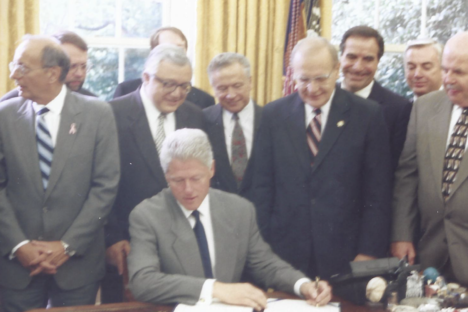
Dennis Dollar, in background at far right, during HR 1151 signing in the Oval Office.
“There’s no doubt that the Credit Union Membership Access Act brought about changes in field of membership that credit unions still benefit from today, and many CEOs today may not be aware of those enhancements even as they make use of them,” said Dollar, who now leads the Dollar Associates consulting firm who was a member of the NCUA board when President Bill Clinton signed the bill also known as HR 1151 into law. Dollar was in the Oval Office for the signing.
“It’s good for them to be reminded that any industry is just one lawsuit or one punitive piece of legislation away from turning good days to troublesome days.”
Dollar, who would eventually chair the federal CU regulator, noted that about 90% of his work providing consulting on field of membership-related issues today literally couldn’t happen without HR 1151, but some of his younger clients don’t realize just how narrow their fields would have to be otherwise.
But that isn’t always a bad thing.
No More ‘Constant Fear’
“The new generation of credit union CEOs don’t live in constant fear that bankers are going to sue them and cause them to lose their opportunity to grow,” he said. “1151 put to rest the fear of banker lawsuits for credit unions.”
But not for NCUA, Dollar is quick to amend. “The agency has been sued twice since then, and won both times.”
That lack of fear has led credit union executives to spread their wings in ways they could only have dreamed of 25 years ago.
“Credit unions are expanding without that constant fear, and that is a good thing,” Dollar said. “But we are careful to remind our clients that the bankers are still out there. You still have to use good judgment. We have only had one (FOM expansion application) that didn’t get approved, and we told them it wouldn’t be and suggested ways for them to pare back the application to get it approved, but they insisted on going for it.”
The ‘Art of the Possible’
Still, with the vast majority of his clients successfully growing their fields, Dollar called the fruits of the CUMAA as “the art of the possible.” Today, he said, growing a credit union can be less about restrictions on what a credit union is allowed to do and more about what a credit union is capable of doing.
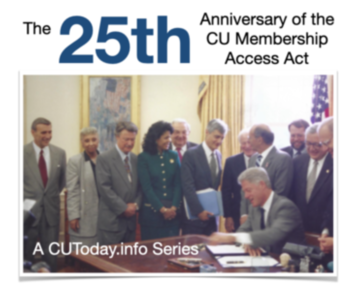
“We tell our clients, ‘You can apply for all of this, but do you have the wherewithal, the capacity to serve all of this?’” he explained, noting that while CU executives wouldn’t have dared to dream about certain things 25 years ago, some today don’t see any limits. “That’s where we come into play. We are willing to interpret the rules as broadly as possible, but there are limits.”
A ‘Congressional Blessing’
Even some of the existing limits can sometimes be pushed, Dollar noted, and that is all only because credit unions were able to convince lawmakers that increased access was a good thing.
“HR 1151 was congressional blessing that everyone who wants to join a credit union should be able to do so,” Dollar said.
If no longer living in fear of banker lawsuits is one of the benefits of the growing number of CU leaders who don’t have the institutional memory about that epic effort, the primary downside may be a degree of complacency, Dollar beleieves.
“I think the biggest disadvantage is a lack of urgency in the event of another 1151-type of advocacy is needed,” he said. “We don’t want to live in fear, but we also have to remember it could happen again. You’re always just one court decision away from that.”
A Different Landscape
And the political environment of 2023 is radically different from that of 1998, he observed. “The dichotomy is much more extreme today. I really wouldn’t want to do 1151 today.”
The political effort and capital that needed to be drummed up and then used almost simultaneously was immense, as was the critical ability to work both sides of the aisle.
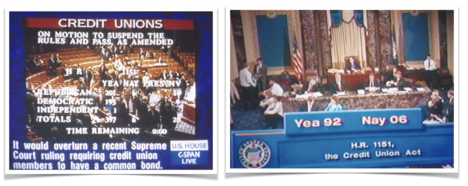
“Historically, banks had better support among Republicans and credit unions had closer ties with Democrats,” Dollar recalled. “That’s why House Speaker Newt Gingrich’s endorsement truly was a seminal moment.”
And not just in the context of credit unions and banks. Traditionally, the Speaker of the House doesn’t sign onto a bill. The fact Gingrich added his name as a co-signer on HR 1151 -- literally the day after the Supreme Court handed down its ruling that gutted NCUA’s interpretation of FOM rules -- was a clear signal to his GOP brethren.
A New Era
It would also prove to be the beginning of a new era of political clout for the movement.
“I knew we had something special in Access Across America (an NCUA initiative) when Maxine Waters offered to do a road trip with me,” Dollar laughed. They were, after all, an unlikely duo, he being the Republican appointee to the NCUA board and Waters being a Democratic House member from California.
But it turns out stranger things can -- and did -- happen. It is unusual for a bill to go from the desks of the legislators who wrote it all the way to the president’s desk in just nine months. It is similarly unusual for a bill to pass with such gigantic margins: 411-8 in the House and 92-6 in the Senate.
An Unusual Situation
And then there’s the unusual situation in the White House unrelated to credit unions that is now a part of CU history and lore: Monica Lewinsky, the White House intern who had an affair with Clinton.
“The bill-signing ceremony came as Clinton was in the midst of the Lewinsky scandal,” Dollar related. “The day he signed the bill was the day he wore the tie that Monica had bought for him, and she was testifying that day. Some believed he was trying to send her a message with that tie.”
Whatever message Clinton may have been trying to send to Lewinsky, the banks received a different one: credit unions would be entering a new era of not only great expansion in their fields of membership, but also in their political might, as credit unions have significantly upped their game in Washington over the last quarter century.