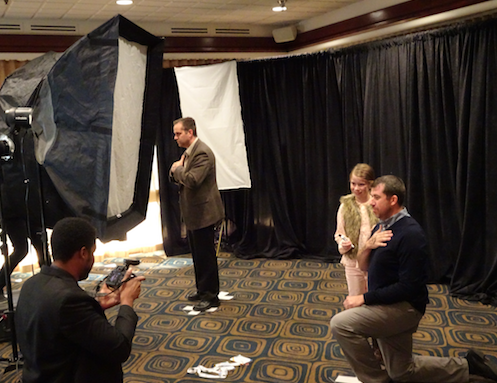
SEATAC, Wash.–Credit unions are constantly being told to tell their stories, but what about the stories of individual CU leaders and volunteers that have nothing to do with credit unions?

As part of a unique project here, three CU people did just that, including one who shared what it’s like to think you’re about to die, while a CEO talked of how life can come full circle.
During the Northwest CU Association’s Maxx Convention here, representatives of the Dear World project—which gathers stories from people who also write their personal statement on their skin—brought together credit unionists to do the same. Prior to videotaping those stories at a separate event as part of the meeting, three people stepped forward from Washington and Oregon to share touching, funny and frightening personal stories. Here’s a look at each (followed by coverage of what the Dear World project is all about):
A Life & Death Acid Test
Jake Jensen, board member, Advantis Credit Union, Portland, Ore.
Portland police officer.
“About five years ago I was working downtown and my partner and I saw a guy riding his bike the wrong way down a one-way street.
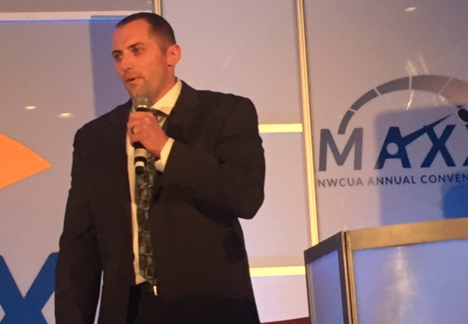
Jake Jensen speaking to MAXX meeting.
That’s not uncommon, but it is illegal. As soon as he saw us he did a full body shiver and made an abrupt change of direction. We pulled him over about a block later, and got his name and date of birth. We found out he was lying and we were going to arrest him. What I didn’t know was this guy is a federal parolee, and he’s violating parole and there’s a warrant out for his arrest that would send him back to the federal pen for 18 months.
“I get out of the car with intent to arrest this guy and he drops back and says ‘I have a gun.’ At that point I knew I was going to be shot in the face. I was scared in the weird way of not having time to be scared. I knew I wouldn’t have time to outdraw him, so I put my shoulder into him as hard as I can and knocked him into the building and, miraculously, did not get shot. I slammed him into the ground, but on the way down he grabs my gun and tries to get it out of the holster. I am hitting this guy pretty hard and after a minute or two we get him under control.
“He didn’t have a gun. He said, ‘I thought when I said I had a gun you guys would back up and I could run away.’ I don’t know if that is the truth or not.
“That was an acid test for me. That was an opportunity for me to use all my knowledge and training and apply it to a problem and a situation and make it end a little less bad. That carries forward into today. Recently, my daughter, who’s two, wouldn’t eat dinner, and I thought, ‘It’s bad, but it isn’t that bad.’”
A Lesson Blooms
Ynette Gibbs, CEO,
Newrizons FCU, Hoquiam, Wash.
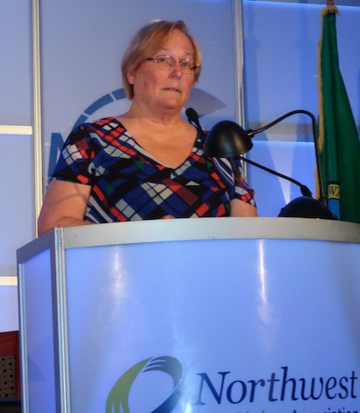
Yvette Gibbs shares her story at MAXX.
Gibbs shared the story of taking her two small boys, then two and four, to meet with their great-grandmother. After a long drive they arrived at Gibbs’ grandmother’s house, where she has a prize garden.
“And she’s paranoid. They are looking at all her prized flowers and she’s saying, ‘Y’nette, grab a hold of them.’ I said don’t worry about it. I told the boys, ‘No hands.’”
And they never touched the flowers.
“As a professional, one thing I love is having the opportunity to foster an environment where everyone feels trusted and they have the creative space to explore and roam around without anybody holding on to their hands, while still being close enough to help when needed.”
Scott Prior, CEO
Connection CU, Silverdale, Wash.
“My story is ‘Paid in Potatoes.’ I grew up on a 750-acre farm in South Central Washington where I grew up in Patterson. This was a small town; the school had five students, two of whom were myself and my brother. Our farm grew potatoes, and my father hired a cast of characters every year to help pick potatoes. These were salt-of-the-earth types. One group was the Love Family from a commune in western Washington. Each year about 20 or so would come—this was the mid-1970s and they were the epitome of hippie—they were camping in teepees and bathing in the river. We got much needed help on the farm, and we paid them in potatoes.
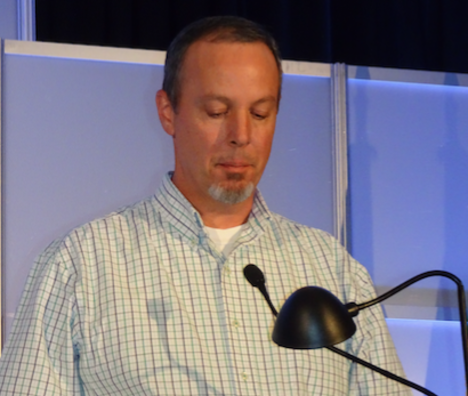
Scott Prior speaking to NWCUA's MAXX meeting.
“This was my life until about age 14 when the commodity market crashed and we lost the farm. Thinking back on that time, it would be easy to think of all the things we no longer had. But I think back on all the people my father gave opportunities to. I had forgotten about those times until 25 years later at my father’s funeral. The church was packed and I was amazed at how many people came up and shared stories of how my dad had helped them. Those people were so genuinely appreciative of that opportunity and it was important to them that I know that.
“Fast forward another decade ago and here I am metaphorically paying in potatoes. In our little credit union we give people opportunities when others won’t. I am always reminded of what goes around comes around.”
How The Dear World Project Got Started
The Dear World project was founded in the wake of Hurricane Katrina in New Orleans when people were asked to write love stories to their city. The project, founded by Robert X. Fogarty, now includes portraits, videos and stories of survivors of the Boston marathon bombing and Syrian refugees as well as recognizable people like Nobel Peace Prize winner Muhammad Yunus, actress Susan Sarandon, and NFL quarterback Drew Brees.
Katie Greenman of the Dear World project introduced credit unions at the NWCUA’s Maxx Convention and said the project is all about what someone “would you say if you had to share a message about your story, that only you can tell because you have lived it. We have traveled all over the world and everywhere we go we ask the question, ‘What is your message to the planet?’”
Among those who have been famously profiled in the project is former ESPN sportscaster Stuart Scott, who died of cancer in 2015. Scott had written on his skin, “Making a difference and kicking cancer’s ass.” Scott famously said, “‘If you die, you still beat cancer in how you live, why you live and the manner in which you live. When you get too tired to fight, lay down and rest and let someone else fight for you.’”
Green told the NWCUA meeting, “That message has resonated with people in the cancer community.”
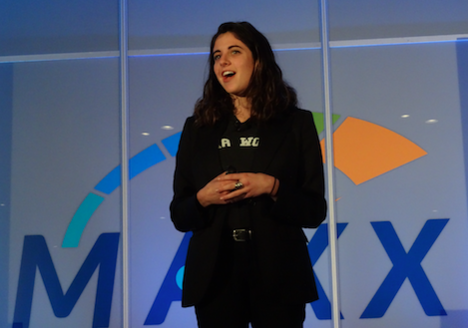
Katie Greenmail speaking to MAXX meeting.
Greenman shared that the Dear World project traveled to a Syrian refugee camp where “we were amazed that this process was the same there. They were hungry to share their stories. We found that kids are just kids. One kid wrote the message, ‘I wish the life I had would come back.’ That broke our heart that a kid would want the past back and not be thinking about her future.”
Greenman shared another story from “Dave,” a runner in the Boston Marathon who was injured by the 2013 bombing, who has made it his mission to create a group of survivors from that day to love running and to “run toward the healing.”
Dave’s story was this: “We have been thinking a lot about time, how it speeds up and how it slows down, how it can slip through your fingers. Time can heal wounds. It can carry you across the finish line or strip away everything we love. But in every moment we have choices; choices to put one foot in front of the other. Time gives a choice to become who we want to be. Over time we have gotten stronger in spite of the things we have lost. But it wasn’t easy. Instead of letting tragedy break us we made a simple choice: to keep running.”
In terms of credit unions, Greenman said, “This step isn’t the what you do, but the why you do it. What drives you to get up in the morning? My assumption is you listen to a lot of people, what they want and hope for and what they hope to do. But I’m curious as to how often people listen to your story and the why and what this work is about for you.
“What is your one-in-seven-billion story?” asked Greenman.
Below, attendees at MAXX Conference share their stories with the Dear World project.