

MILWAUKEE, Wis.—For credit union CEOs heading into 2026, the biggest strategic alarm isn’t loan growth, fintech competition, or interest rates—it’s cybersecurity and fraud.
In fact, 77% of credit union executives reported at least one unauthorized network or data access incident in the past year, while 46% said fraud is increasing and 37% reported rising cyberattacks.

That finding—drawn from Wipfli’s State of the Credit Union Industry: Research and Outlook for 2026—signals a shift: cyber risk is no longer an IT issue, but a board-level growth and trust issue.
The report, based on a national survey of 100 credit union executives, comes from Wipfli, a financial services advisory and accounting firm that works with credit unions on strategy, technology, data, cybersecurity, and organizational performance. While leaders remain optimistic—57% expect asset growth above 5% in the next year—Wipfli’s analysis shows that digital execution, fraud resilience, and integration discipline will determine which institutions actually convert confidence into sustainable growth.
Digital Is The Growth Engine—But Execution Is Uneven
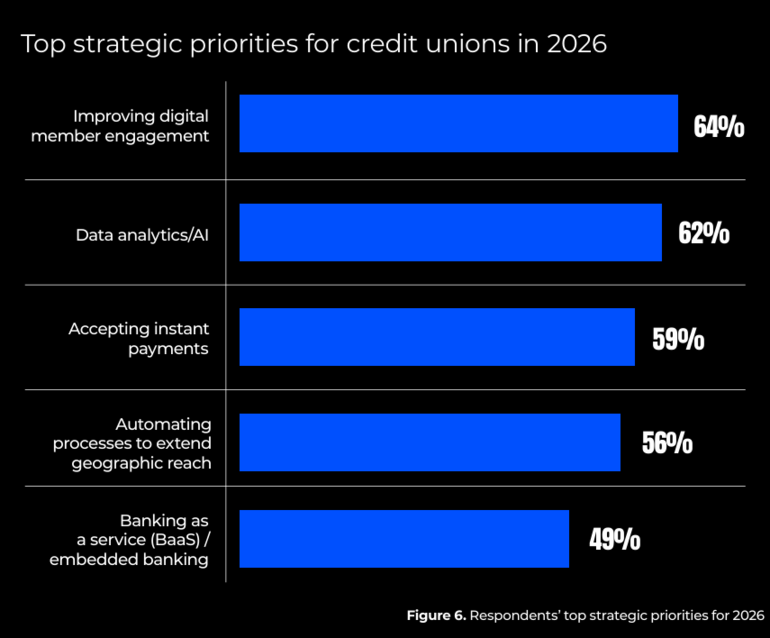
Credit union leaders ranked improving digital member engagement (64%) and data analytics/AI (62%) as their top strategic priorities for 2026. Many institutions are expanding into instant payments, automation, and embedded banking, with 92% now participating in or planning to participate in banking-as-a-service (BaaS).
But Wipfli warns that AI adoption is moving faster than AI maturity. While two-thirds of credit unions are actively implementing AI, only 16% report having an enterprise-wide AI roadmap with governance and measurable business impact. The implication: many institutions are experimenting with AI tools without the data readiness, integration, or oversight needed to generate durable competitive advantage.
Fraud Has Become A Brand And Member-Trust Issue
The data show cybersecurity is now the top concern across all credit union asset tiers, surpassing fintech competition and operational pressures. Executives reported ramping up defenses—boosting cybersecurity spending, accelerating threat detection, and tightening access controls—but Wipfli cautions that digital growth is expanding attack surfaces at the same time. As more member activity moves online, security becomes inseparable from member experience, reputation, and retention.
Branches Aren’t Going Away—They’re Being Rebuilt
Despite the push toward digital, 62% of credit unions plan to open new branches in the next year, and 58% plan to repurpose existing locations.
Rather than serving as transaction hubs, branches are increasingly shifting toward advisory services, community engagement, and relationship-building. Wipfli’s takeaway: digital handles transactions; branches build trust—and institutions that integrate the two effectively will strengthen both growth and loyalty.
Across digital transformation, AI, cybersecurity, and branch strategy, the report returns to a consistent message: isolated upgrades won’t work. Credit unions that layer new tools onto fragmented systems risk wasted investment, weak ROI, and greater security exposure. Instead, Wipfli urged leaders to prioritize integration across data, platforms, workflows, and governance, framing technology as a mission-aligned growth enabler—not a shiny distraction.
Bottom Line For Credit Union Leaders
Wipfli’s 2026 outlook suggests credit unions are positioned for growth—but only if they execute with discipline. The strongest performers will be those that treat cybersecurity as a strategic investment, align AI with measurable business outcomes, modernize without fragmenting systems, and balance digital expansion with mission and trust.
In a year filled with technological temptation and competitive noise, the report’s message is clear: the institutions that win won’t be the ones chasing every new tool—they’ll be the ones integrating strategy, security, and member value into every decision.