

NASHVILLE, Tenn.–Credit union leaders here were offered some provocative challenges around what really causes value-loss in CUs, where there is a problem with boards, and what it is consumers/members value, vs. what credit unions believe they value.
Those challenges came from Peter Sheahan, a thought-leader and consultant to numerous organizations, who has also worked with credit unions and who addressed the THINK Conference hosted by Valera (the new name for the combined PSCU/Co-op Solutions).
Don’t Ever Say This
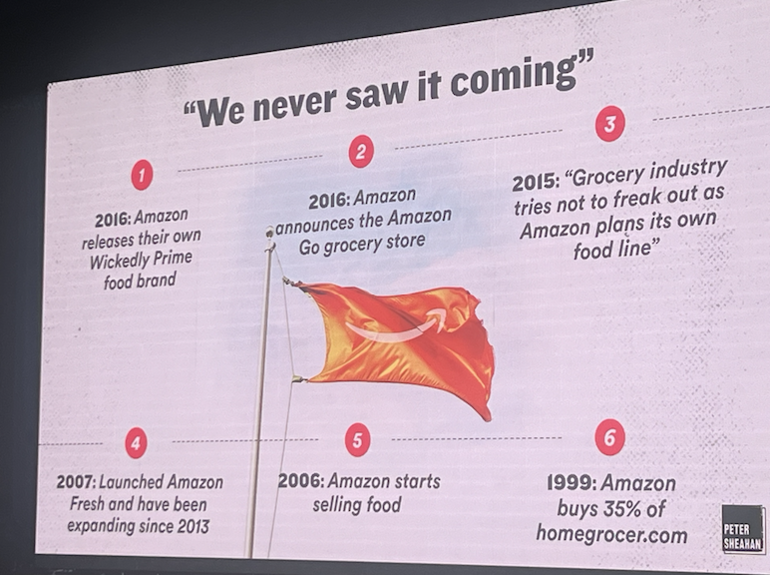
But before delving into credit unions, Sheahan shared the example of one grocery store chain with which he had consulted after it found its market share had been significantly eaten away by Amazon, which owns Whole Foods and other providers. The CEO of the company told Sheahan, “All I know is you can’t hold us responsible, because we never saw it coming.”
Sheahan said he had to bite his tongue, as something as a Google search have revealed everything that is shown on the slide here. In other words, how could the company’s management team not see it coming?
What Organizations Can’t Do
Credit unions waiting for transformation to take place need to understand something, according to Sheahan.
“Organizations do not transform, leaders do,” said Sheahan. “As goes the leadership team’s behavior, so goes the rest of the organization. Growth and transformation is a psychological journey first, strategic second. It means the conversation we’re having in credit unions is not just about technology and strategy and consumer preferences. I think the true conversation is embracing a psychology that the world has changed, embracing a new set of assumptions about the member, and being willing to fix what isn’t broke.”
Question Your Assumptions
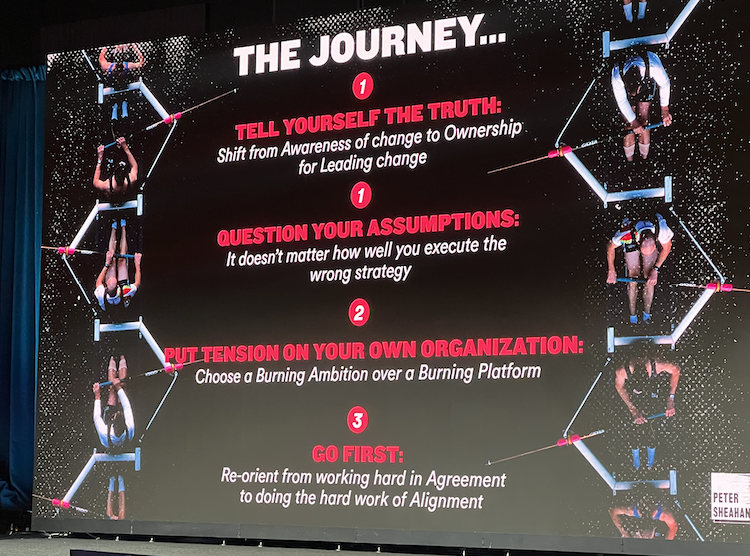
But that can be easier said than done, agreed Sheahan, as it involves telling oneself the “truth” and “accepting reality.”
“It’s harder for a leader to move from awareness to ownership than from ownership into action,” Sheahan told the meeting.
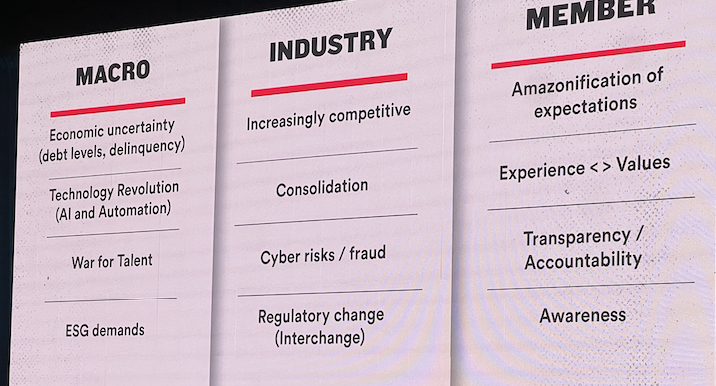
Sheahan used the slide above to illustrate his view of the credit union market.
“I think there is a really interesting thing happening in the value proposition of credit unions,” Sheahan suggested. “People value experience even more than the values of credit union…The number one challenge with the next generation for credit unions is awareness. Don’t tell me in five years you never saw it coming.”
In fact, don’t wait five years to make a critical shift in being more agile by compressing time to accept those new realities, Sheahan advised.
“Power has shifted from the organization to the individual and the social contract has changed forever,” he said. “Lead with intention. Lead with purpose. If the rate of change outside your business is faster than the rate of change inside, you are becoming less relevant.”
Getting it Wrong
Noting that it “doesn’t matter how often you execute the wrong strategy,” Sheahan offered some provocative thinking around credit unions and boards.
“Ninety percent of all value loss (comes from) bad decision-making by boards and management teams. One of the challenges I think you have is I don’t think your boards represent the communities you have the opportunity to serve. They represent the communities you were founded to serve.
“Boards are also human, and they tend to project the experiences they want onto the experiences they believe all members want,” he added.
Sheahan acknowledged the “governing is hard because you are a steward of what’s being built. But the only way to steward is to change.”
The role of the board and management, he said, is to migrate the credit union from one competitive advantage to the next.
“I think there is some work to do on governance.”
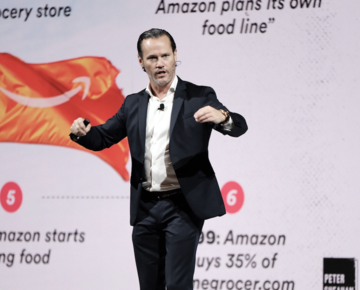
Peter Sheahan speaking to THINK conference in Nashville.
Overvaluing the Proposition
Given how much they talk about it, Sheahan said he believes credit unions “over-index” the values they represent in people’s lives, believing it’s enough “even if we create a subpar experience.”
“One of the things I’ve heard most in working with credit unions is this belief (CUs) have a monopoly on member intimacy. I think we’ve got work to do here,” he said. “My understanding is only about 25% of credit unions in North American have exceeded two products per member. Most independent experts on financial wellbeing say the average person or family needs about 6.8 products to manage their lives well. And we have half of those products. Truly meeting the member’s needs means making sure they have all the products they need. What that means is we might need to create cultures that promote cross-selling for the betterment of the people we serve.”
Burning Ambition
Sheahan urged credit union leaders to think about the areas in which they are making assumptions that are worthy of more objective exploration.
“Put tension on your own organization,” he advised. “Are you capable of escaping the gravity of your own success? Choose a burning ambition over a burning platform.”
Sheahan shared an observation he heard made by Jeff Bezos, who said Amazon’s leaders get up in the morning with two questions in mind: Where is our customer going? How do we beat them there?
“Twenty-five percent of credit unions have a strategy to meet the needs of the member today. By the time you catch up with the member, they have already moved on. Are you leading your members to the future or are you following them there?”
The Non-C Job
Sheahan noted credit unions, like many organizations, have hired people who are experts at various things and given them a C-level job like chief marketing officer, chief diversity officer or chief transformation officer. But the title doesn’t matter, he said.
“The real leadership characteristic in times of significant change is no matter who you are, and you don’t have to be in a senior position, you go first. You probably can’t do it on your own, so partner like you mean it. Go and create the future together.”