

LAKE FOREST, Ill.—More than 50% of depositories make money on business checking accounts. In contrast, less than 7% of consumer checking portfolios make money for institutions, a new report reveals.
That same report also offers a Top 10 List of reasons why credit unions should offer business checking accounts.
Consumer checking is a loss-leader for most depositories, while business checking is the “goose laying the golden eggs,” said Michael Moebs, economist and CEO at Moebs $ervices, which recently completed a study on business checking. “Business checking offers a good source of fee income, balances, and new loan business.”
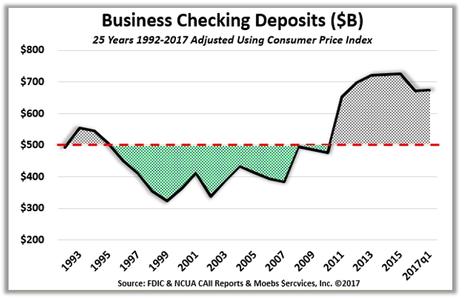
Total business checking deposits are currently $673 billion, which is nearly $198 billion over the norm since 1992.
“Business checking balances are over 40% higher than usual,” noted Moebs. “Business checking acts similar to consumer checking: when times are economically difficult balances are high, and when times are good, balances are low. Business checking also produces a stable source of service charge income, which for all financial institutions is about $5 billion at the close of 2016.”
Top Ten Reasons
According to Moebs, the study identifies 10 to reasons why business checking accounts benefit the consumer and depositories:
10) Business checking is not subject to Consumer Financial Protection Bureau oversight – only uniform commercial code rules.
9) Most small businesses track their cash position with their business checking account and online banking, a basic tool for the 24-million small businesses with 25 employees or fewer.

Michael Moebs, Moebs $ervices
8) Less than half of small businesses borrow; business checking brings non-borrowers who provide fee revenue.
7) More than 10% of small business accounts are hidden in consumer checking portfolios. Business checking is an opportunity to find and sort out those “hidden” business accounts to reduce cost and/or gain revenue, Moebs said.
6) Pricing of rates and fees on business checking is critical. The best practice found in the Moebs Study is to charge a high interest rate offset by charges for services such as deposits to monthly maintenance. The net rate paid can make the funding cost of business deposit balances very low, said Moebs.
5) Only one type of business checking is needed. “Make the business checking easy to understand for front-line personnel who sell the account, and businesses who use the account,” Moebs advised.
4) Free business checking can have caps for charges, credits, and monthly maintenance.
3) Business costs for loan, deposits, and other services are pass-throughs for business checking. “This can bring down the interest earned for business balances, thus lowering yield on the business checking balances,” Moebs said.
2) Attract business checking accounts with high rates—82 BPs, which is the current average Fed funds rate. The high rate paid is offset with fees charged, especially for transactions, Moebs said.
1) A well-designed business checking account brings good loans.
Two Important Essentials
The Moebs Study on Business Checking “found two important essentials,” said Moebs. “First, for depositories, many small businesses have their checking accounts as a free consumer checking account. Shedding these accounts will reduce expenses. Then again, with good pricing on earnings rate and transaction fees these ‘hidden’ accounts can be made profitable. Secondly, for business managers and owners, the best business checking has a high earning rate and low fee prices.”