

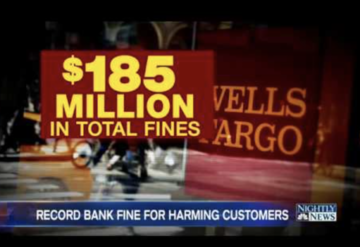
SAN FRANCISCO–The $185 million in fines Wells Fargo is paying for a massive, company-wide scam that involved opening accounts never requested by customers may pale compared to other developments that have followed, not to mention damage to its brand.
While it could prove temporary, the bank’s stock declined 4% yesterday, and is down 6% overall since news of the scandal broke. That means a market cap decline to $235 billion, enough to allow JPMorgan Chase to surpass Wells Fargo as the country’s biggest bank in terms of market value. Wells Fargo continues to hold $1.7-trillion in assets, or more than the entire credit union community.
Meanwhile, since the announcement that it was paying the largest penalty ever imposed by the CFPB ($100 million to the CFPB, plus $50 million to the City and County of Los Angeles and $35 million to the OCC) as the result of more than 5,000 employees secretly opening unauthorized accounts to hit sales targets and receive bonuses, the controversy has continued, including:
- The bank has told some employees to stop cross-selling products to customers.
- The Senate Banking Committee said it will hold a hearing on the bank’s sales practices.
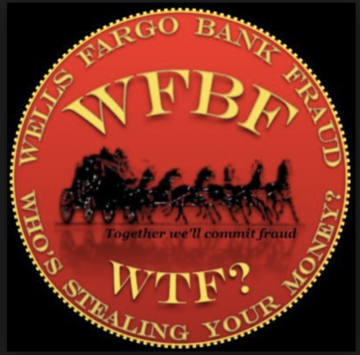
- It has been the subject of extensively negative comments in both mass and social media, with one person observing, “You really want to hurt ISIS? Make them bank at…Wells Fargo.”
- Customers have been sharing stories of dealing with the unauthorized accounts and even having to pay fees to close them.
- It has been bruised by reports that the executive who ultimately oversaw the department responsible for the practices that led to the fines could be paid a $125-million payout when she retires from the bank.
- U.S. Sen. Elizabeth Warren (D-MA) said she will be going after Wells Fargo for violating the privacy of its customers.
- The bank has distributed talking points to customer-facing employees.
Congress Getting Involved
As CUToday.info reported here, the Senate Banking Committee intends to question Wells Fargo Chairman and CEO John Stumpf during a Sept. 20 hearing about CFPB charges that thousands of the bank's employees secretly opened accounts and enrolled customers in services without their consent.
Five Democratic Senators on Monday had pressed for a hearing, including wanting testimony from the Wells Fargo’s chairman and CEO, in addition to CFPB Director Richard Cordray, Comptroller of the Currency Thomas Curry and Los Angeles County Attorney Mike Feuer, the National Law Journal reported. The publication added that the Senate Banking Committee, which plans to formally announce the hearing Tuesday with more details, did not immediately issue a witness list.
In a letter to U.S. Sen. Richard Shelby (R-AL), chairman of the Senate banking committee, the group of Democrats led by New Jersey Sen. Robert Menendez (D-NJ) said “the magnitude of this situation warrants thorough and comprehensive review.”
“Specifically, the committee should thoroughly examine this issue, including: how it is possible that more than 5,000 employees could bilk customers over the course of five years; the timing, extent, and disposition of customer complaints; whether Wells Fargo’s sales and compensation structure incentivized employees to engage in deceptive and abusive practices; and what additional safeguards may be needed to prevent this type of behavior,” the senators wrote in their letter.
Cross Sales Freeze
Meanwhile, The Wall Street Journal reported that Wells Fargo has instructed some employees to cease any cross-sales efforts. The Journal reported that Wells Fargo attributed the cross-selling freeze among customer-service operators to “high call volumes,” according to the internal message. The bank has also sent out talking points for employees who work directly with customers.
A Wells Fargo spokeswoman told the Wall Street Journal the bank would evaluate call volume throughout the week and decide Friday whether to continue the freeze.
Clawback On Exec’s Pay?
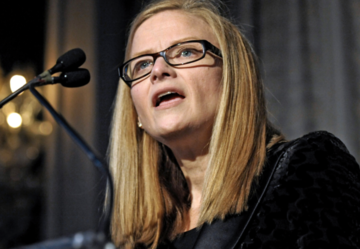
Soon after the $185-million in fines were announced it was learned that Carrie Tolstedt, who oversaw the Wells Fargo department that was responsible for more than two-million unauthorized customer accounts, could see a payout of more than $125 million when she retires later this year after 27 years with the bank, as CUToday.info reported here.
When Tolstedt’s retirement was announced in July, Wells Fargo’s CEO, John Stumpf, said Tolstedt was a “standard-bearer of our culture” and a “champion for our customers,” according to MSNBC.
Carrie Tolstedt
According to proxy statements from Wells Fargo, Tolstedt has been earning approximately $9 million annually. In 2015, that included $7.3 million in stock and a cash bonus, with the bank noting that “under her leadership, Community Banking achieved a number of strategic objectives, including continued strong cross-sell ratios, record deposit levels, and continued success of mobile banking initiatives.”
Wells Fargo disclosed that Tolstedt will leave the bank with $124.5 million in stock, options and restricted Wells Fargo shares, some of which has yet to vest. MSNBC reported that had Tolstedt been fired she would have had to forfeit $45 million of the total amount.
Several analysts are now questioning whether some or much of that money can be recaptured via “clawback” provisions.
Dennis Kelleher, chief executive of Washington-based financial-advocacy group Better Markets, told the Wall Street Journal the Wells Fargo episode seems “exactly designed” for clawback provisions under the bank’s own guidelines. He said the bank should reclaim any pay attributable to fraudulent conduct. “If you don’t do that, then you incentivize your employees to break the law,” he was quoted as saying.
A ‘Criminal Enterprise’
Writing in the New York Times, Andrew Ross Sorkin said in part, “Wells Fargo has long tried to separate itself from Wall Street. Given its West Coast headquarters, in San Francisco, the bank has sought to portray itself as a bank for Main Street. Its entire ethos, Wells Fargo has long suggested, is one of trust and ethics.
Social media has skewered Wells Fargo.
“But this episode raises all the same questions that have been asked about virtually every firm on Wall Street. Whatever distance Mr. Stumpf tried to maintain for Wells between it and the big New York banks with bad-boy reputations just evaporated.
When politicians talk about Wall Street as a ‘criminal enterprise,’ this is exactly what they are talking about.” The full Times piece can be found here.
The Trade Group Response
In the wake of the news of the fines and the practices that led to them, credit unions and community banks have been quick to respond. NAFCU CEO Dan Berger called last week’s news about Wells Fargo “flat-out fraud” and said the scandal highlights what is different about credit unions, while Camden R. Fine, CEO of the Independent Community Bankers of America (ICBA) said “Not only is this conduct appalling and harmful to American consumers and communities, it also contributes to the growth of excessive regulation that needlessly burdens the local community banks that do right by their customers.” For Fine’s full statement, go here.
What Customers Are Reporting
Not surprisingly, customers have begun stepping forward with stories of dealing with unauthorized accounts and even fees for having them closed.
MoneyCNN.com shared the story of Wells Fargo customer Brian Kennedy who said he went online to check on his Wells Fargo mortgage only to discover he had a checking account he never asked for—and it had a negative balance of $60 for two months of fees and penalties. Kennedy told MoneyCNN.com that when he went to a local branch to complain, the account was promptly closed, but he was charged $1 to do so.
"It really pissed me off," said Kennedy.
Another customer, Jeanne Young, told MoneyCNN.com she was signed up for a credit card she never requested and left the bank and closed her accounts. "I was livid about the whole thing. I don't trust them. There's no doubt in my mind it was deliberate," Young said.
Several of the customers expressed concerns their credit scores would be affected by the account closings.
Social Media Messages Not So Social
Some of the comments that have been made in both reader comments to news reports and in social media have included:
- “What will focus attention at any big Corp is a big fine, or lawsuit, paired with bad press. Witness VW's tribulations. It's like hitting the bowling pins with the big ball. Otherwise, nothing will change. Even then, change may not last permanently due to a number of possible factors. Those include new staff cycling into upper management, or with a short corporate memory. Then, slouching back to the prior culture over time becomes likely.”
- “So 5,300 rank-and-file employees lose their jobs over Wells Fargo's account slamming scandal, but Carrie Tolstedt, the executive in charge of retail banking operations, walks away with a $124 million retirement package. Should anyone wonder why people hate banks?”
- “This reminds me of the days of Worldcom when competitors like AT&T were envious of their performance. It never occurred to them that Worldcom might be cheating.”
- “Again, no criminal charges for fraud and discovering said fraud only after the creation of another bureaucracy tasked for said discovery. As usual the fines, if any, do not go to the victims. You really want to hurt ISIS. Make them bank at Buffet's bank—Wells Fargo.”