

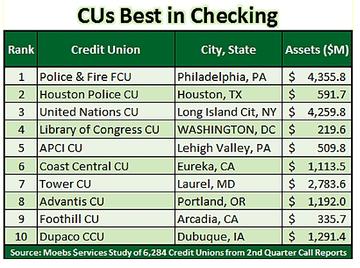
LAKE FOREST, Ill.—What credit union has the best checking account in the United States? According to a new study, it’s $4.3-billion Police and Fire FCU in Philadelphia—which has more than two-thirds of its members using its service.
Success in checking is critical, notes the same analysis, which found that more than 95% of credit unions actually lose money on their checking portfolios, with those that perform best making a counter-intuitive decision–they price overdrafts below market prices.
Moebs $ervices performed a comprehensive analysis of checking accounts at 6,284 CUs, looking closely at product aspects that are not only important today, but more so in the future, the company said.
Study results are based on which CUs have the most profitable checking portfolio, which have the highest checking penetration, and which ones do the best job of cross-selling other services (see chart).
“Police and Fire does an unbelievably good job,” said Michael Moebs, economist and CEO at Moebs $ervices. “They make money, and they have an extremely high percentage (82.6%) of members who have the credit union checking account. They have a split overdraft fee—$19 for a paper check and $6 for a debit card. These guys do a fantastic job, plus they average 4.4 services per member, counting the mandatory savings account.”
Account Of The Future
The key financial service is checking, reminded Moebs, who said the study is based on Q2 Call Report data.
“We designed the Best in Checking Study to reflect the transaction account of the future. We wanted to identify those CUs that are currently operating at the year 2020.”
Moebs explained that in his conversations with regulators, legislators, credit union CEOs, vendors in IT, and members themselves, it became clear that financial institutions need t

Michael Moebs, Moebs $ervices
o be good at three things in checking to be “winners” in 2020.
“The study shows the three major criteria to be: Checking is no longer the ‘milk ’n eggs’ of financial services or a loss leader – checking must be profitable,” explained Moebs. “Selling was an important criterion. Credit unions need to have a large number of members with their checking accounts. Third, it is important the credit union cross-sell other services to develop relationships once the checking account is secured.”
Moebs said the credit unions at the top of the Best in Checking report generally sell checking to two-thirds of their members, while the others sell one-third.
“The best not only cross-sell twice as many services to their membership, they have 39% lower expenses, which translates into making the checking account profitable instead of losing money. In fact, 95.5% of CUs lose money with their checking portfolio,” said Moebs.
Surprising Finding
The big surprise, noted Moebs, is the CUs at the top of the list don’t make much more in general checking revenue than the other CUs. Where the difference lies is in how they handle fee revenue, he said. The median price the top performers charge for an overdraft is $23.70, while the credit union industry median is $28.50. One of the leaders in the Moebs’ analysis charges less than $10.
“We’ve been telling all financial Institutions for more than 20 years that if they give the member an overdraft price that is lower than their competitors, they will get more revenue from volume and get more members to sign up for checking,” noted Moebs. “This analysis proves the best in checking are doing exactly that.”
Moebs added that the study shows “conclusively” that expense control and selling are critical for successful checking programs.
“The member wants a checking account that is modern with the ability to access their checking account, funds, and balances easily and quickly,” said Moebs. “The member wants the overdraft safety net to have a low, reasonable price, which will also generate more usage and volume to increase revenue. The credit unions that provide for these member needs while keeping their costs down and execute cross-selling will be the winners now and in the future. The CUs doing the best in checking prove that.”