

By Ray Birch
SCOTTSDALE, Ariz.—Is the checking account losing its luster in the eyes of consumers?
One analyst says that financial institutions, especially smaller institutions, should start preparing for a time when the long-time bedrock checking account is no longer a source of solid, dependable cheap core deposits.
According to Ron Shevlin, director of research at Cornerstone Advisors, there are several trends displacing funds from checking accounts today, eroding the checking account’s status as the core consumer banking product.
Shevlin pointed to digital wallets—including Starbucks’ highly successful offering—prepaid cards, PayPal and Venmo accounts, and Health Savings Accounts, all of which are diverting away balances, sometimes even before they make it to the direct deposit.
“Many consumers now see the checking account as nothing more than a placeholder for the paycheck before money goes to other places,” said Shevlin. “They view the checking account this way because money is getting very easy to move, and there is no penalty for moving it and no benefit for keeping it in a checking account that pays virtually no interest. It’s simply convenient for them, for example, to store money in a Starbucks account to make it even easier to pay for a cup of coffee.”
Wake-Up Needed
Shevlin said he wants to “wake up” banks and credit unions to the situation facing them.
“This is not about disruption and banks and credit unions going out of business,” he said. “This is about the diminishing importance of the checking account, which has nothing to do with checks. It has to do with displacement of deposits away from the financial institution into other accounts, and the need for both banks and credit unions to figure out strategies to combat this displacement.”
CUToday.info has also reported on concerns over checking deposits, which reached record levels during the recent recession, leaving quickly for mutual funds once interest rates noticeably rise.
Shevlin said that if banks and CUs don’t find ways to address how the checking account is starting to become a short-term parking spot for the paycheck, they will face issues with funding lending programs.
“For the mid-size banks and most credit unions this is a huge challenge—keeping the money. They can attract the checking deposits, but in the coming years it will be harder for them to keep them,” said Shevlin. “The mega-banks over the last five to ten years have done an incredibly good job of capturing deposits. I know credit unions love to point out how their membership is growing, but the reality is when you look at the dollar side, the mega-banks are growing their deposit base by trillions of dollars and this is a threat to credit unions.”

Ron Shevlin
Four Trends
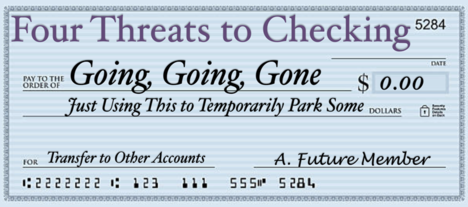
Shevlin pointed to four trends that don’t bode well for the future of checking deposits.
His first concern is the marked increase in use of Health Savings Accounts. Shevlin noted that these products “languished” for many years after they were created in the early 2000s. He noted that is no longer the case, however, with HSA dollars more than tripling since 2012.
“The U.S. is now approaching almost $45 billion in HSA savings, up from less than $14 billion in 2012,” said Shevlin. “The question to ask banks and credit unions is where are those extra HSA dollars coming from. For the most part, they are diverted away from checking accounts in the direct deposit process.”
P2P is another checking threat, said Shevlin.
“P2P payments have become very popular in the last few years. Venmo is on track to do $30-$35 billion in transactions in 2107. Apple and Facebook, too, have become aggressive in this space,” noted Shevlin, who said the threat to FIs and checking is not P2P itself, it’s the amount of money sitting inside P2P accounts. “According to an internal source, Venmo customers have more than $2 billion just sitting in Venmo accounts, and that is $2 billion not sitting in a bank or credit union checking account.”
Money Sitting Idle
Shevlin said the same thing is happening with successful retailer digital wallet loyalty programs, such as Walmart Pay and Starbucks.
“Many consumers have money just sitting in Starbucks accounts,” said Shevlin. “The Wall Street Journal reported in 2106 that the total was $1.5 billion, but I have an internal source who places that figure closer to $8 billion. I am not sure I agree the money could be that high, but I am certain the money sitting in Starbucks accounts is well over $2 billion. Again, not a lot of money on the grand scale, but money not sitting in a checking account.”
The fourth big threat to checking comes from robo-advisory accounts, said Shevlin.
“AT Kearney estimates that by 2020 there will be $2 trillion held in these accounts,” said Shevlin. “Kearney estimates that about half of these funds are shifting out of financial institution deposit accounts.”
Shevlin reiterated that these trends combine to create a serious threat to the status of checking as that core financial institution account.
“The whole premise of offering free checking is to get consumers into your institution with that product and then provide them with other services. That was the ‘freemium’ model before anyone defined the word freemium. Roll the clock forward to 2017, and while most banks and credit unions continue to think of checking as the core product within a relationship, from the consumer perspective the checking account has become much less important for day-to-day use. The value they are getting out of the checking account has diminished.”
Time Will Tell
Shevlin said he does not have a solution for the problem, but suggested that given all the other means consumers can easily move money today and that they lose very little interest when parking money in other places, that FIs may need to raise the interest rates paid on checking accounts to get the money to stay.
“It’s not an issue of attracting checking deposits, it’s really a matter of getting them to remain within the institution,” said Shevlin. “Retention is the growing issue. Maybe you provide better financial advisory tools. I don’t know of anyone fighting this displacement trend well. I am not sure what the solutions are, but maybe we will know more in a year from now.”