

WASHINGTON–During testimony before a House committee, NCUA Chairman Todd Harper urged Congress to provide the agency with a number of new or permanent authorities, including oversight of third-party providers, noting that between 2008 and 2015 CUSOs alone contributed to more than $300 million in losses to the ShareInsurance Fund.
In addition, Harper called for statutory changes to provisions governing the National Credit Union Share Insurance Fund and for extensions of provisions related to the Central Liquidity Facility, while also offering responses to questions posed related to garnishment by CUs of members’ stimulus payments, how credit unions will deal with forbearances, and whether field of membership laws should be expanded to allow CUs to address “banking deserts.”
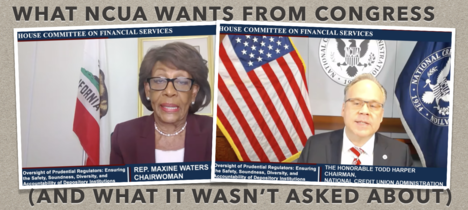
And while the recent acquisition of a billion-dollar bank in Georgia by Jacksonville, Fla.’s VyStar Credit Union set off a wave of point-counterpoint accusations/responses between bank and credit union trade groups in the days leading up to a House Financial Services Committee hearing, when the question was raised by one congressman it was not directed at Harper, but instead at FDIC Chairman Jelena McWilliams.
Asked by Rep. French Hill (R-AR) over whether she continues to have the “concerns” she had expressed earlier over such acquisitions, McWilliams responded, “I have heard the same concerns from banks. I would say we always have a lot of questions when there is an acquisition of a community bank in particular, and particularly if it’s in a rural area or where a banking desert is more likely to exist.
“During my first year at FDIC we had 220 banks merge into other banks or credit unions, which is a large number of community banks that disappeared,” McWilliams continued. “If that trend continues during my (five-year term) that would mean 1,000 fewer banks. Consolidation is a longstanding issue. I don’t know what the appropriate number of banks are. But I do have concerns that in some communities, rural communities, farm communities, that they are not being appropriately served by the number of institutions in the area.”
No Questions on Oversight
Similarly, Harper fielded just one question related to his request for third-party oversight authority, which CUNA has said it wants limited if enacted and which NAFCU has said it opposes in its entirety (see related coverage here).
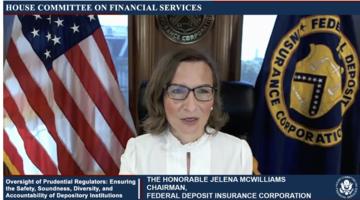
FDIC Chair Jelena McWilliams
Rep. Ed Perlmutter (D-CO) asked the question, but it was really just a confirmation that NCUA lacks such oversight, asking if it was correct the agency lost its oversight on third-party vendors after the Y2K-related reviews of two decades ago.
Harper confirmed that was the case, and noted NCUA is the only regulator without such authority, which he said is needed for safety-and-soundness reasons related to cybersecurity, consumer financial protections and more.
Meanwhile, Harper, who Committee Chair Maxine Waters (D-CA) noted was appearing on his birthday, was asked by Waters about his earlier comments related to “reputational risks” to CUs that garnish members’ stimulus payments.
In response Harper said he believes during the most recent round of payments credit unions “stepped up” and have not engaged in garnishing the payments, and he noted both CUNA and NAFCU have called on Congress to close a loophole that permits financial institutions to seize the payments.
Foreclosures & FOM
In addition, Waters asked Harper about post-pandemic foreclosures and the possibility credit unions will be faced with homeowners unable to pay their mortgages.
Harper said the latest data collected by NCUA show there have been approximately 1.3-million forbearance agreements reached by credit unions, and there has been approximately $38 billion in loans modified.
“Going forward we are going to continue to stress to examiners and credit unions the need to work with members, and that prudent workouts can be a win-win for the credit union and members,” said Harper. As for the closures of branches in many communities, Harper told Waters he shares the concerns over “banking deserts,” and that credit unions have been working to find ways to serve those who may have been “left behind.”
Should credit unions be allowed to expand their fields of membership to serve communities that have become such deserts? asked Waters.
“That would be helpful,” answered Harper. “The NCUA board has long called for credit unions, not just multiple common bond credit unions, but single common bond credit unions, to be able to expand services to those markets.”
Three Priorities
In his prepared remarks, Harper focused his comments during the hearing titled “Oversight of Prudential Regulators:Ensuring the Safety, Soundness, Diversity, andAccountability of Depository Institutions” on the areas noted above where the agency wants Congress to take action.
All three priorities were included in a memorandum on draft legislation circulated by the House committee prior to the hearing.
Harper was joined in testifying by:
- Michael Hsu, acting Comptroller of the Currency
- FDIC Chairman Jelena McWilliams
- Fed Vice Chairman Randal Quarles
Legislative Requests
Saying the agency will provide the House Financial Services Committee with more detailed information on each of its threerequests in the coming weeks, Harper outlined:
Vendor Authority
Harper said NCUA wants Congress to consider legislation toprovide the agency examination and enforcement authority over third-party vendors, including CUSOs, noting that sincethe NCUA’s Inspector General, the Financial Stability Oversight Council, and the Government Accountability Office have all requested NCUA be granted the authority.
“Currently, the NCUA may only examine CUSOs and third-party vendors with their permission, and vendors, at times, decline these requests,” Harper stated. “Further, vendors can reject the NCUA’s recommendations to implement appropriate corrective actions to mitigate identified risks. Forexample, in the past, several vendors refused to implement the NCUA’s recommendations to improve network securityand safeguard sensitive member information due to costconcerns. This stands in stark contrast to the authority of our counterparts on the Federal Financial Institutions Examination Council.”
Risk From a Few
Increasingly, said Harper, activities such as BSA/AML compliance and expanding technology services are being outsourced, creating growing reliance on those vendors.
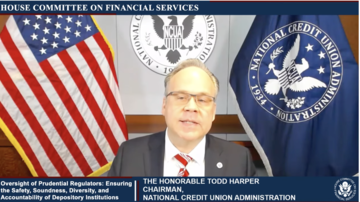
NCUA Chairman Todd Harper during hearing.
“While there are many advantages to using these service providers, the concentration of credit union services within CUSOs and third-party vendors presents safety and soundness and compliance risk for the credit union industry,” Harper said. “For example, the top five credit union coreprocessor vendors provide services to approximately 87% of total credit union system assets. The top five CUSOs provide services to nearly 96% of total credit union system assets. A failure of even one of these vendors represents a significant potential risk to the Share Insurance Fund and the potential for losses from these organizations are not hypothetical.”
Harper said between 2008 and 2015 CUSOs contributed tomore than $300 million in losses to the Share Insurance Fundalone.
NCUSIF Improvements
Harper noted the Dodd-Frank Act made several changes to the Federal Deposit Insurance Act to increase the authority to manage its Deposit Insurance Fund, including increasing the DIF’s minimum reserve ratio from 1.15% to 1.35%, and removing the 1.50% upper limit on its designated reserve ratio and eliminated the requirement that dividends be provided fromDIF when the reserve ratio is between 1.35%-1.50%.
But Congress did not make similar statutory changes to the Federal Credit Union Act’s provisions governing the Share Insurance Fund following the financial crisis more than a decade ago, he said.
In response, said Harper, the agency is seeking to:
- Increase the Share Insurance Fund’s capacity by removingthe 1.50% statutory ceiling on its capitalization
- Remove the limitation on assessing premiums when theequity ratio exceeds 1.3%, granting the NCUA boarddiscretion on the assessment of premiums
- Institute a risk-based premium system
“These recommended changes, if enacted, would allow the NCUA board to build, over time, enough retained earnings capacity in the Share Insurance Fund to effectively manage a significant insurance loss without impairing credit unions’ contributed capital deposits in the Share Insurance Fund,” said Harper. “Moreover, these changes would generallybring the NCUA’s statutory authority over the Share Insurance Fund more in line with the statutory authority over the operations of the Deposit Insurance Fund.”
Liquidity Facility
Harper noted the CARES Act contained a provision that provided NCUA with an “important tool” that expires on Dec.31, 2021, including “enhancements” to the Central Liquidity Facility granted in the CARES Act that the agency would like to see made permanent.
Other Issues Addressed
Among some of the other issues touched upon by Harper as either part of his oral testimony or included in his submitted testimony:
State of the Credit Union System
The credit union system, said Harper, has remained on “solidfooting.”
Harper noted that at year-end 2020 there were 5,099 federally insured credit unions, 2.6% fewer than a year earlier, and membership increased 3.3% to 124.3 million. The number of federal credit unions declined by 3.0% over the same period to 3,185, and the number of state-charteredcredit unions declined 2.0% to 1,914.
“The decline in the number of credit unions mainly resulted from the long-running trend of consolidation across all depository institutions, which has remained relatively constant across all economic cycles for more than threedecades,” said Harper. “In recent months, economic conditions have improved and the outlook for the year ahead is generally favorable. Credit union performance, however, will continue to be shaped by the fallout from the pandemic and associated recession. The NCUA is actively monitoring economic conditions and assessing these and other risks to credit unions, their members, and the Share Insurance Fund.”
Factors Affecting the Industry in 2021
Harper said the top priority for the NCUA is ensuring that the credit union system and the Share Insurance Fund areprepared to weather any economic fallout related to thepandemic.
“To protect the Fund, the agency is actively monitoring certain segments of the system, including credit unions closely connected to the oil and gas, travel and leisure, and agricultural sectors, among others,” Harper said. “The agency is also focusing on credit unions with elevated risks, such as thosewith large concentrations of commercial real estate loans relative to assets.
“As during past recessions, it is likely that credit union performance will trail any improvement in the labor markets by one to two years,” Harper continued. “Accordingly, system-wide delinquency rates, which remained low through the end of 2020, could begin to rise as forbearance programs end…In the year ahead, a credit union’s ability to manage interest-rate risk will play a crucial role in financial performance.”
State of the Share Insurance Fund
Harper noted the dramatic rise in insured shares throughout last year resulted in an equity ratio for the Share Insurance Fund of 1.26% at the end of 2020, and that if the equity ratio falls below 1.20%, as the NCUA board projects it to do so within six months, then the board is required to establish and implement a restoration plan within 90 days that would increase the equity ratio to at least the statutory minimum of 1.20% before the end of the eight-year period beginning upon the implementation of the plan.
Harper said the board will need to adopt a restoration plan at some point absent a sizable change in these underlyingfundamentals.
Update on the NCUA’s COVID-19 Response
Harper said throughout the COVID-19 pandemic, the NCUA hasfocused on three priorities:
- Protecting the health and safety of NCUA staff and contractors, so the agency can continue to perform its mission
- Assessing the impact of COVID-19 on credit union membersand operations
- Analyzing how the pandemic will affect the future financial condition of credit unions and the Share Insurance Fund
Supervisory Priorities in 2021
According to Harper, some of the agency’s supervisory priorities are reviews of credit unions’ efforts to:
- Maintain sufficient loss reserves
- Comply with the Bank Secrecy Act and anti-moneylaundering laws and regulations
- Implement provisions in the CARES Act applicable to credit unions and the CARES Act provisions extended through the Consolidated Appropriations Act, including thesuspension of the requirement to categorize certain eligible loan modifications as troubled debt restructurings
- Comply with consumer financial protection laws andregulations
- Monitor and control credit risk
- Protect information systems and strengthen cybersecuritydefenses
- Transition from the use of LIBOR
- Manage for the potential liquidity risk due to the economicimpact of the pandemic
Regulatory Flexibility Measures
Harper said through 2020 NCUA provided temporary and targeted regulatory flexibility and that in December 2020, the board approved an extension of the effective date of certainregulatory requirements, including taking steps that:
- Raised the maximum aggregate amount of loan participations that a federally insured credit union may purchase from a single originating lender to the greater of $5,000,000 or 200% of the credit union’s net worth
- Suspended limitations on the eligible obligations that a federal credit union may purchase and hold
- Suspended the required timeframes for the occupancy ordisposition of properties not being used for federal creditunion business or that have been abandoned.
Those modifications expire on Dec. 31, 2021.
Working with Borrowers Affected by COVID-19
Harper noted that “tragically,” the COVID-19 pandemic hasdisproportionately affected low-income communities and communities of color.
“As cooperative, member-owned financial institutions that reinvest their earnings, many credit unions have a long historyof assisting their member-owners in times of need,” said Harper. “Throughout the COVID-19 pandemic, the NCUA has encouraged credit unions to work with members experiencing hardship by extending the terms of repayment, or otherwise restructuring their members’ debt obligations. When prudent, credit unions may ease terms for new loans to members, as doing so may help consumer and business members deal with any impact on their financial well-being due to COVID-19. The NCUA has also instructed its examiners to refrain from criticizing a credit union’s efforts to provide prudent relief formembers, when conducted in a reasonable manner with propercontrols and management oversight.”
Other Comments
In his submitted comments, Harper also addressed rulemakings currently before the board and other issues.
Harper’s full statement can be found here.