

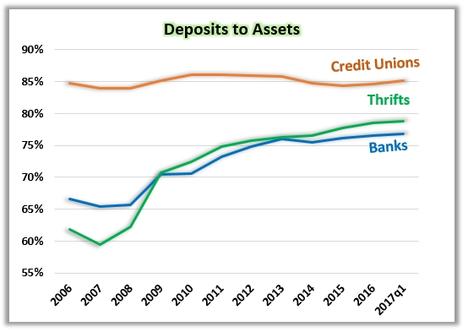
LAKE FOREST, Ill.—Deposits among all financial institutions in the U.S. at the close of Q1 reached their highest levels since 2006, just before the Great Recession, according to a new report that also reveals CUs are lagging behind banks on the deposit side.
The report further found that lending is down for all FIs over that same period.
“Loans at almost all banks, thrifts, and credit unions are still underwater for the same period of time,” said Michael Moebs, economist and CEO at Moebs $ervices. “Deposits, measured as a percent to assets, are 77.6% in 2017 Q1, or the highest since 2006. But loans-to-assets fell in the first quarter and are at 54.9%, a decline of 9.7% since 2006.”
Deposits are up 10.2% at all banks, up 17% for thrifts, but have only increased 0.4% for all credit unions—with the exception of CUs greater than $5 billion in assets, the only asset size of all depositories showing a decrease in deposits to assets, noted Moebs.
“Using assets as a common denominator allows for an accurate comparison of large and small financial institutions and those of different charters,” Moebs told CUToday.info.
Small Biz Lending
While deposits are growing at most financial institutions, small businesses with fewer than 25 employees and the average consumer are still having trouble securing loans, according to Moebs.

Michael Moebs, Moebs $ervices
“Underwriting is tight for the consumer and small businesses, as reflected in auto sales being down in 2017, negligible wage growth, and unemployment (U6) at 8.4%,” said Moebs. “Since 2006, those financial institutions at their economy of scale, which ranges from $5 billion to $25 billion, have collected more than 12% growth in deposits, which is funding more than 2.8% growth in loans. The exception in this category are the credit unions with greater than $5 billion in assets that have shown a decrease in loans and a decrease in deposits.”
Moebs said that the bottom line from the study is that capital is still a concern for many financial institutions.
“Deposit growth without loan growth hurts most depositories, since loans help provide the revenue needed to pay for interest on deposits and provide much needed capital,” said Moebs. “As for the average consumer and small businesses, almost a decade after the start of the Great Recession, access to credit, measured by loan to asset ratio, shows many still suffer.”