

By Ray Birch
CARMEL, Ind.—The increase in the frequency of natural disasters in recent years is testing CUs’ mettle, but they’re coming out of the events stronger and more prepared to address events in the future, one analyst insists.

“When I started at Allied Solutions 18 years ago, catastrophes weren't as prevalent as they are today,” said Tina Love, vice president of claims and recovery at Allied. “Every year we weren't dealing with a number of hurricanes, tornadoes, flooding and wildfires. Credit unions did not have the solid catastrophic event (CAT) plans they have today. In the last several years they have been forced to build out those plans and I think many are very sound right now.”
Hurricanes Sharpen Focus
Love contends CAT plans began to improve following Hurricane Katrina in 2005, and were refined after hurricanes Harvey and Irma battered the U.S. in 2017.
“Katrina was the catalyst, I believe. I think many credit unions along the Gulf Coast said, ‘OK, how about we do more planning. How about we create a plan, review our plan, and share our plan and check our plan and make it a living document. We need to check our plan every year, sometimes two and three times a year just to make sure that we’re prepared.’”
What really sharpened CUs’ disaster preparedness skills, said Love, was Hurricane Harvey, which included torrential rains and historic flooding far inland that changed people’s perceptions. It created the realization that almost anywhere in the country can be affected by a disaster.
“I have seen credit unions come up with some really great plans in the past few years,” said Love. “Those plans address things like can my employees get to work, do we have everybody's phone numbers, do we have alternative ways to get in touch with staff, do we have strong and fast ways to quickly assess whether we can remain open following a disaster, do our employees have remote capability…”
Recognizing an Expanded Risk
What Love has also seen credit unions do very well in recent years is realize how widely spread their risk is.
“Many credit unions’ exposure is more widespread today,” said Love. “For example, they may be based in Florida, but have made auto loans in California, and then a wildfire hits and they have issues with their collateral. So, that is a different kind of concern than a hurricane hitting their offices along the Atlantic Coast, but more CUs are now ready for that. They are not caught off guard.”
Love said many credit unions were unprepared for the impact of Harvey on their auto loan portfolios, surprised the flooding was so great and how deep inland the storm’s flooding reached.
“Harvey was an eye-opener,” Love said. “A lot of credit union members just called their CU and told them they did not know where their car was. The damage to automobiles in that part of the country was vast.”
No Fun at the Fairgrounds
Love recalled that many of the auto recovery efforts had authorities towing vehicles to local fairgrounds.
“It was very difficult for credit unions to find their collateral post Harvey, that is, if they did not have license plate recognition software (LPR),” said Love. “Our lenders who had tracking data via LPR were able to easily locate any collateral that had been transported to the fairgrounds.”
Love said more lenders are using LPR technology today. The tech uses optical character recognition on images to read vehicle registration plates to create vehicle location data. It can use existing closed-circuit television, road-rule enforcement cameras, or cameras specifically designed for the task.
“There’s been so many big catastrophes lately, credit unions have learned how to better handle these things,” said Love, who said the cost of disasters has reached almost $90 billion dollars in a single year based on data from NOAA, doubling the expense in five years from 2013 – 2018. 2017, in particular, was a devastating, record-breaking year of billion-dollar losses with back to back events. “In the past, one of the most common mistakes was just not having good data sources. I've seen clients who rely on their local weather news, and the Weather Channel to prepare for a storm when they really needed a connection with FEMA, which offers daily bulletins.”
Not Ready for Next Steps
Moreover, many CUs were just not that ready to take next steps, she suggested.
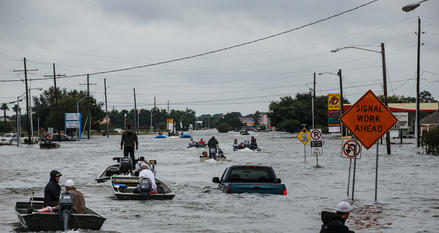
Hurricane Harvey
“It used to be, ‘Oh gosh, how are our employees going to get to work? How are we going to work with our building down? Can we work out of a trailer?’ I don’t see these things anymore. Credit unions are very battle tested.”
Love stressed what credit unions are doing best these days is getting better at preparing for the unexpected.
“Today we are seeing record-setting events reaching so many more parts of the country,” said Love. “Look at what happened with Hurricane Dorian recently—hurricane-force winds that produced tornadoes. Many people were prepared for the rain and storm surge and winds, but would you expect a hurricane to spin out tornadoes? It's gotten pretty crazy.”
Steps to Take
Love outlined some disaster preparedness steps CUs should be taking:
- Create and manage a “living” CAT plan that allows for changes to be made before, during and after catastrophic events. “Make sure that you continually update your plan at least on an annual basis,” she said.
- Stay in tune with FEMA and other agencies such as the NOAA (National Oceanic and Atmospheric Administration), paying special attention to their predictive analytics on hurricane activity. “This data can give you a good idea of the exposure your institution faces, so you can begin working on your CAT strategy early on,” she said.
- Work with your insurance tracking partner to immediately assess the exposure from a catastrophic event. “That way you are working less tirelessly to play damage control. Immediacy and responsiveness is the name of the game during hurricane season, fire season or when any other disaster hits,” Love said.