

ALEXANDRIA, Va.–During a briefing NCUA hosted on its proposed 2018-19 budget here, credit unions and trade groups were generally supportive of budget moves the agency has made, but they also called for additional reductions and again questioned why NCUA’s budget continues to grow even as the number of credit unions continues to shrink.
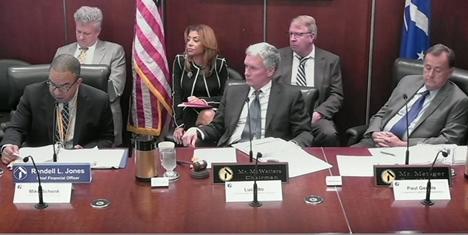
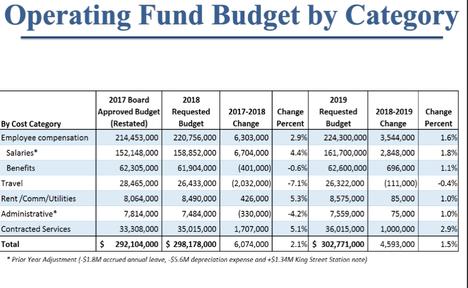
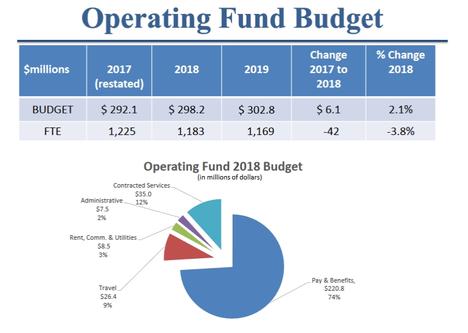
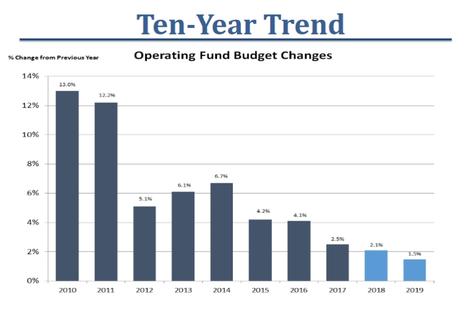
During the two-hour Budget Briefing at NCUA’s headquarters, discussion was focused on the 2018 Operating Fund budget, which at $298 million is a 2.1% increase over the 2017 restated budget, and the 2019 Operating Fund budget, which at $302.7-million is a 1.5% increase over the 2018 budget, but as one person testifying before the board observed, it reflects a 70% increase over the agency’s budget for 2009.
In opening the Budget Briefing, NCUA Chairman Mark McWatters said the briefing reflects his priorities, including a full regulatory review with the goal of empowering credit union innovation, while lifting unnecessary regulations and streamlining others; a top-to-bottom review of the agency to determine what works, what doesn’t and where we can improve; and, greater control over the agency’s budget and resource allocation process.
“In collaboration with Board Member (Rick) Metsger, I have sought to discharge my responsibilities with transparency, thoughtfulness and deliberateness,” said McWatters.
McWatters reminded that the 100-page budget is available online for review, as well as its strategic plan and performance plans, and audit results.
NCUA Chief Operating Officer Rendell Jones told the board, “We are undertaking actions that will improve our operating efficiency while ever mindful of our mission and statutory responsibilities. NCUA remains committed to ensuring the safety and soundness of the credit unions it regulates,” said Jones, pointing to savings from the closing of regional offices and further reductions in travel and training expenses.
He said NCUA is committed to reducing staff, but will do so through attrition rather than layoffs. He said the budget includes “necessary expenditures to ensure successful execution of the agency’s mission and strategic goals.”
Following Jones’ comments, McWatters added that “to decrease the budget requires us to spend some money to wind down operations, but over the long run this will have a slowing effect on the rate of growth.”
McWatters noted that 17% of the NCUA budget is related to compliance demands it must itself meet.
Here’s a look at what four people told the NCUA board during the budget briefing, with their remarks presented in the order they were given:
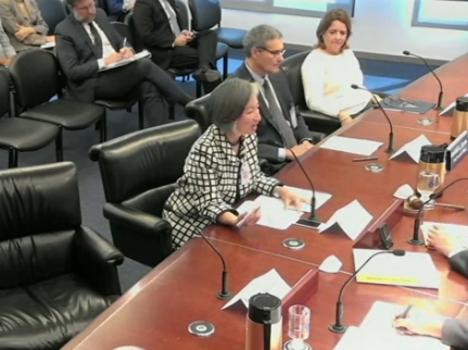
Offering comment during Budget Briefing, from left: Lucy Ito, Mike Schenk and Beverly Zook.
Paul Gentile, President, Cooperative Credit Union Association
Gentile, who testified at the Budget Briefing in 2016, addressed his inaugural comments to NCUA’s capital budget, which over 2017-19 has increased by $50 million, and asked, “Does this get us closer to the virtual exams?” He asked NCUA to more specifically identify which portion of the capital budget is allocated to virtual exams.
Similarly, Gentile pointed to contract services, which have also seen sharp increases in the NCUA budget. “I see a lot of money going to IT, which I think is great, but it’s hard to tell from the budget if that’s going to get us to the virtual model,” he said.
Lucy Ito, President, National Association of State Credit Union Supervisors (NASCUS)
Ito said it is NASCUS’ position that regulatory agencies are in the best position to determine their own budgets. But in terms of what she described as “general observations,” Ito called the steps being taken by the agency to cut costs coming at the same time as budget increases “counter-intuitive,” but also recognized that it will take time for investments that have been made to begin showing returns.
Then Ito moved to what she called NASCUS’ and NCUA’s “historical shared discussion” on the overhead transfer rate (OTR), which has long been the subject of disagreement between federal and state charters.
“I know the two of you are painfully aware of the fiduciary responsibility that the NCUA board has to protect the National Credit Union Share Insurance Fund,” said Ito, before urging the NCUA board to keep its commitment to reviewing the Normal Operating Level of the NCUSIF on an annual basis.
Ito also called on NCUA to “hold fast” to its Title I responsibilities, and said the biggest area where NASCUS has concerns lies in Principle 2, which allocates 100% of costs related to CUSO reviews and third-party reviews to the NCUSIF.
“We recommend that 25% of those workload hours be allocated to Title I,” said Ito.
Beverly Zook, president and CEO, Money One FCU, Largo, Md.
Testifying on behalf of NAFCU, Zook said that “while the industry appreciates that NCUA has begun to slow the rate of year-over-year budget growth, it should come as no surprise that we remain steadfast in our desire for budget efficiencies.
“As a credit union CEO, I am fully aware that the agency needs an adequate budget to ensure that it is able to meet its dual mandate of prudential regulator and insurer, a duty that includes the hiring of experienced personnel and investment in new technologies,” Zook told the NCUA board. “Today, the credit union industry is well-capitalized and strong, meaning credit unions are positioned to continue providing their members with high-quality products and services…Keeping in mind the need for a strong NCUA, I am not suggesting the agency arbitrarily slash its budget without reason. Such a dramatic approach to the budget would only serve to raise questions about the agency's ability to effectively carry out its mission. However, what I am suggesting is that there must be a continued agency-wide commitment to increasing efficiency, eliminating redundancy, and creating a sustainable budget that does not rely on annual increases. Credit unions are looking forward to a time where we could see a decrease in the budget.”
Zook posed several questions she and NAFCU want NCUA to “consider,” including:
- In what environment, economic or otherwise, would NCUA envision its budget seeing a true reduction?
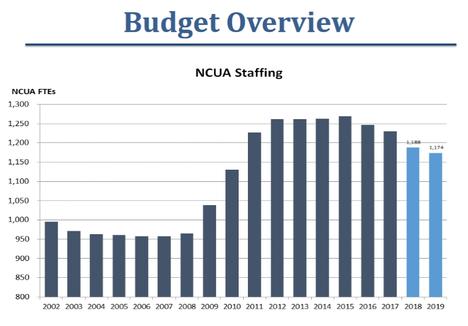
- How can the agency reduce its staff in a manner that reflects the consolidating industry?
- When will the industry begin to see the cost-savings and economies of scale that are being promised in this budget?
“While NCUA has traditionally cited growth of credit union assets as a reason for year-over-year increases to its operating budget, I believe that justification raises questions. As has been said before, NCUA examines and supervises credit unions, not assets,” said Zook.
While praising the steps NCUA has taken to date to streamline operations and be transparent, Zook said she also wanted to emphasize the “positive impact on the budget that could be gained through the adoption of an extended 18-month exam cycle for all well-run, low-risk credit unions.” She further noted that while the 2019 budget proposal reflects a decline in full-time employees as a result of increased remote monitoring and pre-exam consultation with credit unions, most CUs have yet to see any changes.
Zook also raised the issue of a “Credit Union Advisory Council,” saying the small costs of such an entity would increase “stakeholder input” and has her support and that of NAFCU.
Before closing, Zook also called on the NCUA board to return the Normal Operating Level of the National Credit Union Share Insurance Fund to 1.30%.
Mike Schenk, Chief Economist, CUNA
In his comments to the board, CUNA Economist Mike Schenk shared what he called “some high-level observations” on the NCUA budget.
While expressing support for the decreased pace of certain budget increases at the agency, Schenk said
“proposed spending levels in the aggregate remain a concern.”
“Our updated analysis, comparing changes in NCUA’s budget to the changes in the banking industry’s comparable spending, reveals that NCUA’s budget remains approximately 95% higher than pre-recession levels whereas banking industry outlays are up 75% over that period,” Schenk said.
Schenk said CUNA generally supports the capital investments being made by NCUA, but the trade group also fully expects the proposed investments in capital, systems, and technology to lead to further improvements in efficiency, lower staffing levels, and additional relief for CUs.
Similarly, while praising NCUA for reducing its staffing levels, Schenk said the cost per full-time employee continues to increase substantially faster than inflation and marginally faster than the increases bestowed on credit union employees.
“While the agency proposes a 5.7% increase in salary per FTE, CUNA’s 2017-2018 Staff Compensation survey reports budgeted salary increases of 2.9% for management and 2.8% for non-management during the upcoming year,” said Schenk. “Once again, we note this difference isn’t large over a one-year period, but if maintained over time, the cumulative effect will produce significant differences in pay between the regulator and the regulated.”
Schenk said CUNA believes credit unions can play more of a role in helping establish pay increases (or lack of increases), saying feedback from CUs on the performance of individual examiners – to the extent it is collected at all – is obtained in a generally random fashion.
“The only formal feedback mechanism available is through the examination appeals process – but credit unions are loath to use that process mostly due to fear of retribution and a perception that the process is largely ineffective,” said Schenk.
Instead, he said CUNA wants to see NCUA develop and conduct ongoing, confidential, examination staff satisfaction surveys – distributed to credit unions after each examination –and then compiled outside the purview of the agency staff by an outside third party with each examiner’s average rating shared with the regions to assist in both the merit pay process and in filling education and training gaps.
When it comes to exams, Schenk said CUNA recognizes the progress toward efficiencies that have already been made and wants to see the trend continue.
When it comes to how the NCUA budget is funded, largely through the Overhead Transfer from the NCUSIF, Schenk said CUNA remains concerned that the Overhead Transfer Rate remains at “an all-time high,” as well as concerned over the fact the “actual amounts of the total Operating Fee for Federal credit unions decreased over the previous few years, although the overall total budget for the NCUA has increased and the OTR has dramatically increased.” The full details of Schenk’s comments on the OTR can be found in his full statement in CUToday.info’s The Gov here.
Schenk said CUNA continues to support either a large reduction in expenses related to, or the complete elimination of, its Asset Management and Assistance Center (AMAC).
In his comments at the beginning of the meeting, NCUA CFO Rendell Jones reminded that NCUA is largely realigning AMAC’s business model so that its functions are transferred to the respective regional offices.
Finally, Schenk noted the NCUA budget proposal creates an office focused on chartering and credit union expansion and it eliminates Economic Development Specialist (EDS) consulting.
“Many of the nation’s small credit unions have benefited from the Office of Small Credit Union Initiatives (OSCUI) and from the EDS program,” Schenk told the meeting. “The latter service is frequently praised for its emphasis on meaningful personal contact, customized strategic and operational solutions, and (more recently) service provision aimed at those most likely to benefit from the services. NCUA’s internal research showed that EDS consulting was one of the most impactful activities in the OSCUI office and that those impacts were most obvious among the smallest credit unions – many of which are institutions in the greatest need of such services. There is little discussion on the details of the significant changes being proposed. CUNA urges the NCUA to carefully consider the approach taken on this front.”