

By Ray Birch
LAKE FOREST, Ill.—Deposits at all financial institutions are up by $3.4 trillion since the pandemic began, with 30%—or $1.1 trillion—landing in checking accounts, according to a new study that shows credit unions have been warding off checking dollars. At the same time, former NCUA Chairman Dennis Dollar said there are lending opportunities to be had.

The report from Moebs $ervices reveals where that money is going: Commercial banks have grabbed the largest share of checking dollars during the COVID crisis. Savings banks and fintechs have been the most aggressive, seeing the largest percentage gains in new checking money, and credit unions have been the slowest to add the funds.
“Knowing where the money has gone is vital, because some financial institutions have led while others have followed. Savings banks and fintechs came out on top, while banks and credit unions missed the mark,” explained Michael Moebs, economist and CEO at Moebs $ervices.
Moebs said savings banks and fintechs “seized the moment.” But as CUToday.info has reported, many credit unions have little interest in seizing the deposit moment, given the inflow’s effect on net worth. And that’s especially true should there be another round of stimulus checks.
“Often in life those who get to the top are highly motivated, and in this case savings banks and fintechs proved this true,” said Moebs. “As the chart shows (above), CDs had huge losses. Jumbo CDs lost $184.4 billion. Retail CDs lost $141.4 billion. These deposits are the core of savings bank funding for mortgages and fintech funding of commercial loans.”
Moebs said there’s a reason savings banks and fintechs saw much larger percentage gains in deposits.
“Savings banks and fintechs maintained their interest rates at pre-COVID levels before gradually reducing them,” said Moebs. “As the Federal Reserve quickly dropped Treasury bill and bond rates, banks and credit unions followed in lockstep. Savings banks and fintechs were slower to reduce rates, offering their current and new customers higher interest than market prices.”
A Quick Recognition
Moebs added savings banks and fintechs also quickly recognized many consumers and small businesses were “panic stricken” and were seeking liquidity and easy access to funds.
“So, savings banks and fintechs offered interest checking starting at 0.25% and much higher rates for more funds in higher tiers or tranches. Banks and credit unions on average were at 0.05%,” noted Moebs.
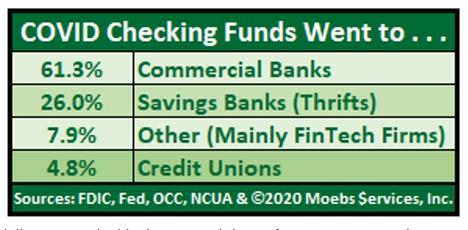
Savings banks aggressively promoted interest-bearing checking, resulting in a 26% increase in the inflow of checking dollars, a rate double their normal share of new money, explained Moebs.
“Fintechs were even more aggressive and got 7.9% of the COVID checking funds when they normally claim only 3% of checking deposits,” he said.
Banks took the lion’s share (61.3%) of COVID checking dollars, but fell 20% short of their normal stake of new money, said Moebs.
Faring the Worst
“Credit unions fared the worst, gaining only 4.8% of the COVID checking funds,” said Moebs. “Severely concerned about preserving capital—more so than banks—credit unions were 40% off from what they would normally get in new checking dollars.”
What should depositories do with the new funds?
“If capital is a concern, along with future growth, then the choice is easy—curb new funds inflow and let deposits return to manageable levels as consumers and businesses will increase spending as the economy improves resulting in an outflow of deposits,” Moebs said.

Michael Moebs
But if capital is sound, how might depositories manage a new surge of COVID-reated deposits?
“Promote relationships with other deposits, loans and fee services,” answered Moebs. “Interest checking is critical. It is not just about balances, but about how balances are used to earn interest and/or reduce fees.”
Moebs emphasized banks and credit unions should not set blanket goals around checking account numbers and balances. Instead, they should target account holders they want to keep and build relationships with, and recognize those they can lose, he suggested.
“Ultimately, the future lies with financial institutions that know how to balance fees, rates and balances,” he said.
Leverage New Loans
Meanwhile, former NCUA chairman Dennis Dollar suggested credit unions focus on new lending options to improve loan-to-share ratios and to keep net worth from falling.

Dennis Dollar
"Managing deposits is a major issue for credit unions today as the COVID pandemic has brought about historic high deposit growth—mostly into checking accounts—from stimulus checks, PPP proceeds and a general flight to the safety of federally insured accounts during a time of economic uncertainty,” said the Dollar Associates principal.
Dollar reminded that with lending volume below normal growth levels, the excess deposits are being invested at very low rates.
“Because of the impact on their ratios, many credit unions would just as soon see most of these deposits flow out,” he said. “But that is missing an opportunity.”
Dollar said the biggest opportunity is moving into new areas of lending, such as boats, RVs, swimming pools, solar, manufactured housing and refinancing student loans with parental co-borrowers.
“With auto lending down, most credit unions are making up for that volume with mortgages—both purchase loans and refinancing,” Dollar said. “There are other lending options that should be considered when deposits are up and the margins are so tight on investments."