

By Ray Birch
SANTA ROSA, Calif.—The forest fires, the evacuations and now the increase in frequency and reach of the rolling blackouts has made life—and running a credit union—in Northern California “extremely complicated,” says Brett Martinez.

The CEO of Redwood CU, which has become a critical resource in its region for not only providing support for members impacted by the growing number of fires in California but also for the communities the $4.7-billion CU serves, acknowledged doing business in the region now means adjusting to a great deal of change.
‘Complicated’ Situation
“It's gotten so complicated, so many pieces of the puzzle to address, but I guess, fortunately, we're pretty good at this,” said Martinez, whose credit union has raised more $35 million over three years to aid fire victims in California, as well as provide food and shelter.
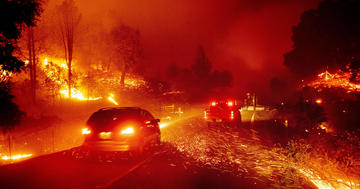
“We’re dealing with the Kincaid fire right now,” said Martinez last week, sounding concerned and weary during an interview with CUToday.info as the CU dealt with a massive fire that forced Redwood to evacuate from its main office approximately 55 miles north of San Francisco. “This is the largest fire burning right now.”
The Kincaid fire as of Tuesday morning had destroyed 77,758 acres and was 84% contained.
Martinez compared the current fire to the Tubbs fire that in 2017 destroyed 7,000 homes almost overnight, noting there had been concerns the Kincaid fire might produce those same devastating results.

Brett Martinez
“But we have been fortunate and the emergency teams and firefighters have kept losses to only about 95 homes right now. But this fire has destroyed a lot more acreage,” he said.
The New Challenge
The latest fire threats have created a new challenge.
“The mandatory evacuations are making it significantly more complicated and significantly more impactful,” he said. “We have over 200,000 people evacuated from our area and millions and millions without power. And then there's smoke that makes it difficult and dangerous to breathe—so you can factor in fire, smoke, power outages and evacuations. The complexity … to be honest with you, it's not a good situation.”
Shelters Overflowing
Martinez estimated more than 2,000 people have been evacuated as a result of the Kincaid fire.
“The shelters are overflowing, the hotels and motels are full, people are staying with family members. There’s there just isn’t the infrastructure to house an extra 200,000 people,” Martinez said. “People—including our employees—are spread all across California and even into other states.”
The biggest issue for Redwood this time is its main headquarters, located at 3033 Cleveland Avenue in Santa Rosa, is in the evacuation zone.
“More than 400 employees work out of our main headquarters, and it’s not accessible to us now,” explained Martinez. “That's where everything runs out of. But the good news is out of our 18 branches only one is without power now. Ten of them had lost power, but we brought them back pretty much immediately with backup generators.”
Only Place With the Lights On

The lost power from the fires and the rolling blackouts initiated by Pacific Gas & Electric—which has been turning over power when there are high winds in order to reduce the risk of fires due to downed electrical lines—has often made Redwood the only financial institution open in the areas the CU’s branches serve, said Martinez.
“For a while we were the only financial institution operating with ATMs and financial services,” said Martinez, emphasizing Redwood’s commitment to remaining open for business. “When you're evacuated, the first thing you need is access to cash and your credit and debit cards. You got to go out and barter and trade…find housing and food and clothes sometimes. We play a humongous role in times of disaster. We take this very seriously.”
Martinez reiterated the difficulty of dealing with the evacuations. He noted that during fires the CU’s main office has always been a place for employees, and even the community to come for shelter, food and a shower. But when the Kincaid fire rolled in and the evacuation order was given, it blew up Redwood’s plans.
“All of a sudden this area becomes an evacuation zone…it’s really complicated things,” he said.
Inconvenient, But…

Martinez said the increase in the frequency, duration and reach of the rolling blackouts has become an additional distraction but not a major problem, when compared to the threat of the fires and the evacuations.
“The blackouts may be the least impactful of all the things from the fires,” said Hernandez. “People lose power, many have backup generators, and they have learned to adjust. They have learned how to camp out, so to speak. They tell their kids they are going to be camping for a couple days.”
But the blackouts become a larger issue when they drag on beyond a couple days, some now lasting a week, explained Martinez. He said people run out of supplies and gasoline to fuel generators is in high demand.
“With the blackouts many gas stations are not open because they don’t have power. And then the ones that are open have long, long lines,” Martinez said.
Financial Pain
The blackouts, too, hurt members financially, especially those living paycheck to paycheck, explained Martinez.
“Homes lose power and people lose all their food. That’s a lot to replace, especially for people who don’t have even $400 for an emergency, as the statistics show is the case among many Americans,” he said. “Then, they have to go out and replace that food with money they don’t have. And what about the people whose businesses shut down because of the power outages? Those people may not be getting a paycheck for a week. That's just a double whammy.”
Martinez said Redwood has not had to change its member assistance programs for the blackouts. The same programs—delaying payments, waiving fees, low and no-interest emergency loans, and just working with members individually to provide assistance—are the same ones needed during blackouts.
As for why Redwood Credit Union steps up in the trying times, Martinez said, “We have this brand and reputation—people know they can count on us.”
The Rolling Blackouts

Eighty miles to the south in Redwood City, Calif., Wade Painter, CEO of $1.2-billion San Mateo CU, said his shop has had deal with rolling power blackouts, but he does not expect the power company to pull the plug in its market very often as it is the heart of Silicon Valley.
“We have not experienced the rolling blackouts like credit unions farther north of us,” said Painter. “I feel for the credit unions in the North Bay. I used to work at Redwood Credit Union, and what they are facing is tough stuff. I think all that is going on there is really changing their way of life, for the communities and for the credit unions.”
A Reminder for Members
As CUToday.info reported here, in the East Bay Patelco Credit Union has been reminding members to keep cash on hand as not only can ATMs be down, but many retailers will be unable to process card transactions.
“We want to assure you that we have plans in place to keep our operations running in the event of a shutoff,” Patelco said in an email to members. “However, please note that some of our branches and ATMs may be closed if they’re in an area with no power.”
Patelco has been posting updates on its website, as well as on Twitter and Facebook.