ORLANDO, Fla.–Leading a credit union may not ever be as physically and mentally taxing as climbing Mt. Everest, but according to one person who’s been there—and who said she learned more when she didn’t make it—both tasks share commonalities, including relentlessly moving forward one step at a time, and coming to understand that moving backward does not mean you’re not moving forward.
Allison Levine, who has been widely acclaimed for her outdoors achievements, including the “Adventure Grand Slam,” which is summiting the highest points on all seven continents and solo skiing to both the North and South poles, spoke to the League of Southeastern Credit Unions annual conference here.
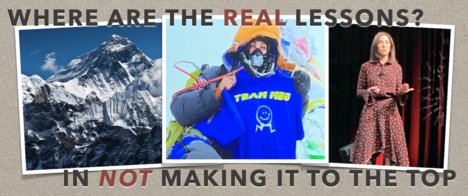
Levine was also selected to captain the first American Women’s Everest Expedition in 2002, and it was primarily the lessons from that experience and a return trip that she shared with the attendees.
‘You Have to Step Up’
Captaining that team, Levine related, was not a job she initially embraced, having turned the opportunity down at first.
“At the time I still didn’t really know if I had what it would take to get up that mountain, but I knew if I didn’t step up to the plate and try, I would never know,” Levine related. “There are times in your life when you have to step up even if you don’t know if you can do it.”
With sponsorship from the Ford Motor Co., which had coincidentally just launched a full-size SUV called the Expedition, Levine shared something she learned from Duke basketball coach Mike Krzyzewski when he talked about what he looks for when putting together a team.
“What he said he looks for first is ego. And I thought, ‘Right, you don’t want that’,” said Levine. “And he said, ‘No, you want ego.’ He said when he’s recruiting a team there are two kinds of ego: the first is performance ego, people who are good and know they are good. The second kind of ego Coach K looks for is team ego. He said, ‘I want people who are on my team who feel proud of being part of something that is collectively greater than who they are alone.”
Those were the attributes Levine said she also looked for in putting together the first American Women’s Everest Expedition.
‘Not the Same as Backing Down’
After extensive planning and training, Levine shared what the process is like of climbing the world’s highest mountain. Ten days are spent hiking to the base camp at 17,000 feet. After acclimating to that altitude, the team hikes to Camp 1 at 20,015 feet. After one night, the team hikes back down to base camp, before climbing again to Camp 1 and then Camp 2 at 21,500 feet. After one night, it’s back down to base camp, before repeating the process and then finally climbing to Camp 3 at 23,621 feet. And after arriving at Camp 3—it’s back to base camp.
“The reason you have to come back to base camp is you have to let your body get used to the attitude slowly. It’s acclimatization. If you were dropped off at Mt. Everest, you’d be dead within minutes. Anytime you are above about 18,000 feet your body is starting to deteriorate and your muscles are getting weaker,” said Levine. “It’s a crazy Catch 22 of wanting to climb, but you have to go back down to eat and gain strength. Psychologically, it’s incredibly frustrating. Even though you are going completely backwards, you are still making progress. We tend to think that progress is linear, that it goes in one direction. But sometimes you have to go backwards a bit to move forward. You’re not losing ground, you’re regrouping and gaining strength. Backing up is not the same as backing down.”
The Advantages of Fear
Among the greatest and most dangerous challenges of the climb is the infamous Khumbu Icefall. It’s also where Levine, who has lectured at the college level on leadership in extreme environments, said she learned another key lesson.
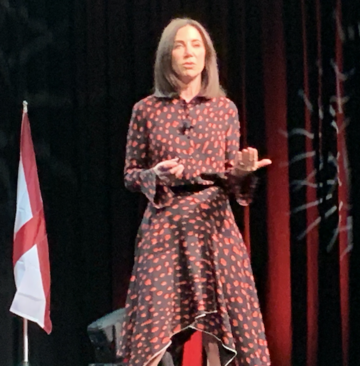
Allison Levine speaking to LSCU meeting.
“Fear is OK. It’s complacency that will kill you,” said Levine. “Don’t beat yourself up for being a little scared or intimidated. Fear can be used to your advantage; it keeps you awake and alert. Fear is fine as long as it doesn’t paralyze you. Complacency will do you in every single time.”
Levine said that anyone in a leadership position, “even when you hurt like hell,” must still “get out there and do your job.” She said every single person on any team and in any function is a leader, regardless of title or tenure.
“Everyone has a responsibility to help the team move toward a goal, and to look out for one another,” Levine told the meeting. “At 24,000 feet, everybody has a banging headache and is sick to their stomach. As a leader, you cannot expect members of a team to endure anything you’re not willing to endure.”
The types of severe storms for which Everest is infamous are only temporary, Levine said.
“You have to keep your bearings and at some point the clouds are going to go away,” she said. “The key to surviving this is you have to be able to take action based on the situation at the time, not based on some plan. Planning is really important—it keeps you organized and on track—but you have to remember whatever plan you came up with is over as soon as the environment shifts or changes. You can’t be hell-bent on sticking to that plan. You want to be focused on executing based on what’s going on at that time.”
A Step at a Time
The American Women’s Everest Expedition finally made it to High Camp at 26,000 feet, which is also known as the “death zone.” At that altitude, five to 10 breaths need to be taken with each step, she said. With 3,000 feet to the summit, Levine said the only way she could “wrap my brain around what we still had to do” was to break down the remaining distance into short pieces and set goals.
The team proceeded that way until it was within several-hundred feet of its long-anticipated goal, the peak of Mt. Everest. And then another storm blew in.
“We had to make a tough call,” said Levine, sharing how the team chose to turn around. “Turning around and walking away is harder than continuing on. But you have to make very tough decisions when the conditions around you are far from perfect. You have to think about how your decisions affect everyone around you. You cut your losses and you walk away. You can always go back, but if you do something dumb up there you may not have the opportunity to go back. We all know of situations where one person’s bad judgement can bring down an entire organization.
“I think as long as you come back alive and with all your fingers and toes, it’s a pretty good trip,” she added.
‘A Big Moving Freight Train’
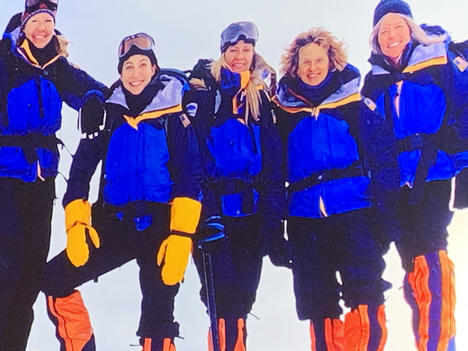
The American Women’s Everest Expedition team in 2002.
Levine told the credit unions from Florida, Alabama and Georgia that the descent is by no means risk-free or easy.
“It’s sunnier, it’s easier to breathe, and it feels more calm, but you have to remember that even when things feel calm there is still risk and the climb is not over until you walk into the front door of your house,” Levine said.
When the team returned to the Khumbu Icefall, it had already passed through seven other times without any problems. But the eighth trip would be different. An avalanche of ice Levine described as sounding like a “big moving freight train” was rushing toward the team, with Levine admitting they thought they were about to die. It stopped just five feet from them.
Eventually, all the team members returned to the United States.
The ‘Tough Part’
Returning home meant team members had to do media tours, with nearly all the attention on how close the team had gotten to the summit and some suggesting they had failed. Not having reached the peak, said Levine, meant some people would say, “Oh, you didn’t climb Mt. Everest.”
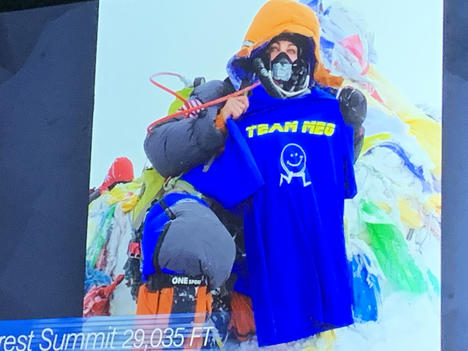
Allison Levine on top of Mt. Everest.
“It was tough to be part of such a high-profile failure. All anyone wanted to talk about was that we didn’t make it,” said Levine, who said every time she was asked if she would return, she responded “hell no,” and that she had “zero unfinished business on that mountain.”
But the death of a close friend and a fellow athlete at a young age helped to change Levine’s mind, and she returned to Everest in 2010. While in High Camp, she was facing yet another storm, but rather than turn around she said she pressed on, and eventually reached the summit on May 24, 2010.
“People ask, ‘What was it like to go back eight years later and finally stand on top of the highest mountain in the world?’” said Levine. “I can honestly tell you it just wasn’t that big of a deal. It’s just a pile of rock and ice and standing on top of that for a few minutes doesn’t change you or the world. Lots of other things do change the world. How about raising kind, compassionate children who contribute to their world, or just being there for someone when they are having a tough time? Sharing a few kind words of support to someone who is struggling can completely change an outcome.”
Failure Tolerance
But what was important about standing on the roof of the world, said Levine, is the lessons learned along the way and then what is done with that information going forward.
“The only reason I made it was because I had that failure under my belt. I think in general we’re not really a failure tolerant society, and that’s too bad because a lack of failure tolerance prevents people from taking risks,” Levine said. “When you truly embrace the spirit of innovation and set high goals, you have to give your teams the freedom to fail. Just come back better for the next time around.”
Showing her audience a picture of herself at the peak, Levine added, “What you don’t see are all the others at the summit who helped me get there. Nobody gets to the top of this mountain by themselves.”
The Peak Lesson
Recalling all she experienced not just reaching the top of Mt. Everest, but also everything involved in her other epic adventures—including overcoming the fact she has a heart condition—Levine shared this: “If I had to sum up all the lessons I learned it is that some things are going to go your way, some things are not going to, but you have to be willing to get out there and push yourself on these peaks day after day, especially when it feels uncomfortable. My biggest takeaway from the entire experience is you don’t have to be the best, fastest, or the strongest climber out there every day on the mountain. You just have to be relentless about putting one foot in front of the other.”
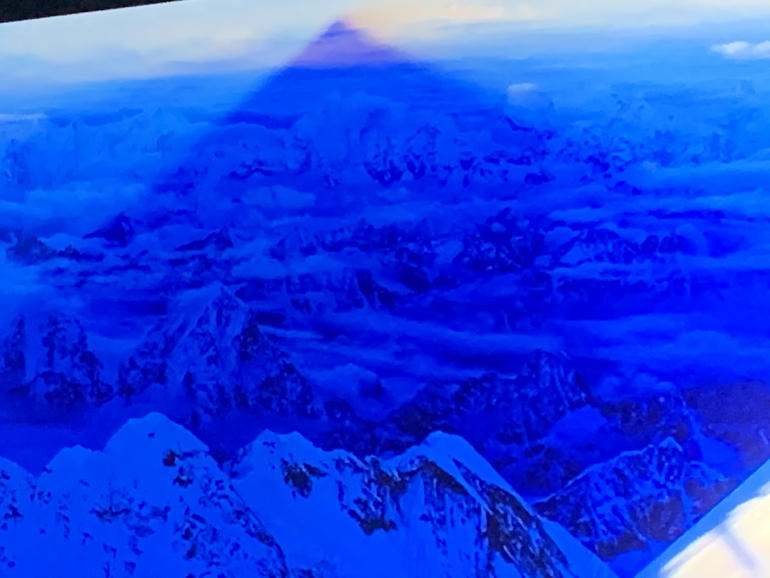
Below, a photo of Mt. Everest's shadow as shot during Allison Levine's trek to summit.