

LAKE FOREST, Ill.—Reports that deposit rates nationally are declining are accurate–but it’s a trend being driven largely by banks, as credit unions have been raising rates to grab share, says one economist.
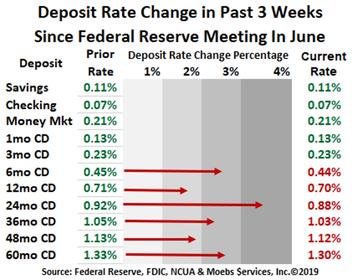
In fact, in many cases long-term CD savings rates for credit unions are double what banks are paying, said Michael Moebs, economist and CEO at Moebs $ervices, citing his company’s newest Interest Rate Study.
“Yes, the deposit rates show a decline in long-term rates for banks, thrifts and fintech firms, but not at credit unions, according to our study,” Moebs told CUToday.info. “Long-term CD rates, six months or longer, are almost twice as high at CUs as compared to all other financial institutions and have not declined. The Fed is substantially short in growing the money supply. So, credit unions are grabbing as many deposit dollars as they can now before the Fed starts growing money supply and increasing rates, then all depositories will start fighting to get as many deposit dollars as possible.”
A Slice of the Market
Moebs noted that credit unions have more than $1 trillion in deposits, but this is only about 8% of the $12 trillion held by all depositories.
“So CU changes are often missed,” he said.
The last decline in deposit rates was August 2013.
“It has been almost six years since any type of deposit rates have fallen. Or, more importantly, six years of steady deposit rate increases has ended,” said Moebs.
The recent rate drops only impacted long-term deposits with rates on savings and short-term deposits remaining unchanged, explained Moebs.
“At $2.8 trillion, long-term deposits only account for 23.8% of all deposits,” said Moebs. “The rates on the remaining $9.3 trillion of deposits remain the same.”
A Response to FOMC
Moebs said the decline in long-term rates is in response to the recent Federal Open Market Committee meeting that concluded by making no changes to the basic federal Funds rate of 2.40%.
“While the decline in long-term rates seems slight from one basis point to four BPs, this is actually quite substantial. because it ends a six-year rise in CD rates,” explained Moebs. “Most notably it signifies a switch in rate direction by the marketplace.”
The federal funds rate reached a low of 0.09%, or nine BPs, at the start of 2014, almost coinciding with the lowest point for all deposit rates, explained Moebs. The 24-month CD rate was 0.36%, at the start of 2014, noted Moebs. In 2014 the two-year Treasury bond rate hit a low of 0.28%.

Michael Moebs
“These rates are now Fed Funds 2.37%, the two-year T-bond 1.77%, and the two-year CD 0.88%,” said Moebs. “The Moebs Interest Rate Study reconciles these current rates. The Fed fund rate and two-year T-bond are inverted, or showing a gap of 60 BPs. If the two-year T-bond rate is adjusted for deposit insurance and savers’ aversion to the stock and bond markets, the two-year T-bond is 88 BPs, which is the same as the two-year CD rate.”
What’s Coming?
Looking at the Moebs study, what’s ahead?
“Banks, thrifts and fintechs may continue to reduce long-term deposit rates, and I expect credit unions may soon join them,” predicted Moebs. “Short-term saving deposit rates will stay the same—credit unions may be the exception. CUs may change share rates and money market deposit rates to protect themselves from any of these savings dollars leaving. Also, CUs may aggressively raise rates to get more dollars.”
Moebs said the Federal Reserve is the cause of the inversion of the yield curve with inflation and unemployment in check.
“And the Fed will continue to counter deposit market conditions on over $12 trillion in deposits and wait for deposit rates and Treasury rates to increase, or get to the level of credit unions, through 2019 and into 2020 to match the Fed’s rates.”