

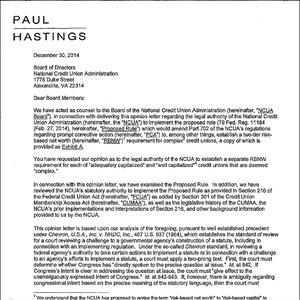
ALEXANDRIA, Va.—CUToday.info has obtained a copy of the legal opinion letter at the heart of a controversy over whether NCUA can create a two-tiered risk-based capital plan, or whether Congress’ intent and the Federal Credit Union Act prohibit anything other than a one-tier plan.
Click here for a copy of the the letter.
NCUA Chairman Debbie Matz said the agency’s general counsel and outside counsel it retained at a cost of $150,000, Paul Hastings LLP, support the revised plan with the two tiers.
But NCUA Board Member Mark McWatters, who is an attorney, disagrees, which he made clear in remarks at the Jan. 15 board meeting at which he was the dissenter in the 2-1 vote in favor of putting the revised plan out for comment.
McWatters said NCUA is misreading Section 216(d) of the Federal Credit Union Act.
During the NCUA board meeting, Matz said she had sought out a number of law firms to offer an opinion letter on NCUA’s authority to issue a two-tiered plan, before settling on Paul Hastings, which has offices throughout the United States and the world. At the Jan. 15 meeting Matz said she wanted to release that letter, but that Paul Hastings had said it did not want the opinion letter released and that it is to remain confidential.
However, CUToday.info has obtained a copy of the letter following a Freedom of Information Act request with NCUA.
Chevron Standard
To arrive at its opinion, Paul Hastings said it examined the proposed rule, NCUA’s statutory authority to implement the rule as provided in Section 216 of the Federal Credit Union Act and Section 201 of 1998’s Credit Union Membership Access Act, and legal precedent established by the 1984 case Chevron, USA v. NRDC, Inc., which led to what is now known as the Chevron Standard or Chevron doctrine.
In its 13-page opinion letter reviewed by CUToday.info, Paul Hastings said that it had concluded that “we are of the opinion that, under current principles of applicable law and existing case law, a court of appropriate jurisdiction, in a litigated matter or proceeding, could conclude that NCUA’s statutory authority pursuant to Section 216 of the FCUA permits the NCUA to establish the proposed two-tier RBNW requirement set forth in the proposed rule.”
It was the word “could” in that opinion with which McWatters took issue during the board meeting, saying it is a “relatively weak standard,” and that the word “could” offers “little comfort.”
Moreover, McWatters was critical of the $150,000 expenditure for the legal opinion and the fact the agency wasn’t releasing it, saying, “If you are troubled by this allocation and complete absence of transparency, you are not alone.”
In the opinion letter reviewed by CUToday.info, Paul Hastings states, “NCUA’s proposed two-tier RBNW requirement under the Proposed Rule constitutes a permissible construction of the statute and, as such, should be upheld by a court under the Chevron doctrine. By providing sufficient explanation of its reasons for imposing a higher and more conservative RBNW requirement for complex credit unions to be deemed well capitalized, it is our view that the NCUA’s implementation of a two-tiered RBNW requirement would withstand a court challenge alleging the agency’s approach is arbitrary, capricious, or manifestly contrary to the statutory language of Section 216 of the FCUA.”
FCU Act Language
The opinion letter looks closely at whether the language of the Federal Credit Union Act, Section 216, expressly gives NCUA the authority to create two-tiered rule.
“We find that the language of Section 216(d) is, at best, ambiguous with respect to the statutory authority of the NCUA to implement a two-tier RBNW requirement for complex credit unions, as the language can be interpreted in multiple ways…”
It is the ambiguity that, in part, contributes to the opinion that NCUA can offer the two-tiered proposal.
“The plain language of Section 216(d)(2) does not expressly restrict the NCUA from imposing a higher RBNW requirement for ‘well capitalized’ versus ‘adequately capitalized’ credit unions for the supervisory purpose of building in additional risk management controls before a credit union becomes undercapitalized. . . In our view, the only clear restriction imposed on NCUA as a result of the language of Section 216 (d)(2) is that the RBNW requirement that is to be ‘designed’ by the NCUA must take account of certain kinds of ‘material risks’ contemplated by Congress. In this regard, and in our opinion, the language of Section 216 (d)(2) does not prevent NCUA from imposing higher requirements on ‘well capitalized’ credit unions to provide greater protection against these risks.”
The letter also notes that a court applying the Chevron Standard on NCUA rulemaking must “give considerable deference to the NCUA where ambiguity exists within Section 216 of the FCUA.”
According to the letter, if a court determines that Section 216 language is ambiguous regarding NCUA’s authority to issue a two-tiered system, that the court would then be required to turn to the second question under Chevron, which is whether the NCUA’s interpretation of Section 216 “is a permissible construction of the statutory language.”
As noted earlier, the letter concludes that “NCUA’s proposed two-tier RBNW requirement under the Proposed Rule constitutes a permissible construction of the statute.”
Related
McWatters Challenges NCUA’s Legal Authority To Issue Two-Tiered Rule
CUNA, NAFCU & NASCUS Weigh In On RBC