

WASHINGTON–In what is a turning point in U.S. credit union history, the two long-time national credit union trade associations technically disappeared over the weekend and are now a new entity in 2024.
Effective Jan. 1, the Credit Union National Association (CUNA) and the National Association of Federally Insured Credit Unions (NAFCU) merged to form the new trade group called “America’s Credit Unions.” The groups have said the new legal entity will be in place with the new year, with a goal of being fully operational by 2025.
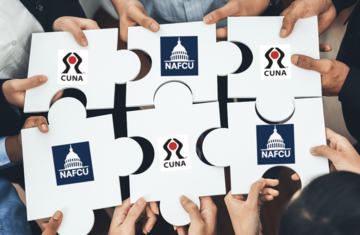
The new name, incidentally, isn’t the first time the two trade groups have come together under that umbrella. With their backs against the wall in Washington in the late 1990s, CUNA and NAFCU joined to form the Campaign for Consumer Choice as they fought to get critical legislation passed, and in much of the advertising they often referred to “America’s Credit Unions.”
CUNA and NAFCU are also merging at the same time the new year also starts with the merger of two of the biggest CUSOs in credit unions, PSCU and Co-op Solutions
‘Highly Influential Voice’
The two groups announced in August their plans to combine, and later reported 90% of credit unions that voted cast their votes in favor of the combination.
In a statement issued at the time of the announcement, CUNA and NAFCU said that by combining strengths into a single entity, America’s Credit Unions “will be a highly influential and effective voice” for credit unions in Washington, D.C., and, in partnerships with the leagues, across all 50 states, Puerto Rico and Guam.
Plans call for CUNA CEO Jim Nussle to lead America’s Credit Unions. NAFCU CEO Dan Berger will exit at year-end. They have also announced a conference schedule under the new organization, many of which were already announced as CUNA and NAFCU events, which can be found in the CUToday.info calendar.

The famous 1934 meeting at Estes Park, Colo., where CUNA was formed.
History of Two Groups
CUNA was formed in 1934 at the now famous meeting in Estes Park, Colo. at which numerous credit union pioneers and legendary names were on hand. It replaced what was then known as the Credit Union National Extension Bureau and its first director was Roy F. Bergengren.
The group was for much of its existence headquartered in Madison, Wis., before it moved its headquarters to Washington, D.C., in the wake of the fight to pass the Credit Union Membership Access Act (H.R. 1151) in the late 1990s.
The operations it continues to have in Madison have vacated the space where they were previously housed inside the iconic campus buildings owned by TruStage (formerly CUNA Mutual Group) and now lease space in other facilities.
Group Began in a Restaurant

The Cockatoo Hotel, where NAFCU was formed.
The National Association of Federal Credit Unions (it would change its official name to National Association of Federally Insured Credit Unions in 2016 as it sought to expand its membership) was formed in 1967 by a group of credit union CEOs who initially met at the restaurant at the Cockatoo Hotel in Los Angeles, which has since been demolished. All federally chartered, they were seeking a stronger voice for FCUs in Washington, where credit unions had only a minimal voice at the time.
Once formed, NAFCU would go on to score a number of victories, including one of its earliest, legislation that created the National Credit Union Share Insurance Fund.
Over its life NAFCU prided itself on being smaller and more “agile” than CUNA. Even on its website today, it continues to promote how it has been different, stating, “We were the sole (and successful) defender of the NCUSIF in the early 1990s when regulators and the White House were advocating for major change to it, and we were the only trade association to oppose the CFPB's authority over credit unions when the agency was formed (a stance we keep to this day as we fight to reduce the agency's burdensome impact on credit unions).”
NAFCU would often remind that CUNA did not object to the creation of the CFPB and its supervision of credit unions at the time it was created after the financial crisis of the early 2000s.
Numerous Issues Remain
While the merger has been announced and the new trade group will technically exist beginning next week, how numerous issues will be resolved has yet to be announced.
Both CUNA and NAFCU have declined repeated inquiries from CUToday.info on behalf of credit unions over what kinds of headcount reductions are planned, how the finances of the two organizations will be handled (CUNA has operated in the red during several recent years, while NAFCU has been in the black), and what will become of NAFCU’s Alexandria, Va., headquarters building, which it owns.
CUNA leases space in the District of Columbia in the Navy Yard area.
The new branding and new logo for America’s Credit Unions have also not yet been released.
New Management Team
As CUToday.info reported earlier, Nussle has announced the names of those he has selected to be the new management team at America’s Credit Unions.
They include:
- Jill Tomalin, executive vice president. Tomalin is currently EVP and COO with CUNA, and has Tomalin has more than 30 years of experience within credit unions. Tomalin will oversee membership and engagement, communications and marketing, operations and finance, and association services.
- Carrie Hunt, chief advocacy officer. Hunt is currently president and CEO of the Virginia Credit Union League and prior to that had a long career as an executive at NAFCU. Overall, Hunt has more than 20 years of experience in consumer finance and financial services law, credit union regulations, and association lobbying.
- Anthony Demangone, chief membership and engagement officer. Demangone currently serves as EVP with NAFCU, and has more than two decades of experience in credit unions and “brings with him significant compliance and legal expertise.”
- Eddie Rivera, chief operating officer and CFO: Rivera is currently CUNA’s CFO and has nearly 30 years’ experience in credit unions and “brings a deep understanding of business operations, including the importance of collaborative relationships with external partners and internal departments.”
- Meghan Burris Small, chief communications and marketing officer. Small is currently VP-communications and media relations at NAFCU. Small has more than a decade of experience in financial services and regulatory policy communications.
- Todd Spiczenski, chief association services officer. Spiczenski is currently EV and chief products and services officer with CUNA, and has more than 30 years of experience in credit union member services.

Transition Board
CUNA and NAFCU have named 15 members who will serve on a transition board.
Executive committee members of the proposed board are Vice Chair Lisa Ginter (CUNA board chair), who is CEO of Community America Credit Union; Treasurer Patrick Pierce, who is CEO of City and County Credit Union, and Secretary Karen Harbin, president/CEO of Commonwealth Credit Union.
In addition to the executive committee, the remaining proposed board roster includes:
- Lonnie Nicholson, president/CEO of Educational Employees Credit Union
- Nader Moghaddam, president/CEO of Financial Partners Credit Union
- Jeff Olson, president/CEO of Dakota Credit Union Association
- Gary Grinnell, president/CEO of Corning Federal Credit Union and current NAFCU board chair
- Lori Herrick, president/CEO of Manchester Municipal Federal Credit Union
- Scott Simpson, president/CEO of Utah Credit Union Association
- Melanie Kennedy, president of Southwest Financial Federal Credit Union
- Keith Sultemeier, president/CEO of Kinecta Federal Credit Union
- Brian Best, CEO of GTE Financial Credit Union
- Jim Morrell, president/CEO of Peninsula Community Federal Credit Union
- Amy Sink, CEO of Interra Credit Union
Proposed Continuing Board
Meanwhile, the organizations said the continuing board will consist of 15 voting members and two nonvoting members:
- There will be four classes of members: geographic (nine directors), at-large (four directors), league (two directors) and nonvoting (two directors)
- Each geographic class will be represented on the continuing board; there will be three small, three medium, and three large credit unions seats
- At-large members of the continuing board will be elected from all credit unions
- Continuing board executive committee officers will be chair, vice chair, treasurer, secretary, and America’s Credit Unions CEO
- Only directors from natural person credit unions and the CEO will be allowed to hold officer positions
The Dues Structure
According to CUNA and NAFCU, the dues structure if the merger is approved will be as follows:
2024 Dues
Calculated using the same CUNA methodology or NAFCU methodology currently in effect, as of December 31, 2023.
2025 Dues
Calculated using 2023 invoice methodology.
2026 Dues
Calculated using 2023 invoice methodology.
2027 Dues
Calculated by the new America’s Credit Unions dues structure, as will be determined by the Board of Directors.
Existing Dual Members as of Dec. 31, 2023
2024 Dues
“Dual members are encouraged to pay membership dues for both organizations,” the trades groups said, noting dues will be calculated using the same CUNA methodology and NAFCU methodology currently in effect, as of Dec. 31, 2023.
Members Paying Dual Dues for 2024
2025 Dues
Equal to the greater of the dues that would have been paid using CUNA’s current methodology or NAFCU’s current methodology, as of Dec. 31, 2023.
2026 Dues
Calculated using 2024 invoice methodology as indicated for existing dual members.
2027 Dues
Calculated using 2024 invoice methodology as indicated for existing dual members.
2028 Dues
Calculated by the new America’s Credit Unions dues structure, as will be determined by the board of directors.