

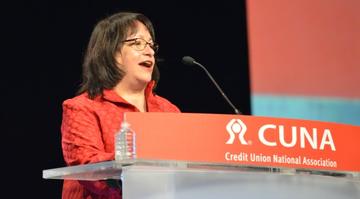
Susan Streifel
WASHINGTON–The CUNA board has voted in favor of presenting to its affiliated member CUs the most significant revision of its bylaws since the association was formed in 1934.
Under the proposed bylaws changes, credit unions will likely be given a “choice” of belonging to their state league only, belonging only to CUNA, or having membership in the traditional league/CUNA model.
In addition, the CUNA board has also voted in favor of opening membership beyond just natural-person credit unions to not just other organizations but perhaps individuals themselves.
All of the changes are expected to be presented to credit unions for a vote some time in early 2016.
Much is still to be worked out in terms of what “membership optionality” will mean, and it could mean different things to credit unions in different states. This week CUNA staff made a presentation on the board on the bylaws proposals. With the board voting in favor of changing the bylaws, the job will now shift back again to CUNA’s staff and its Corporate Governance Committee to formalize the language.
Another key issue with which CUNA and the state leagues will need to wrestle is how to structure dues depending on the type of membership.
The decision will not just affect CUNA. The various state leagues/associations are also going to need to decide on making changes to their own bylaws. A number of state associations have already voted in favor of the “choice” position, which is what led the CUNA board to consider the policy change.
In a letter to credit unions, CUNA Chairwoman Susan Streifel said, “While the Board strongly believes in an interdependence model – one in which CUNA is working in concert with our League partners on behalf of credit unions – we also believe that the time is now for CUNA to change and modernize its bylaws in response to the evolving needs and demands of our credit union members. A key component of that change will be to institute bylaws that accommodate membership optionality, or choice, while also strengthening the ability of CUNA and the Leagues to work together as credit unions' strongest advocates.”

Jim Nussle, CUNA
According to Streifel’s letter, major principles of the proposed new bylaws would include:
- CUNA is committed to interdependence with state credit union leagues.
- Voting membership available to all natural-person credit unions and leagues.
- Non-voting membership available to a wide variety of individuals and organizations that “support the credit union system.”
- Dues structure to be set by the board, with the intention of reducing the rates in the future as credit union assets grow.
- Flexibility to reduce the size of the board, expected to remain at 24 for the foreseeable future.
- Four classes of CUNA directors, with three representing credit unions based on size and one for leagues. Elections for directors from smaller credit unions likely to be within districts, and nationwide for larger credit unions and leagues.
“To be clear: Modernizing our bylaws and, as part of that, our membership structure, does not mean that our principles have changed,” said Streifel. “In fact, quite the opposite is true. An interdependent system in which CUNA and the Leagues work together – strategically and forward-looking – remains unmatched.”
A full copy of Streifel’s letter can be found here.
After 80 years of few changes to CUNA’s bylaws other than minor technical or language adjustments, the new wholesale change to its membership rules were brought about by pushback from credit unions—and by default, their state leagues—after the CUNA board voted to reject recommendations made by its System Structure and Government Task Force that it consider the “choice” option, as CUToday.info reported here.
“The board’s vote today shows recognition to the fact that new market forces and increasing expectations demand more direct accountability between credit unions and CUNA,” said CUNA CEO Jim Nussle, who had earlier announced that he would be spearheading the effort to make changes in the bylaws. “That interdependence stands for a united system that is the best advocate for credit unions, not mandated linked membership. That change is all around us, and CUNA is going to be part of it. Ultimately, I aim to position CUNA and our system for a stronger, interdependent and united future by delivering greater value, accountability and advocacy success.”

The Estes Park, Colo. meeting in 1934 at which CUNA was created.