

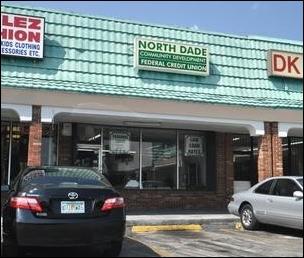
Source: South Florida Business Journal
MIAMI GARDENS, Fla.—A $4-million CU here that did more than $1 billion in outgoing wires in 2013 and which has been hit with a $300,000 fine is declining to comment on the matter.
North Dade Community Development FCU is not discussing reasons behind why it ignored BSA reporting requirements, nor is it commenting on the cease and desist order it received from NCUA that led to the fine from the Financial Crimes Enforcement Network (FinCEN).
That $300,000 fine represents almost half of the $4-million CU’s net worth. (http://www.cutoday.info/Fresh-Today/FinCEN-Fines-4-Million-CU-300-000)
But its Call Report data reveals a credit union whose direction markedly shifted over the last three years—away from providing typical credit union services to relying heavily on income from wire transactions.
North Dade CDCU did not return calls from CUToday.info.
Earlier this week FinCEN assessed a $300,000 civil money penalty against the CU that during 2013 did $1.01 billion in outgoing wires and $984 million in remotely captured deposits. North Dade was assessed the fine for what FinCEN called “significant” BSA violations.The credit union, too, was issued a cease and desist order from NCUA last year for similar violations, the South Florida Business Journal reported.
North Dade’s focus on lending and membership growth apparently changed in 2010. Total loans fell by almost 50% since 2010, dropping to $457,454 through September of 2014 from $889,197 in 2010. Share drafts dipped to $181,131 this year from $265,219 in 2010. Regular shares declined to $2 million in 2014, from $3.8 million in 2010.
Membership growth has continued to fall, dropping by 42% in 2011 and 14.38% so far this year. NDCDFCU was founded in 1997 and describes itself on its website as place providing “friendly, growth-oriented financial services that also serve to support a successful community,” and that it offers that community a “wide range of financial services, debt counseling, entrepreneur classes and fee free business and personal checking.”
The CU has seen dramatic swings in its financials in recent years, with net worth moving from 5.43% in 2011 to 10.02% in 2012, to 21.01% in 2013 and 16.88% so far this year. The CU showed a net income loss of $113,733 in 2011, and then profits of $191,379 in 2012 and $384,290 in 2013. Through September North Dade posted a $298,615 loss, without the FinCEN fine factored in.
Despite 16.88% capital, losing almost half of its current $616,641 net worth may challenge the viability of the CU. North Dade this year, showed a significant drop in other income, finishing $38,698 in the black through September, well off last year’s $964,037 total.
According to FinCEN, the credit union, which has five employees, contracted with a third-party vendor and money services business (MSB) to provide services and sub-accounts to 56 MSBs located in high-risk jurisdictions far outside its field of membership, including locations in Central America, the Middle East, and Mexico. The revenue generated from these accounts constituted 90% of North Dade’s annual revenue.
“North Dade’s anti-money laundering (AML) failures exposed the United States financial system to significant opportunities for money laundering and terrorist financing from known high-risk jurisdictions,” said FinCEN.
CU Willfully Violated BSA
FinCEN said NDCDFCU consented to the assessment and admitted that it willfully violated BSA programs, reporting, and recordkeeping requirements. Included within these lapses, the credit union failed to comply with Section 314(a) of the USA PATRIOT Act, a program requiring financial institutions to search their records to locate accounts and transactions of persons that may be involved in terrorism or money laundering, FinCEN said.
“When a small institution opens its doors to the world, takes on greater risks than it can manage, and puts profits before AML controls, bad actors are bound to take advantage,” said FinCEN Director Jennifer Shasky Calvery in a statement. “This case raises pretty obvious questions that no one seems to have asked. Why would MSBs located all over the world choose a small Florida credit union to conduct close to $2 billion in transactions? Credit unions pride themselves on close and low-risk relationships with known neighborhood customers. However, North Dade welcomed customers far beyond its field of membership, without adequate policies and procedures to ensure AML compliance.”
Director Shasky Calvery also expressed concern about North Dade’s failure to comply with FinCEN’s 314(a) program. “It is of great concern that North Dade failed to even review the 314(a) requests it received. These are time-sensitive requests that, by their very nature, are intended to further criminal investigations into significant money laundering and terrorist financing activities.”
According to FinCEN, from 2009 through 2014 North Dade had significant deficiencies in all aspects of its AML program, including its internal controls, independent testing, training, and failure to designate an appropriate BSA compliance officer. North Dade also had a systemic failure in meeting its 314(a) obligations. North Dade did not provide any meaningful risk assessment for its size and type of business and blindly relied on a third-party vendor to conduct due diligence for all 56 MSBs, which held sub-accounts at North Dade.
“Without itself knowing or understanding its customers or risks, North Dade was unable to adequately monitor, detect, or report significant suspicious transactions and other activities taking place through the credit union, including those related to money laundering and drug trafficking,” FinCEN said. “When the credit union did file suspicious activity reports, the reports were often late and insufficient.”