

By Ray Birch
SAN DIEGO—California Coast CU felt it needed to do everything possible to protect its staff and members during the COVID-19 crisis, and that meant temporarily hiring an expert in chemical engineering and biochemistry to provide direction on how to keep its branches safe—and that includes how hand sanitizer is stored and when employees need to stand in the corner.

It also led to creating a “pandemic playbook,” which is not only helping the $3-billion credit union remain safe today, but will help if another health crisis occurs, according to CEO Todd Lane.
“We did something unique,” said Lane. “We brought in a health expert, a consultant in chemical engineering and biochemistry, and an OSHA (Occupational Safety and Health Administration) expert, to help us with our branch safety.”
Lane said California Coast has never closed its lobbies at its 26 offices during the health crisis, and while the credit union had been keeping abreast of government guidelines for businesses that either reopened or remained open, Lane said he felt the credit union needed to do more.
“I am not sure you can really do this yourself,” said Lane. “We had been monitoring the CDC website and the state of California website for requirements and recommendations regarding things like sanitation and personal protective equipment. But I told my team that we don’t know what we don’t know. There are just so many things you won’t think about that an expert will. And we found that out.”
Suspicions Confirmed
The CU’s suspicions were confirmed when its health expert, Mychelle Fernandez, principal environmental, health, and safety consultant for Corporate Environmental Advisors, pointed out numerous areas the credit union should address and change, even after paying close attention to CDC rules. Lane also said the consultant was a big help in keeping the credit union compliant with state and CDC rules, which he noted are not always in line with each other.
“I'll give you one good example. Symptom screening is mandated by the county of San Diego, so we started that right away,” said Lane. “The CDC guidelines say that a temperature of 100.4 or lower is fine. But San Diego County says 100 degrees. So, there's a difference. And the county allows for others to take your temperature for you with a with a non-contact device, whereas the CDC guidelines discourage other people from taking your temperature unless there is a physical barrier between you and that person. It's those sorts of things, those inconsistencies, that concerned us too. We wanted to be as safe as possible, and we felt we needed a health consultant who knew all the rules and the best approaches to take.”
Each Office Gets Visit

Todd Lane
Lane said the consultant visited each office and not only looked for issues that needed addressing, she established consistencies in processes and procedures regarding pandemic safety.
“She looked at the training we were providing staff. She looked at protocols, air filtration—everything that you could think,” shared Lane. “She even looked at how we stored things like hand sanitizer.”
That led to a recommendation to stop storing cases of hand sanitizer in one location—at the CU’s main office in two conference rooms.
“She pointed out that hand sanitizer can be considered a hazardous material with large amounts of it in one place,” Lane explained. “It’s 80% alcohol, which is flammable. And that much of it in one place? She recommended we spread out storage of the sanitizer in multiple branches.”
15 Recommendations
Overall, Fernandez developed 15 formal recommendations for California Coast Credit Union.
“Half of the recommendations were for the back office, around standardization of training of the use of personal protective equipment,” said Lane. “Like use of gloves. She questioned the use of gloves. There are differing opinions on the use of gloves—if they really make things safer. For instance, when you use gloves are you are you washing your hands less often. Are you using hand sanitizer less often?”
Lane said Fernandez also addressed physical space in each office, offering guidance on how many staff should be in a particular area at one time.
“She had us post signs outside each room stating how many people are allowed in at one time,” Lane said. “And we did that with our elevators—two people at a time and you have to stand in the corners.”
‘One Interesting Finding’
Recommendations also called for stronger procedures for ensuring sick employees are not allowed to go to work.
“She pointed out ways we could improve our cleaning and sanitizing procedures,” Lane said. “One interesting finding was that our janitorial crew was not cleaning printers, which our employees use a lot. So now we have a procedure in place now for our staff to clean printers themselves.”
Fernandez also recommended removing handles on bathroom doors, and installing a “foot pull,” a device that lets staff pull the door open with their shoe when the leave the restroom. Cloth seating, which is harder to clean than vinyl and leather, is being removed.
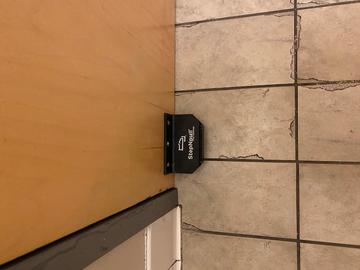
Door with foot pull
The Playbook
With the help of Fernandez, California Coast has also created a digital pandemic playbook that outlines all of the necessary actions, procedures, protocols and policies the CU needs to take now and if a pandemic ever strikes again.
“I know every credit union went into this pandemic with contingency plans,” said Lane. “But I know now ours did not even scratch the surface of what needs to be done in this type of crisis. This is an electronic handbook our staff now uses. It’s like handing out the credit union’s handbook when a new employee comes on board. This is so important today, as we are going to be in this crisis for a while, and we don’t know if another pandemic will come around again.”