

LAKE BUENA VISTA, Fla.–Which of these three responses is your credit union’s board making to the fundamental change taking place in financial services:
- Laying the corner in a fetal position and sucking thumbs and hoping it all just goes away.
- The passive-aggressive response of acknowledging the change but not doing anything about it.
- Seeing the change and disruption, understanding it is changing the way the credit union brings value to the community, and responding.
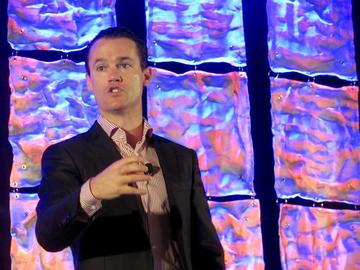
Peter Sheahan speaking to CUES Directors Conference in Orlando on Monday.
Those responses are not unique to credit unions, according to Peter Sheahan, who has worked with some of the world’s largest companies as well as credit unions as they have wrestled with the very same questions about their own futures. It is a future, said Sheahan, that will be very much decided by CU boards that are willing to begin by challenging their own board room practices.
Sheahan, founder and CEO of ChangeLabs, which has recently become Karrikins Group, challenged CU board members at the CUES Directors Conference here to give some hard thought to how they are leading the response to fundamental change, suggesting that while most would say their response is “number three,” above, it’s very likely that is not the case.
Citing statistics around consolidation within credit unions—the 300 CUs that will disappear in 2015 illustrate the price of not responding to change, he said–he pointed to the $300 billion in payments being done through PayPal and the $50 billion in payments now done through Square as indicators that consumers all “want an omnichannel experience, but they also want the same fee base as what they had before: no fees.”
Sheahan said his experience in working with some of the biggest companies and best-known brands has shown that “boards and CEOs often destroy value in responding to change.”
Good & Bad Responses
The question of what differentiates a good response from a bad response to fundamental change, said Sheahan, was put to him after being retained by News Corp., which owns Dow Jones and the Wall Street Journal among other properties, which was faced in 2006 with threats to its own business model of controlling access to content and ideas.
Sheahan and his team looked at historical parallels and responses, including a 1901 strategic plan commissioned by the mayor of London in which “some of the smartest people on the planet” worked on a plan for the year 1925. Their conclusions: London was seeing huge population growth and would need one-million more horses, even though there were already 78,000 cars on the road and the city was building a subway. The plan was irrelevant by 1905.
Similarly, in the mid-1990s AT&T hired respected consulting firm McKinsey & Co. to determine what the size of the mobile phone market would be in 10 years. After millions of dollars of research, McKinsey’s answer: 900,000 units. “In 10 years it was 900 million units,” noted Sheahan.
In 2008, recalled Sheahan, he was part of a presentation in which a leading executive in the satellite TV industry predicted that “broadband speeds will be fast enough in next 10 years to threaten the distribution of content.” That prediction came even though there had been two billion downloads on YouTube in the 24 hours prior to the speaker’s remarks.
History is replete with examples of companies and organizations completely misreading the signs all the way to their bankruptcy filing. Sheahan challenged CU board members to keep several truisms in mind to avoid joining those companies’ ranks, including:
- “Nothing ever changes in industry that didn’t exist on the periphery for a period of time. Nothing truly comes out of nowhere. What differentiates good decision making from bad is the quality of the assumptions those in governance have about the changes and how likely they are to disrupt. And in nine out of 10 cases, they underestimate.
- “Change is really slow—until it’s not. People think Uber is a new technology. Uber turns 10 next year. It sat for eight years and no one had heard of it.”
“The most important thing for you as boards to do is to understand your role as a questioner of legacy beliefs and assumptions,” Sheahan told the CU volunteers. “It turns out that it doesn’t matter how well you execute the wrong strategy. In times of disruption, getting clarity right is actually as important as getting execution right. Your job as board members is far more important in a period like this. The assumptions you make will echo long into the future.”
Strategy, said Sheahan, should not be over-complicated, even if it’s hard to do.
“You start with some sort of vision of what you’re trying to build. Then you consider the context,” he said. “Then you and your colleagues make a set of beliefs and assumptions about that context. If you don’t have as part of your process an explicit assumptions piece, I would encourage you to make that a part of your process. It’s scary to find out how few boards do this. I encounter boards that genuinely see their jobs as protecting the legacy of where they have been, rather than taking the best parts of that legacy to get to the future.”
8 Assumptions to Explore
Sheahan said there are eight assumptions worthy of exploration and challenge by every credit union board. They are:
- We can win by NOT being a bank.
- We only compete with banks.
- Our value proposition can remain unchanged. “I actually think credit unions are perfectly positioned to win,” he said.
- We deliver a superior level of member/customer intimacy. “This is the biggest debate (our company) has in the credit union space. There are only 400 CUs that have more than 1.8 products per member. But the average person has 3.2. Wells Fargo has 6.8 products per customer.”
- We know our members better than banks know their customers.
- We will be able to maintain our independence.
- Our members won’t demand the same level of technology innovation as they do from other providers.
- Wealth management/advice is a secondary offer.
“The real question should be how do we avoid making those assumptions,” said Sheahan. “What disciplines and practices could you embrace at the board level to help you avoid making bad assumptions.”
Among those disciplines and practices every CU board should put in place, according to Sheahan:
1. Orient around the outcome, not around the latest solution.
He recalled meeting with a major company at a high-level planning session when one young person who also addressing the group urged it to recognize the emerging strength of social media. “You mean things like Twitface and stuff?” one board member asked, Sheahan related. High-level managers “laughed” at the speaker, said Sheahan. Nine months later to the day, the Arab Spring took place, driven largely by social media.
2. You can’t define the world by the inputs you decide upon to create them.
“If a better way comes along to create those inputs the member will eventually migrate there anyway. When the future meets the past, the future wins six days a week and twice on Sunday,” said Sheahan. “You have to keep hold of all the things that make credit unions unique in their communities” while moving forward.
3. Do not let your existing member alone define your future value proposition.
“Now, clearly, you are owned by members so you must meet the member need. But you have to balance it with what does tomorrow’s member look like. The job of the board is to remain vibrant and sustain viability over time. And remember that members may not be able to articulate what they want until they see it. “
As an example of the latter, Sheahan noted that 10 years ago Nintendo was considered an also-ran in the gaming space that was owned by Sony and Microsoft and at which was the fundamental belief that the gaming market was boys age 12-22. And then a 25-year veteran of the industry challenged that thinking at Nintendo, and created the Wii. “What’s really interesting is what Nintendo did to Sony and Microsoft is now being done to Nintendo by 99 cent apps on a smartphone,” noted Sheahan
4. Elevate above your personal identity/attachment to role.
“When you create a board you give disproportionate power to a small group of people,” observed Sheahan. “It’s the nature of the beast and it comes with inherent risks, one of which is it allows one or two people to take their personal beliefs and desires and so then go the beliefs and desires of the organizations.”
He cited a quote from a surgeon in India who is far more productive in heart procedures than surgeons in the U.S., in which the surgeon explained why by saying, “Where there is ego, there is excess, and where there is attachment, there is flawed decision-making.”
Individual opinions, biases and assumptions and how they can manifest in a group and affect ability to respond can best be seen, said Sheahan, in the 300 CUs that started 2015 but will not finish it.
“What is happening to credit unions in North America is a textbook maturity process. When an industry matures, certain things happen,” said Sheahan. “In prematurity, everyone is in ‘HappyLand,’ with healthy margins, relationship-driven business, some sort of geographical barrier to entry. Then something happens and Happy Land is disrupted.”
3 Models To Choose From
That disruption, said Sheahan, typically sends companies to pursue one of three business models:
- Volume-based business models
- Service-based business models
- Niche-based business models
“All three business models work,” said Sheahan. “But the mistake organizations make is not necessarily the direction they go, but that they don’t choose any direction at all. They are not quite the cheapest and they don’t provide all the products or solutions their member needs. They get stuck in Happy Land, but it’s not Happy Land anymore, it’s the Land of the Boiling Frog. Margins get squeezed a little every year. New solutions come along every year. When you hear, ‘Do you remember the good old days?’ you know you’re in the Land of the Boiling Frog.”
The real key for boards, said Sheahan, is to align investments, people and capital toward the decision that is made.
“Clarify your future aspiration and align every decision to that desired state,” said Sheahan. “I would say 99.9% of credit unions will end up in a niche value proposition. You can’t out-Chase Chase.”
Unfortunately, said Sheahan, “In my experience there are more boards than I would care to acknowledge that have not yet made the decision (on direction and business model).”
Pointing to retailers that have rolled out small, limited tests of various market strategies, Sheahan said, “Learning at the edge of change is the secret. It’s compartmentalizing the risk where you can afford to learn. We should be developing cultures that encourage smart, compartmentalizing of risk.”
What CUs Can--and Must--Do
Sheahan, who noted several times throughout his remarks that while he has worked with some of the largest and most successful companies in the world, including financial institutions, he is convinced credit unions can find their niche and prosper—but only if they leverage being credit unions.
“There is no reality on earth with the level of technology innovation and level of compliance burden there is that credit unions will be able to win if they don’t collaborate to win,” said Sheahan. “Credit unions don’t have the balance sheets to build the technology ourselves, but we’re going to have to build it ourselves. I think one of our greatest assets is ‘movement,’ the ability to make decisions together.”
To do that, he added, credit union boards will need to let go of some of their individual power in order to achieve a collective success.