

By Ray Birch
LAKE FOREST, Ill.—For the first time in a decade, credit unions reduced annual expenses during 2020, as financial institutions overall became more efficient during the pandemic-stricken year, according to a new report.

The Moebs $ervices study also projects 2021 will be a year in which FIs further reduce costs, placing a keen eye on what the health crisis taught them last year about the amount of staff actually needed to run the organization.
“COVID is forcing a great lesson. Expenses for all three types of depositories simultaneously fell in 2020,” stated Michael Moebs, economist and CEO at Moebs $ervices. “This is the first time in decades non-interest expenses declined for banks, savings banks, and credit unions at the same time.”
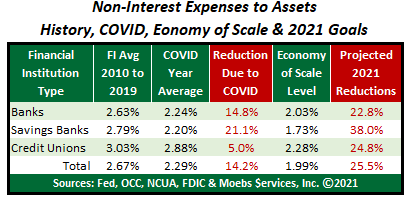
Comparing the non-interest-expenses-to-assets ratio for the 10 years prior to COVID-19 shows the 2020 ratio declined approximately 14% overall among financial institutions.
“Savings banks showed the greatest expense reduction at 21.1%,” said Moebs.
With the pandemic expected to continue into the summer of 2021, Moebs emphasized the first half of the year is ideal for FIs to reduce expenses by determining appropriate staffing levels.
Questions to Ask
“Each FI should ask this question: ‘How many staff did I really use as COVID shut down the market or markets I serve? Can I continue to serve efficiently and satisfactory at these lower levels?’”
Examining the non-interest-expenses-to-assets ratio more closely, during 2020 banks did a much better job than credit unions, cutting expenses by 14.8% while CUs reduced costs by 5%. Moebs, however, projects credit unions will take a sharper pencil to expenses in 2021 than banks and is forecasting cooperatives will reduce expenses by 24.8%, compared to banks 22.8%.
“If you were a baseball player wouldn’t you want to bat .300 or more? CUs operate less efficiently than banks—3.03% vs. 2.63%—15.2% less efficient than banks,” explained Moebs. “So, who has a better chance of winning the World Series—a team batting .300 or a team batting .260? In financial services, the non-interest-expenses-to-assets ratio is the opposite of the baseball batting average, meaning the lower the ratio the better chance of getting more consumers with lower prices, and having a better bottom line, which increases capital and allows the FI to grow faster.”
Avoiding a Merger
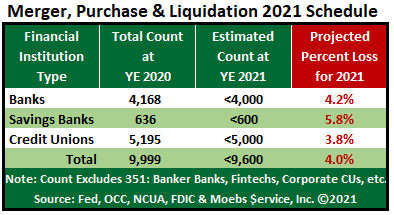
Growth cannot only drive greater economies of scale, it can also avoid the need to merge, noted Moebs. The latest Moebs study found that during 2020 banks consolidated at a faster rate than credit unions (see chart below), and forecasts the trend will continue in 2021.
“If an institution does not want to sell or be merged, then expense management and efficiency are keys to growing,” said Moebs. “Economy of scale (EOS) is a benchmark for any depository to strive to achieve. About 10% to 15% of all types of FIs have achieved their EOS. The challenge is to not only get to EOS, but to stay there. A critical element of financial services is people. Firing often is despicable. Work from home, done properly, can reduce costs for employee and employer. Not replacing unforced departures can be done. Compensating for performance is another way to increase productivity and limit expenses. Trimming expenses can be fair and professional and if done properly it can be completed by 2022.”
Another Harsh Lesson
Moebs said another “harsh” lesson the pandemic has taught financial institutions is the consumer grew intolerant of FIs using fees as penalties for services incorrectly priced.
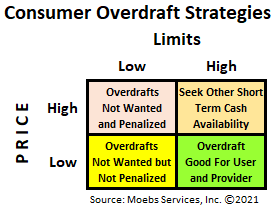
“Since overdrafts constitute the largest fee item in dollars and volume for most depositories, the chart (below) shows the key strategies a bank, savings bank or CU can use for pricing fees,” explained Moebs.
Choosing a Policy
Each strategy is relevant, Moebs said, noting each FI can choose an appropriate policy:
- High price and low limits mean the FI does not like unsecured credit and penalizes for its use
- High price and high limits mean the FI does not want the consumer to overdraw, and the consumer should seek short-term cash elsewhere
- Low price and low limits mean the FI doesn’t like overdrafts but will put up with consumer doing overdrafts to cover costs
- Low price and high limits mean the FI views overdrafts as errors, not penalties, and wants to drive payday lenders out of business