

NEW ORLEANS—Happiness and CFOs are not commonly associated with each other. But one Harvard researcher stressed that CFOs, trained to focus on risk and negative events, would benefit greatly from rewiring their brains, as would their credit unions.
But the greatest benefit, and resulting appeal to CFOs, said Shawn Achor, a Harvard professor and expert on positive psychology, is that quantifiable, bottom line effects can be driven as the result of improving employee and organizational happiness. All a credit union and its staff have to overcome is what he calls the “Tetris effect.”
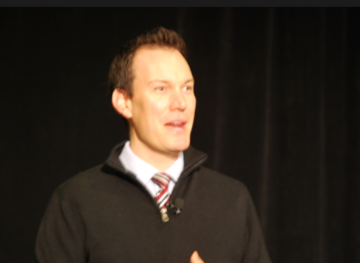
Shawn Achor speaking to CUNA CFO Council meeting.
The world is going through what Achor called “twin revolutions,” with the first being the more obvious technological revolution, but the second being what he called a “hidden, more powerful” revolution, which is the ability to see in great detail the inner workings of the brain.
“We can now peer behind the curtain to see what the brain is doing,” Achor told the CUNA CFO Council annual meeting. “The brain can process 40 bits of information per second. But it receives 11-million bits of information per second. What we attend to first becomes our reality, which means we often can’t scan the world for that which is more meaningful. What this means is scientifically, happiness is a choice for the individual. We can create the happiness advantage, our ability to use our knowledge and technical skills to their highest degree.”
Achor was quick to note that when talk turns to “happiness” it is often misunderstood, particularly as it relates to work. “People think of it as pleasure,” he said. “But the ancient Greeks defined happiness as the joy you feel moving toward your potential. We’re kind of afraid of happiness as a society. We’re afraid that if we get too happy we’re going to stop trying as hard. That’s what pleasure does. But joy does the opposite. It fuels us toward our potential.”
Achor said if any business should embrace the concept of happiness it’s credit unions, saying the research “validates” CUs. The concept, he stressed, is not “ignorance is bliss” or about avoiding the unpleasant.
The Cult of the Average
“Optimism is great, but it doesn’t stop reality from impacting our lives,” he said. “If we sugarcoat the present people stop believing in our financial solutions. Rational optimism does not start with rose-colored glasses. It starts with a realistic assessment of someone’s world. But throughout the process of working with them we maintain the belief that your behavior will ultimately matter, as long as you’re linked to the people around you. That’s what makes you effective.”
A significant challenge in achieving potential, said Achor, is what he called the “cult of the average.”
“We tailor schools to the average, our workplaces to the average. If we study what is average, we will remain average; in our schools, our companies,” Achor said. “We need to study the outliers, and you are an outlier in financial services. We could delete you, but we would miss out on very important information.”
Achor, who repeatedly noted that it is the “lens through which we view the world that impacts us,” said individuals and organizations must understand what he termed “ripple effects and mirror neurons.”
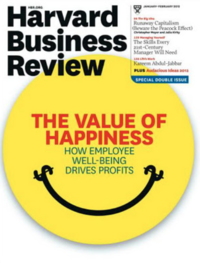
Actor's research appeared on the cover of the Harvard Business Review.
“Positive individual changes ripple through to culture change,” said Achor, saying hat stress and negativity can spread through organizations like “second-hand smoke.” But that doesn’t mean that stress must—or even can—be removed.
“The first path many people take is to eliminate those people from their lives. That’s a mistake,” said Achor. “We don’t process the world. We co-process the world. Other peoples’ views dramatically change our thought patterns, which leak out through our non-verbals, which is then picked up by other people wirelessly. We are in a continual feedback loop with every person we work with, live with, get on a plane with.”
Achor stressed that his research and work with numerous organizations has proven that happiness, which has a direct effect on the bottom line, can’t come from the top down, but must percolate from the bottom up.
As an example, Achor pointed to work he had done with Ochsner Hospital, not far from where the CFO Council annual meeting was taking place in Louisiana. The hospital was wrestling with the fact that hospitals are perceived as places of sickness and disease that no one wants to visit. To work around that, it looked outside the medical industry, in this case to the Ritz Carlton, which has a 10/5 rule in place for employees: when within 10 feet of a guest, staff have been trained to establish eye contact; within five feet, the employee always greets the guest. Ochsner Hospital deployed the strategy among half of the medical buildings it operates.
Becoming a 'Default Optimist'
“The patients were never told about it, but unconsciously they learn a new social script,” he said. “They learn that as I come into this building I’m supposed to treat people like human beings. Not only do they learn from it, they start initiating it. What I wanted to learn was how this had impacted the levels of care. The groups of buildings that had adopted this showed gains in patient recommendations and doctor engagement levels. What’s phenomenal is this is a one-second behavior change. What I’m interested in is what happens if we have more than one second.”
Achor has found the answer to that question in work he has done with other companies.
“What we wanted to know was if by changing our own brains and patterns, could we actually change the default pessimist and make them a default optimist? And that’s what we found,” he said.
Achor, whose work can be found in a documentary available on HBO on Demand called “State of Play: Happiness,” as well as on YouTube with his TED Talk, said he has heard the critics who say his theories really need to be tested in places such as Venezuelan slums and children’s cancer wards. But he said those places, where happiness would seem to be scarce, have proven the research holds true there, as well.
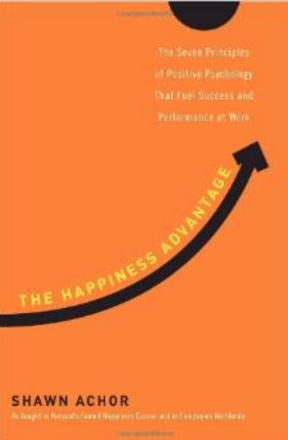
Shawn Achor's book, 'The Happiness Advantage'
“Children with cancer who are in a cancer ward are actually more likely to be the ones telling their parents everything is going to be OK,” he said.
“Short-term happiness is very easy to predict,” continued Achor. “But as we look at you and your children’s level of happiness and optimism over days, weeks and years, if I have all your external data we can only predict about 10% of the long-term variability of your happiness. How do you process your job, your family members? Change that processing and amazing things can happen.”
Just 25% of job success, said Achor, can be attributed to the combination of job skills and intelligence. The remaining 75%, he said, can be attributed to optimism that one’s behavior matters, to strong social connections, and to how stress is processed.
It's Not Just About the Genes
Another misconception that has taken root, according to Achor, is that “some people are great at dealing with stress and others not, that it’s in the genes.” But work he said he did with mega-bank UBS found the processing of stress can be altered. Breaking employees into two control groups, with one told stress is bad for you and the other that stress is can actually be a positive enhancement, Achor said it was found six weeks later that both groups continued to have the same level of stress. But with the latter group had a 23% decrease in the negative effects of stress.
“What that means is stress is inevitable, but its effect is not,” he said. “ And it’s mediated not by your genes but by your mindset.”
When any information is framed as a threat, it causes the brain to function in ways that lead to an inability to effectively deal with that threat, Achor said.
“Threats cause the front part of your brain to shut down. The brain is emotionally hijacked. For instance, when people on both sides of the political spectrum listen to talk radio, they get so angry they can no longer change the problems they are talking about.”
To change that, he said threats need to be framed as “challenges. It changes everything.”
In another test, Achor said after MetLife discovered that the top 10% of optimists among its salesman were outselling the other 90%, it took a risk and began hiring not according to how well someone did on a standardized industry test, but instead based on optimism. By year two, those new hires were outselling others by 50%.
“What the company learned was that it isn’t that sales lead to happiness, but that happiness leads to sales,” said Achor.
As a Harvard professor he had plenty of research and statistics to support his thesis, noting that when people are happy sales are 27% greater on average, people are twice as creative, 31% more productive, 40% more likely to receive a promotion, 23% less likely to report fatigue symptoms, and up to 10 times more engaged.
Improving Every Business Outcome
“Every single business outcome we know how to test for improves when the brain is positive,” he said. “The greatest competitive advantage in the modern economy is a positive and engaged brain.”
He noted that the so-called “Tiger Mom” approach of aggressive, forceful parents driving kids to success, with that success then leading to happiness, actually doesn’t work. “It’s the opposite; those are the ones that break,” said Achor.
For credit union executives that measure both professional and personal success by checking off boxes, Achor cautioned that likely isn’t contributing to their own happiness.
“I think we can follow a formula for happiness and that success then shuts it down. It’s ‘As soon as I finish this project, hit these numbers, reach this net worth, etc., I’ll be happier.’ But happiness if often on the opposite side of success. Every time your brain has a success you change the goalposts of success, often almost immediately. You must flip it around: if you can increase your optimism your likelihood of hitting those goals rises. So how to do that?”
The Tetris Effect
To answer that question, Achor cited the addictive online game Tetris.
Like Tetris, which requires the player to place different shaped objects together, “If you view the world through the same pattern for too long, you see the world through that pattern,” Achor said.
A good example, he said, was his audience of CFOs, or the auditors within credit unions.
“These people are trained to scan the world for mistakes and errors, and that’s good,” Achor said. “But they aren’t trained to compartmentalize, or to scan the world for the positive, too. That part of your brain atrophies until you use it again.”
As example he cited another test run inside a company, in this case American Express. Employees in the test were brought together and for 21 straight days made to express three things for which they were grateful, and it had to be three different things each day.
“If you have to think of three new things to be grateful for, you begin to scan the world in a new way,” he said. “It changes the Tetris effect. Not only does your brain get better at scanning the world for the things you’re grateful for, your neural processes change and the same environment begins to look differently to you.”
The very same thing can be accomplished with a young child who is genetically disposed to be pessimistic.
“Take a four-year old child and talk about three positive things every day, and their level of happiness changes above their genetic happiness level. You can create a default optimist out of them. I would have never believed a 45-second change to your day could trump your genes and your environment. We’ve been told it’s genes and environment for so long it’s created tyranny. It’s the cult of the average. But if you make changes to mindset and habits, we see dramatic changes.”
Strategies for Positive Change
To create sustainable, positive change, Achor offered these strategies:
- The Three Gratitudes (outlined above).
- The Doubler. This strategy involves writing down on a piece of paper every positive thing a person can remember from a positive memory. “We know the brain can’t distinguish between visualization and actual experiences,” he said. “These are the building blocks of how we can deviate from the genes and the environment that got us today.”
- The Fun Fifteen. This is all about exercise, even 15 minutes a day. “It creates a new Tetris effect; the brain creates a victory that cascades to the next activity,” said Acher.
- Meditation. Google has tested having its employees take your hands off their keyboard for just two minutes each day, to go from multi-tasking to only watching their breath go in and out for those two minutes. “We found that if you do this for 21 days in a row, your accuracy rates improve, as does happiness.”
- Conscious Act of Kindness. In another test, this one conducted at Facebook, a group of employees was required over a 21-day period to spend no more than two-minutes sending an email or a text praising or thanking a coworker (or someone else) for something they had done. 21 day test at Facebook. “If it’s more than two minutes, people stop doing this,” said Achor. “But if you do this, your brain will literally become addicted to it. You will consider yourself amazing. You will get amazing emails back. Twenty-one days later, the breadth, depth and meaning of your social relationships will be off the scale.”
It is that latter issue, social connections, said Acher that is the greatest indicator and predictor of long-time happiness by far.
The three conclusions of all the research, said Acher: Happiness is a choice; Happiness spreads; Happiness is an advantage.
For more information: HappinessAdvantage.com