

KEY WEST, Fla.–CEOs gathered here were given warnings and some reassurances over a wave of litigation risks credit unions are facing, but cautioned the biggest threats are coming not from C-suite decisions, but instead from all the letters being sent out and phone calls answered each week by employees
But the risks don’t end there. Three attorneys with extensive experience in credit unions told NAFCU’s CEOs and Senior Executives Conference they also expect a new wave of ADA/website-related litigation against credit unions in 2020 as new plaintiffs with standing are identified.
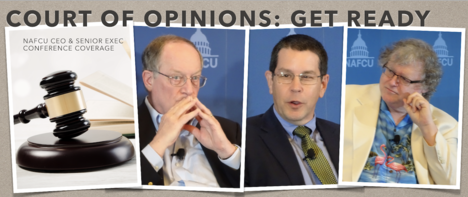
During a session on the real costs from rising class actions against CUs, those legal issues and a host of others were discussed during a Q&A moderated by NAFCU’s EVP/general counsel, Carrie Hunt. The attorneys participating included Bruce Jolly, a partner with Reed and Jolly; John DeLoach, president of WilliamsGautier Law, and John Bredehoft, an attorney with Kaufman and Canoles, P.C.
Here’s a look at the insights shared in both opening remarks, and in response to questions from both Hunt and the audience:
DeLoach: I started 27 years ago, and at that time we were generally not on the class action lawyers’ radar. If I heard at once, I’ve heard it 50 times–that’s what CUMIS bond coverage is for. And in those days that wasn’t a bad answer. At this point the dollars involved with these and the co-pay–and if you haven’t read your bond lately there’s a co-pay, and I think it was a reasonable decision–we have some real exposure. With the recession we had a change in the world with white shoe lawyers. Do you know what a white shoe lawyer is? It’s a lawyer who looks like Matlock but has the soul of Hannibal Lector. They have found some magical words in our regulations: ‘attorney’s fees and costs.’ All they have to do is to prevail. There are so many (potential risks). Overdraft continues to be a big one. ADA. Have you read your indirect lending agreements to see what that skip payment fee is? I’ll bet you dollars to donuts you use that same fee for every skip payment you have.
It’s risk management at this point. They are going to take the easy ones, the low-hanging fruit. They don’t want to be litigating, they want to settle and they want your checks.
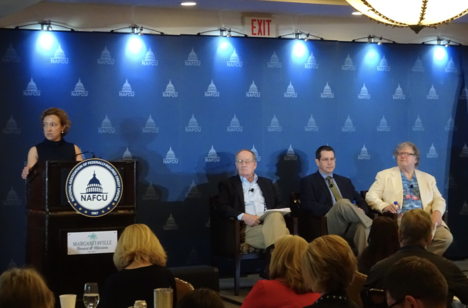
Carrie Hunt, left, leads panel discussion.
Bredehoft: There’s an Internet Magazine called LawyerandSettlements.com. This is where the lawyers commune. For the recent Navy FCU (overdraft) settlement, the item was headlined, “$6.1 Million Fee Received.” Lawyers are incredibly expensive and I have to echo what John said about this fee-shifting provision. There are regulatory provisions. If you have a technical defect in membership agreement or a typo or some very minor technical things that haven’t hurt anyone, there is probably a state statute that has $100 minimum fine, plus treble damages plus attorney’s fees. So it can end up costing you $10 million or $15 million. When the other side sues you under a statute, you have to pay their fees. (Bredehoft shared that in one case that involved flying one firm’s expensive lawyer to Washington, D.C., and housing him in the Mandarin Oriental Hotel for four weeks.)
We are still seeing class actions around technical mistakes in letters. (He said some suits have been filed against CUs that lend across several states because documents that are compliant in one state actually become an unfair trade practice in another.)
Hunt: Should a credit union have in-house counsel? Is there an asset size level?
Bredehoft: I don’t think everyone needs an in-house counsel. I’ve worked with a lot of small and midsize CUs, out of preference, say $500 million. You don’t need to be carrying a lawyer on your staff.
Jolly: When my bills become a certain level, it’s embarrassing, I recommend you go-in-house, because you can afford it and need it and you’re going to get better service with someone down the hall.
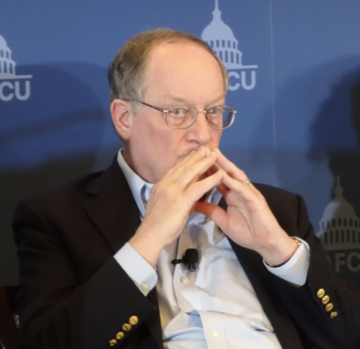
Bruce Jolly at NAFCU meeting in Key West.
DeLoach: We work regularly with in-house counsel, and when they have an open door, you fill their days and they need the help and outside expertise. But it really depends on what you’re doing and how complex your shop is. If you’re doing indirect lending participations, then yes. Probably that magic number is between $1 billion and $2 billion in assets.
Hunt: Not all litigation is class action, but could you talk about the mechanics of class action?
Jolly:There are six basic steps to a class action:
- Plaintiff’s attorney has to be able to describe adequately the class.
- Is the class ascertainable? Can you figure out who they are? Credit unions keep really good financial records, so it makes them easy.
- Numerosity. Are lots of people available?
- Is there a common issue of law and fact? Commonality is the key.
- Are the defense’s claims and assertations likely to be typical?
- Is there adequacy of remedy? Can the defendant pay?
“Once through all the defenses, a judge either strikes or accepts for class certification. Once the class is certified, there is only one thing most attorneys are looking for: How much do I get? They are going to blow it up to the largest amount of recovery they can get for the particular sin you have committed, and they are going to scale (their fee) down to at least a third. But I have seen higher.
Hunt: In the ADA cases, can we get an update on progress of these suits? Can you also offer comment on Domino’s case?
Bredehoft: (ADA cases) were last year’s issue and I’m afraid they are going to be next year’s issue, as well. Virtually all the cases filed by non-members have been mostly been dismissed on the basis of standing. And earlier this year the Fourth Circuit said you have to be a member. Does anyone here have members? Perhaps any of those members are visually impaired? If they sue, they have standing, and the next wave will be members suing. I’m worried that’s what we’re going to see, and we’re going to have to confront the actual issue of whether the websites have to be available to the visually impaired.
In the Domino’s case, a visually impaired person in California couldn’t get the customized pizza he wanted and (the site) didn’t read it to him. The Ninth Circuit said websites are covered, as websites are services of places of public accommodation, and there are exclusive deals you can only get on the website. The one thing that is a theme is, are there things on the website that you can’t get in person? Does it mean you should do websites accessible in braille? No. But it does mean you should have things like a little legend if you need help reading the website or accommodating this website, and a number to call for help.

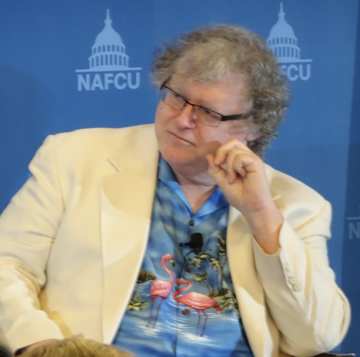
John DeLoach at NAFCU conference in Key West.
DeLoach: In Florida, we have a particularly favorable FOM law. With state charters having a lot of possibilities for membership, we have folded (and settled cases). Do we want to be in this for five or seven years? We explain to clients who ask, ‘What about these wins here (in other ADA cases?), and we said, ‘What about your field of membership? Can anyone in this alumni association join for $5?’ So this not a place to spend time and money. I agree we probably do have a round two scheduled.
Hunt: What about lawsuits related to overdrafts?
DeLoach:They continue to have legs. The original cases came out of California and they tied a Reg E component into it due to attorney’s fees and costs. For those of you who haven’t read your agreements, it defines overdraft as meaning not having enough money in your account. Is that true? No. It means not having sufficient funds in your account. It creates some confusion for Joe Lunchbucket. You have a contract claim here that has some legs. Any language provided by vendors is probably very generic. So, what can you do? It’s like locking your car–it’s not so someone can’t steal your car, it just makes you less attractive. And that’s how I see this, as risk management. You can put some custom, big bold language in your contract that it’s available balance. In your follow-up letter to members who signed up for overdraft, which isn’t controlled by Reg E, you want to put language there. Make sure your documents reflect what you actually do and when in doubt, over-disclose.
Hunt: What about including arbitration clauses in contracts with members?
Bredehoft: Arbitration is in everyone’s master service agreements. They can be wonderful and they can be horrible. The Supreme Court had been edging toward a decision they made last week in a terribly reasoned decision that nonetheless helps us very much. The Supreme Court said if you have an arbitration agreement and it doesn’t say you can have a class action, then you can’t have a class action. The question that remains is, do you want to do that? Probably, yes. The reason is in most of these class actions, the claims in the case of an individual’s damage isn’t going to be taken by any attorney. So, it can reduce the attractiveness of your credit union as a potential class action plaintiff. It is a deterrent, it increases expense on the other side, and they are perfectly valid.
Hunt: What about potential big data class actions?
Jolly: You as CEOs will hear you need to use big data and need to be aggressive in using it. But there are risks, with fairly simple options for protecting yourself. Technically, big data is taking the personal characteristics of an individual, making it anonymous, and using it. Here’s the risk: the FTC asked, ‘Is big data used as an inclusion or exclusion tool?’ It constitutes the creation of a credit report, and now you have an area of potential concern. The FTC said it sees two risks in evolving use of big data: The first is related to the Fair Credit Reporting Act. As a practical matter, what does a CEO do when confronted with people saying we have to use big data? The CEO needs to ask, ‘What are our policies on the use of big data?’ Have a code of ethics in using big data to protect an individual’s privacy.
The second FTC risk is to make sure the vendor providing that data is warranting it’s not subject to numerous laws, and it will hold harmless and defend you if a claim is brought on the use of big data we provide.
John Bredehoft at NAFCU conference in Key West.
Hunt: How can credit unions insulate themselves from big data risks?
DeLoach: The biggest issue we have isn’t credit unions being unaware, it’s implementation. There is one credit union that is a three-peater (facing the same lawsuit over the same disclosure issues three times). Apparently, they haven’t heard of a lockable PDF. I’ve talked to an attorney who is incredulous credit unions continue to do this. In one case, a CU had the right documents, but the marketing department decided to do a short-form application (that didn’t include necessary language).
Bredehoft: The Uniform Commercial Code is not. It is different in virtually every state, some are obvious, some are subtle. I had one case that involved a misplaced comma.
Hunt: What is your best advice for moving forward?
Jolly: When you have class action lawyers defending you, make sure they know what a credit union is. A lot of times issues will be misrepresented to the court by counsel who may be great class action lawyers, but they don’t know squat about credit unions.
DeLoach: Lock your car–you just need to be less attractive than the next guy and, hopefully, the next guy isn’t a credit union.
Bredehoft: Read your policies and read your forms. Make sure your employees have read your policies and forms. I’ve had clients who have magnificent policies and forms but no one knows what they say. Especially in this class action space, it’s not what the CEOs are doing that is getting us in trouble, it’s what the people churning out 200 letters a week are doing that is getting you in trouble. Prevention is where you want to go. Forget about the money you are going to pay us. The amount of time it’s going to take inside your credit union is the real cost of these things. And you’re going to eventually settle it. So, spend the money for prevention.