

By Ray Birch
WINSTON-SALEM, N.C.—The CEO of the credit union at the heart of the battle for the Credit Union Membership Access Act says he won’t forget the character, fortitude and teamwork that led CUs to victory 20 years ago.
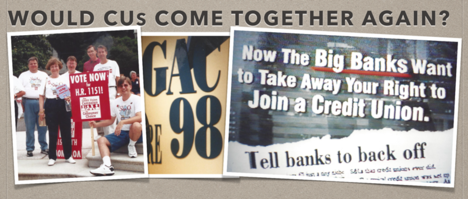
But he also questions whether the movement would show the same kind of strength and partnership today.
“It was a very empowering time and very fulfilling time in the sense that we literally saved the credit union system, and look where it is today,” said Marc Schaefer, who heads the $2.2-billion Truliant FCU. “It was heady stuff for everyone involved at the time. But you have to ask yourself: are we up for that same challenge today if a similar threat presented it itself.”
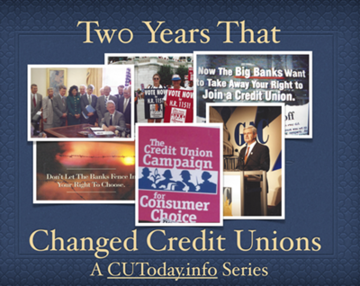
Schaefer’s comments are being featured in CUToday.info as part of a series looking back on the 20th anniversary of 1997 and 1998, the two years that changed credit unions as they fought for passage of the Credit Union Membership Access Act, better known as HR 1151.
Schaefer joined Truliant in 1995, when it was known as AT&T Family Federal Credit Union.
Five years earlier, First National Bank & Trust in North Carolina had filed a lawsuit against AT&T Family, alleging it had violated the Federal Credit Union Act by expanding to serve non-AT&T-related businesses. Eventually, the state bankers association, several other banks and the American Bankers Association signed on as plaintiffs, and NCUA replaced the credit union as the defendant.
Winding Through Courts
The case worked its way through the courts for nearly a decade before the Supreme Court stunned credit unions by announcing on Feb. 25, 1998 that it had ruled 5-4 against NCUA–and credit unions–on the issue of field of membership.
The Supreme Court majority opinion, written by Justice Clarence Thomas, found that in 1982 the NCUA had illegally reinterpreted Section 109 of the Federal Credit Union Act and that credit unions were in fact limited to a single common bond. Thomas had been joined in his opinion by Chief Justice William Rehnquist and justices Anthony Kennedy, Ruth Bader Ginsberg, and Antonin Scalia.
“It was disappointing obviously,” said Schaefer. “We had come down a good long road since the lawsuit was filed by bankers.”
What Schaefer says still stands out most among his memories of the fight for HR 1151 is how the movement—both big CUs and small, as well as competing trade associations—set aside differences and worked together toward a common goal. He acknowledged, however, that the fight against the bankers did not begin with a united front.
“When I arrived at AT&T Family in January of 1995, it seemed like this case was just bumping its way through the courts,” recalled Schaefer. “However, in July of 1996, the bankers got standing in the U.S. District Court of Appeals in D.C.”
Schaefer said that’s when the issue suddenly became more serious to credit unions.

Marc Schaefer
“That is when I believe all of us within the movement said, ‘OK, this is going to be a problem.’ Shortly afterward, NCUA Chief Counsel Bob Fenner called me and said we can’t bring in any more employer groups. That is the point everyone manned their battle stations.”
Don't Go After Bankers 'Head On'
Schaefer said he soon flew to Washington, where he knew several banking lawyers and large PR firms. He said he spoke with legal counselors and public relations firm Hill & Knowlton, which would eventually be retained by credit unions’ in the fight.
“They all advised me that it would not be wise for credit unions to go after the bankers head on,” said Schaefer. “They have more money, more lawyers and more lobbyists, I was reminded.”
He was also advised not to make the fight an attack against the bankers, a misstep he said both NAFCU and CUNA made at the outset.
Schafer, then a member of the NAFCU board and executive committee, advised both trade associations that a central group needed to be formed to defend against the banker attack in the courts, legislatures and Congress. He said it was not difficult for all credit unions to see that if NCUA was prohibiting AT&T Family from adding any more SEGs, that same prohibition would soon extend to all credit unions, including state charters.
“We then started to get a greater sense of urgency from many other credit unions to rally around this issue,” he said.
It was “disappointing,” said Schaefer, to see both CUNA and NAFCU at the outset take approaches with their individual efforts to fight the bankers that ran counter to the advice he had been given.
“NAFCU, if I recall correctly, started a campaign called ‘Beat Back the Bankers.’ CUNA’s effort, I believe, was called ‘Operation Secure’,” said Schaefer. “Both of these campaigns were taking the bankers head on, as opposed to making the argument about consumer choice.”
Trades Needed Prodding
The differences between the two groups and the new strategy were finally settled when CUNA and NAFCU–with their backs to the wall–eventually combined their efforts under the umbrella of the Credit Union Campaign for Consumer Choice, Schaefer noted.
But it took some prodding to get them there, recalled the CEO.
“The National Credit Union Roundtable at the time was fairly independent of both trade associations and we met in Chicago at the Marriott hotel at the airport,” said Schaefer. “We asked the two trade association leaders to join us—Dan Mica, who had just started at CUNA, and Ken Robinson from NAFCU. We basically sat them down and said you guys need to stop fighting against each other and we need a common campaign.”
Schaefer said that the two trades quickly agreed to form a common campaign and CUNA Mutual Group contributed the first million dollars.
“So we began to form a campaign. CUNA Mutual offered up Larry Blanchard to head it, and Hill & Knowlton took the lead from an agency perspective. Long story short, we slogged our way through to 1998 when Supreme Court ruled against us in February, but by August we were able to convince Congress to pass HR 1151.”
Schaefer said that he and many others fighting for HR 1151 had been feeling pretty positive in the lead up to the negative Supreme Court ruling, because most members of Congress “lined up behind us and said that if the Supreme Court votes against us that they would support HR 1151—Republicans and Democrats alike.”
One Big Group
What Schaefer remembers most fondly about the effort to get HR 1151 passed–as have several others in CUToday.info’s series–is how the effort brought together the entire industry to work as one big group.
“It was a true coming together of the credit union movement, and the operation of the democratic system to ensure consumers had the choice to join a credit union,” he observed. “It was a seminal moment for credit unions—I am certain we would not have had the growth we have today had this legislation not been passed.
“It was a remarkable time,” continued Schaefer. “I was honored that our credit union was in the midst of it. We filed amicus briefs and kept ourselves in it, even though we did not have to. But it was a very important time and very important turn of events for American consumers.”
In reflecting on that success, and looking at the credit union community today, Schaefer said he has a big question regarding the movement’s future.
“Today I ask myself, if credit unions faced a similar challenge that threated the movement, would this same thing happen again? Would we all come together under one united front?” Schaefer asked. “I am not terribly happy with some of the things that have happened recently. And I am not bashing anyone. I have a huge amount of admiration for the leaders of both credit union trade associations. However, I do wonder that if the issues surrounding HR 1151 had happened today, would the large credit unions and the trade associations have the will and the fortitude to do the same thing?”
Schaefer said if he had to make a prediction, he believes ultimately credit unions would again pull together.
“We just need to make sure the trade associations are honest with each other as well as CEOs of credit unions, so we can fight the fights that are sure to come,” concluded Schaefer. “The banking industry is not sitting back, and now they have proceeds from their tax windfall that they can use.”