

By Ray Birch
ALEXANDRIA, Va.—The NCUSIF rebate will lead to more loans at many CUs, while others acknowledge they have been in “robust discussions” over how to best use the funds, credit union CEOs are telling CUToday.info.
And several credit union CEOs believe NCUA should be returning more money and CUs should not settle for anything less.
In the second of a two-part series, some of those same CEOs also state that they are not pleased with NCUA or the rebate amount—in all, NCUA has returned approximately $836 million to credit unions.
Both Michael Poulus, CEO at $919-million Michigan First CU in Lathrup Village, Mich., and Karen Church, CEO at $604-million Elga CU in Burton, Mich., said their credit unions expect the NCUSIF funds to go right back out the door.
“Loan demand is heavy, and what we get from NCUA we will loan it right out,” said Poulos.
At $583-million NorthCountry CU in South Burlington, Vt., CEO Bob Morgan said the rebate could end up in members’ pockets at the close of the year.
“NorthCountry received just over $317,000 from the NCUA rebate,” said Morgan. “Our board has had robust discussions over what we will do with the dividend. Options that are currently being discussed, include returning all of it to the members through a patronage dividend to investing it in the reconstruction of one of our busiest branches. Now that we have received the dividend, the board discussions will move from being hypothetical to actionable.”
Building Relationships
In Rutland, Vt., the $41-million Credit Union of Vermont does not intend to make a one-time payment to members from the extra money. Instead, it will use the funds over time to build deeper relationships.
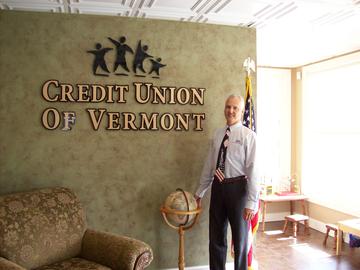
Brian Fogg
“We received $25,282.40 from the NCUSIF payment,” said CEO Brian Fogg. “We have considered a number of ways to benefit our members including a direct payout/bonus dividend. However, that would have been a very small amount on an individual basis.”
Therefore, in an effort to “equitably benefit members” with different types of relationships and using the credit union in different ways, CU Of Vermont has decided to:
- Waive the semi-annual rate increase on its home equity loan portfolio for six months
- Increase the number of free PIN-based debit card transactions
- Increase term certificate rates and accelerate planned future rate increases
“The NCUSIF payment is a return of just a small portion of the capital we lost in our corporate credit union and the payments we made into the NCUSIF,” added Fogg. “While we are well capitalized and in excellent overall financial condition, we remain conscious of the important role a strong capital position plays on a credit union's ability to consistently benefit its members over the long run.”
Not Happy With NCUA
Bill Burke, CEO of $386-million Day Air CU in Kettering, Ohio, is well aware of what has been given to NCUA versus what has been returned.
“The rebate really doesn’t mean all that much to Day Air Credit Union,” he said. “The rebate of $200,000 is a small portion of the $4.5 million to $5 million we’ll post as net earnings this year,” he said. “All funds are fungible, so once received they get intermingled with all other revenues. We’re doing the same with the NCUSIF rebate as we do with all other revenue: looking to become more relevant in the lives of our members.”
But Burke raised a question he believes is on the minds of many credit union leaders.
“How do credit unions feel about receiving a quarter to a third of the funds due them this year versus waiting several years for a complete rebate of the unused stabilization assessments,” he said. “I’m not happy about it.”
Out west, Ronald Westad, CEO at the $1.5-billion Arizona FCU in Phoenix, is also not happy with NCUA.
“The agency took $9.48 million of our members’ assets to fund the TCCUSF and returned 11%, or $1.02 million,” he said. “We will return the funds to the rightful owners, our members, in the form of loan interest refunds and bonus dividends at the end of this year. In keeping with our commitment to return surplus capital to our members—we have returned over $30 million in the last six years and expect to return over $6 million this year. The travesty is the amount returned by NCUA doesn’t even equal the amount of interest we could have earned on the funds.”
Not So Simple
Bobby Michael, CEO at the $1.2-billion Army Aviation Center FCU in Daleville, Ala., said the answer for his CU has always been simple and clear.
“We are at about 13% capital, so the funds we are getting are not that vital to us and therefore we are just really going to bank it in capital,” Michael said. “We aren’t in a liquidity crunch, so the cash is not needed and we’ll probably just park the money with the Feds until needed in the future.”
Eddie Black, CEO of the $31-million Vocal CU in Helena, Mont., had a similar response, saying there is “no sexy way to use the money this time. It will be used to build net worth and fund the allowance for loan losses.”
Nothing Special
The $220-million Pioneer West Virginia FCU in Charleston, W.Va., said it is not doing anything out of the ordinary with the money.
“I can’t say the rebate is prompting us to do anything special or out of the ordinary at all,” said CEO Dan McGowan. “If anything, it gives us some room to strengthen the balance sheet in terms of the allowance for loan losses, employee benefit programs, and such, without depressing earnings from normal operations. And, too, with our loan-to-share ratio still above 100%, it’s always nice to get some cash in to lend right back out again without having to borrow increasingly expensive supplemental funds.”
Finally, Jeanne Kucey, CEO at $197-million JetStream FCU in Miami Lakes, Fla. and chairman of NAFCU, said its decisions on using the funds have been well planned.
“We knew exactly how much we would get back last year and included that amount in our overall 2018 operating budget,” Kucey said.