ORLANDO–What can credit unions learn from a chicken sandwich chain? An awful lot, according to one person, who made clear the chicken place and the credit union mission have much in common, beginning with the fact it isn’t about the chicken at the former or the money at the latter.
David Salyers, who spent his entire career (he didn’t expect to) with Chick-fil-A and who retired as VP-marketing, told the League of Southeastern Credit Unions’ Convention & Exposition the restaurants chain has almost nothing to do with chicken sandwiches, that there is another 80/20 principle, and that there are some big differences between “normal” and “remarkable: businesses.
Salyers said what he discovered at Chick-fil-A changed his life direction, and said the philosophy and approach underpinning the operations of the popular fast-food chain can change the direction of any business (or credit union).

A Life Goal Changed
In college, Salyers recalled, his singular goal was to find a career where he could make enough money to retire at 35. “I’m so glad that didn’t happen,” he said.
Instead, Salyers met S. Truett Cathy while in college. Cathy founded Chick-Fil-A in 1946 in Atlanta. He died in 2014.
“I found something a thousand times better than early retirement,” said Salyers. “It was something as a 21-year-old I could not have imagined existed. I would not have believed it had I not see it play out in front of my own eyes in the life of Truett Cathy. Instead of finding a job I could retire from early, I found a job I didn’t want to retire from. I didn’t realize that work in and of itself could be so satisfying and rewarding and enriching.”
Not that his career with the company began auspiciously. The company’s offices were so small that to expand a mobile home was brought in. That’s where Salyers would begin to work.
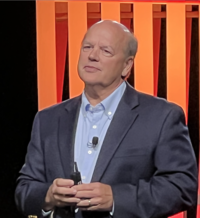
David Salyers speakiing to LSCU meeting in Orlando.
“Truett had a very different view of business than I did when I was 21,” Salyers said. “Truett used to say, ‘If you love what you do you’ll never work another day in your life.’ I feel like I never worked a day in my life for 37 years. I remember going into Truett’s office when he was in his 80s and I asked, ‘Why are you still here?’ He said, ‘Why would I stop doing something I love this much.’”
The Other 80/20 Principle
Credit union leaders are all too familiar with the 80/20 rule, that 20% of members generate 80% of revenue. But that rule isn’t limited to financial institutions, as Salyers made clear. Across the broader business spectrum, it generally means 20% of the input creates 80% of the output, he said.
“At Chick-fil-A, 20% of our products generate 80% of the revenue,” he said of the company that has never had a year in which sales didn’t exceed those of the prior year. “Eighty percent of what Chick-fil-A does is exactly the same as what our competitors do. I might suggest in the credit union world it’s closer to 90%. It’s very much a commodity-based business. Eighty percent will make you competitive. But I wasn’t hired to be competitive. I was hired to create competitive advantages, and the 20% is where those competitive advantages are found. You have to be clear on what that 20% is. Is it compelling? Do you have a clear picture of what your 20% is. That 20% delivers almost 100% of the difference in results.”
Chick-fil-A’s 20% & Perspective
Salyers said he believes one of the most underleveraged business and leadership principles is “perspective.”
“Leaders are in the business of shaping people’s perspectives,” he shared with the meeting. “How we view things will drive how we do things. The way we see things will have a tremendous effect on how we respond.”
During his career Salyers said he would frequently ask the company’s restaurant operators what business they believed they were in. Of the 1,700 or so operators to whom he posed that question, none ever responded by saying “fast food business” or “chicken sandwich business,” he related.
Instead, he said his favorite answer came from a restaurant operator in Virginia who responded, “I feel like I am a leadership development academy masquerading as a fast food restaurant.”
The Philosophy
“Selling chicken sandwiches was the funding mechanism for his real business of molding and shaping the next generation of leaders in his community,” Salyers said.
It’s a philosophy he believes makes for the difference in how Chick-fil-A views its employees vs. the attitudes of other fast food chains toward their workers.
That philosophy he said, is what makes for the difference in employees and their attitudes versus employees at other fast food chains.
“Perspective is the only thing in the world that can radically transform the results you get without altering a single element of your environment,” said Salyers. “What this basically says is when you walk out of this room nothing has to change but your perspective, and then everything can change for you.”
Results Most Fowl
The average fast food restaurant generates approximately $800,000 annually each year, according to Salyers. The average McDonalds store--considered the “gold standard,” he said—does about $2.8 million annually. And what does a Chick-fil-A restaurant generate each year—Salyers reminded it is closed 52 Sundays each year-? Approximately $2.8 million.
Salyers said it those results can be summed up in a quote from Albert Einstein: “Not everything that can be counted counts and not everything that counts can be counted.”
“Transformational growth in any person or organization begins with a transformational perspective of it,” said Salyers.
As an example, Salyers said the perspective of Chick-fil-A that has transformed its business is the mission to “be remarkable!”
“It’s not about saying look at how remarkable we are. In fact, it’s the exact opposite,” Salyers explained. “What we meant was we want to ‘mark’ the lives of the people we serve. We wanted on a daily basis to do things that customers would remark about in a positive way. Word of mouth has always been the most important form of advertising, and it’s exponentially true now with social media. So, we wanted to transform that business into something people would remark about.”
Normal Vs. Remarkable Businesses
In an observation that should resonate with credit unions, Salyers outlined how “normal” businesses compare to “remarkable” businesses.
The “normal” perspective of any business or business owner is the business exists to help them get rich.
“It’s a self-enrichment scheme to get rich at the expense of employees, suppliers, customers, and the community I serve,” Salyers said. “Let me contrast that with the remarkable view of businesses that seek to be rich toward my employees, my customers, my suppliers and the community I serve. When you view it that way the financial aspect takes care of itself.”
Below, Salyers contrasted the perspectives of “normal” businesses with that of “remarkable” businesses.
Normal business: Extract value.
Remarkable business: Create value
Normal business: Create a sale
Remarkable business: Create a fan, “If you create enough fans, sales will never be a problem.”
Normal business: People are here to grow the business
Remarkable business: The business is here to grow the people. “People have to have the opportunity to grow for the business to grow,” said Salyers.
Normal Business: We have to do this.
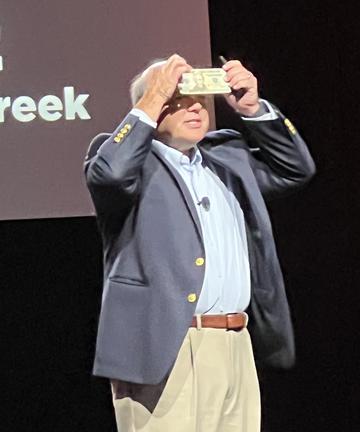
David Salyers, making point most businesses treat customers as ATMs.
Remarkable Business: “Can you believe we get to do this!”
Normal Business: Want to be the best company in the world
Remarkable Business: Want to be the best company for the world.
Normal Business: About P&L and making a dollar. Customers are treated as human ATMs meant to spit money over the counter.
Remarkable Business: Seek to be a platform to make a difference. How does a business communicate that at scale to 200,000 employees. Salyers showed a training video themed “every person has a story.” The video showed customers in a Chick-fil-A restaurant with on-screen graphics showing how person each is different and what their real stories are.
“Isn’t it true every life has a story? Isn’t it true every life is a story? What if we used that to make it our goal to improve the story of every person we do business with?”
‘Warm and Fuzzy,’ But…
Salyers admitted all of that may sound warm and fuzzy, but it has real-world value, he said, citing as an example what one operator did.
Normal Business: Sell 99-cent kids’ meal.
Remarkable Business. With other chains selling 99-cent kids meals to get parents in the door, Salyers said he was part of a discussion where Chick-fil-A asked itself whether a 99-cent kids’ meal was the best idea it had.
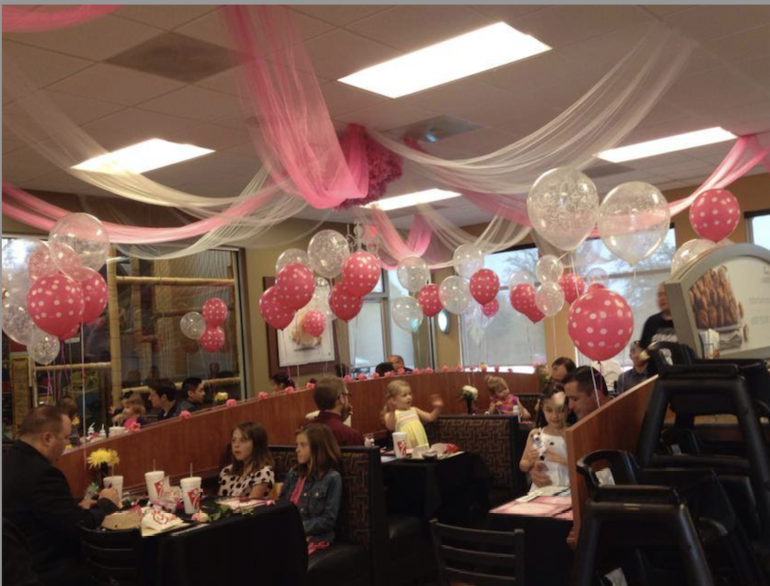
To that end, he shared the experience of one restaurant operator in Kansas who had three young daughters and who created a daddy/daughter night at his store that turned into an overwhelming success. So much so, that as word spread people actually called the store operator and “volunteered” to help.
“This wasn’t a non-profit organization,” Salyers reminded. “Most for-profits aren’t doing anything worth volunteering for.”
A photographer offered to shoot pictures. A car wash owner wanted to wash cars.
There was so much excitement for the event that reservations had to be made, with more than 700 daddies/daughters reserving a table. There was valet parking, a red carpet, carnations for the daughters and a hostess stand.
“This guy wasn’t thinking about selling kids meals, he was thinking about making a difference in daughters’ stories,” Salyers said.
That included placemats that had “thoughtful questions” for dads to ask daughters and for daughters to ask dads, with room for both to record the answers.
The Real Joy
“Instead of thanking somebody a buck or two on a kids meal, they created priceless moments,” Salyers said. “It became a chainwide phenomenon. Part of problem in the business world is we define it so much as ROI, when the real joy is found in giving, in investing.”
Below, a daddy/daughter day at Chick-fil-A.