MADISON, Wis.–It is de rigueur in nearly every CEO retirement announcement published by CUToday.info: Among the retiring CEO’s plans is to travel more.
Packing a suitcase is not on the to-do list for the retiring Dr. Brian Branch, who has visited 104 countries and has spent the better part of half his time during the past decade on the road as part of work that has taken him to some of the world’s most desirable places—and its most dangerous.
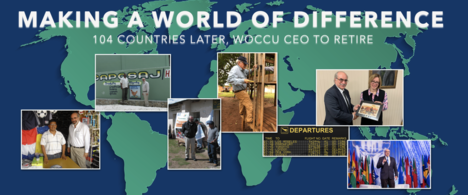
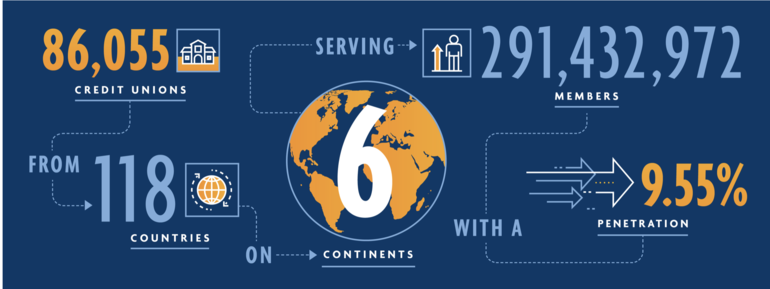
Branch has announced plans to step down as CEO of the World Council of Credit Unions effective in July. He has been with WOCCU for 31 years, and since 2011 has led the organization that represents more than 86,000 credit unions serving more than 290 million people in 118 countries across six continents.
Branch said that in late 2019 the plan had been to retire near the end of 2020 or in early 2021. There were “no negative reasons” for wanting to exit the organization that has been his life’s work, he said, but instead “family commitments” to which he must respond.
“You can’t be on the other side of the world and suddenly need to travel back home,” he explained.
Not that during the past 10 months there has been as much time away from home as there has been for most of his career, when he would be away from Madison, Wis., for up to 170 days a year.
“COVID hit and the world changed drastically,” said Branch. “A number of changes had to be put in place.”
Those changes have included the same adaptions to a virtual environment as natural-person credit unions have had to make, with one big exception: the other participants in those virtual meetings often aren’t in the same time zone—or even on the same continent.
Branch said he and others with World Council can participate in three to four virtual meetings daily, which adds to the demands of the job.
“We have conference calls and Zoom calls at 10 at night and three in the morning. It’s just part of the job and something everyone is dealing with,” said Branch, adding those on the other end of those calls must often deal with the nontraditional hours themselves.
The Maine Thing
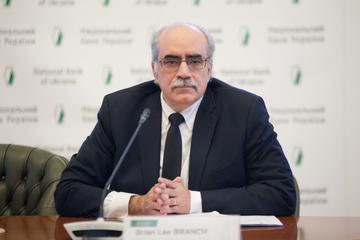
Dr. Brian Branch
Branch is a native of Maine where a French influence remains strong and many take French while in high school.
“But I’m a bit of a contrarian and I wanted to be different, so I took Spanish,” said Branch, who would go on to live in Mexico and Latin America while young and become fluent in the language.
While doing work on his doctoral dissertation at the University of Wisconsin-Madison, Branch got a part-time job doing financial analysis for CUNA, which was headquartered in the city at the time. Branch recalled he was working under then CUNA economist Bill Hampel “and I kept sticking my nose into things that were part of the World Council.” That led to an internal transfer to WOCCU, which began its life in the 1950’s as CUNA’s World Extension Department before being officially incorporated in late 1970 as the World Council of Credit Unions.
“I was doing my dissertation on microenterprises in Latin America and in my research l kept encountering these references to savings and credit cooperatives, and I came to realize these were the same credit unions that my dad had spoken of so fondly when I was growing up,” said Branch, recalling how his father spoke of only being able to get a loan from a credit union. “I was working in CUNA’s Economics and Statistics department and it was a great opportunity. I got in and I never got out.”
In 1990, Branch received his Ph.D. in economics from UW-Madison. Earlier, in 1981, he received a Master of Arts in Latin American studies at the University of Texas-Austin, and prior to that a Bachelor of Arts in government and Spanish, graduating magna cum laude from Bowdoin College, Maine, in 1979.
As the World Turns
Branch would go on to spend the next three decades never getting out and watching as the World Council grew and evolved.
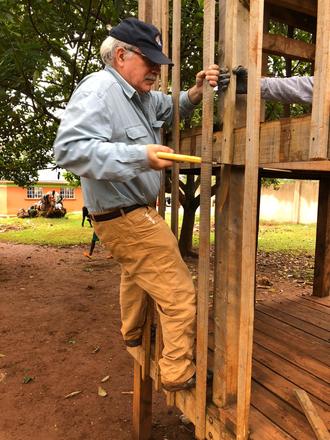
Brian Branch assists with community project.
“The World Council has changed about every five years since I’ve been here,” he said. “When I started it was really about organizing people in the field and self-help. And then it became about having a financial management focus. Then it was about the networking of credit unions together, rather than strengthening individual credit unions. Then it became about pulling people together who had the kinds of deep pockets needed (to support various efforts).
“Since I took the seat it’s been about credit unions increasingly facing regulatory burdens from international organizations,” Branch explained.
As CUToday.info often reports, World Council frequently meets with and comments on proposals from organizations such as the Basel Committee on Banking Supervision, the Financial Action Task Force, the Financial Stability Board, the International Accounting Standards Board, the European Union and other standards-setting organizations and entities.
Branch said the objective is to meet with those organizations ahead of any rulemaking or new regulations in order to ensure the credit union viewpoint is heard.
In addition to those demands, the most recent challenges for WOCCU have been to work with credit unions in upgrading technology and serving members digitally, especially during the worldwide pandemic, said Branch. That’s been critical to being able to attract younger members and respond to different trends, he added.
Change in Funding
Branch said another significant change since he became CEO has been in how its various projects are funded. In the past many of WOCCU’s projects were funded with assistance from the U.S. Agency for International Development (US AID), but that funding has shrunk and it has instead turned to the Gates Foundation, the World Bank and other like organizations for assistance.
“We’re seeing less support from US AID for grassroots credit union development,” said Branch, saying WOCCU now spends more time working to help shape policy and the debate at US AID. Nevertheless, US AID remains important to the World Council. Of its $15.85 million in revenue reported for 2019, for example, WOCCU said grants from USAID were its "most significant" source of revenue. In 2019, grants represented 54% of WOCCU income.
Many in the U.S. credit union community are unaware of the breadth of the various World Council projects for which it has sought that funding. In recent years, a partial list of its projects have included or continue to include:
- A model credit union building project in Liberia that at one point had to be suspended due to a breakout of the Ebola virus. The goal was to help bank 40,000 Liberians previously without access to financial services.
- A four-year Credit for Agriculture Producers Project in Ukraine.
- A Financial Inclusion Project at the Border with Venezuela that surpassed its original goal of delivering financial services to 210,000 rural, low-income Colombians. The border zone has seen economic, social and political unrest as a result of conditions in Venezuela, with many Venezuelans having fled the country.
- A home ownership and mortgage program in Haiti.
- An expansion of agricultural finance in Colombia to micro and small- and medium-sized enterprises in rural and remote areas through the Colombia Banca de las Oportunidades Project, which supported financial literacy and improved savings mobilization.
- Projects to improve small rural producers’ income in Kenya and Guatemala though integrated access to financial services and agricultural markets.
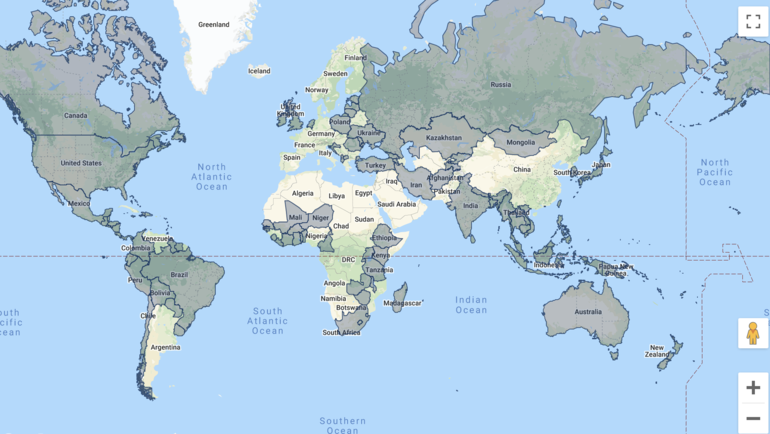
Countries in gray are those in which credit unions are operating.
That’s All Well and Good, But…
Despite the good works done, the impacts on small communities and economies at large, and measurable metrics, many in the U.S., remain unaware of WOCCU’s influence and role, as much of that work remains out of sight. Moreover, American CU leaders often have their own challenges, all of which can combine to make it difficult for the World Council to marshal support and, to put it bluntly, get representatives of the world’s largest CU community to care.
It’s a challenge Branch has long acknowledged.
“Over the last 10 years, for the larger credit union systems, they care about international regulatory work because it saves them money,” said Branch, referring to WOCCU accomplishments related to the types of international standards that often lead to new regulations in the U.S. “And some support us because they believe in the work we do.”
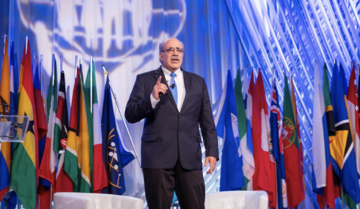
Brian Branch speaking before a World Credit Union Conference.
When other credit unions “ask how does WOCCU help their business,” Branch said the organization points to numerous benefits, including helping CUs to connect with the “diaspora of the membership,” sharing lessons in helping staff to connect, and sharing innovations from other countries that offer examples to U.S. credit unions.
Among those examples: How small credit unions in some countries, or in a few cases, every credit union in a country, have come together on shared platforms, such as data processing or branding. Brazil’s Sicredi movement is one such example of standardization of the back office and more, as CUToday.info reported here and here.
Centralizing those functions and others have helped credit unions in some countries to create scale and “deliver a personal commitment to the brand and a promise of quality,” said Branch.
Another emerging area in which credit unions in some countries have banded together: payments. That includes developing countries, such as Kenya, which was able to leapfrog the legacy payments systems in place in countries such as the U.S.
“A lot of those issues transcend borders. There are no borders anymore,” said Branch.
Eliciting Eye Rolls
Still, demonstrating the value of the international credit union movement to U.S.-based credit unions and others can be difficult, Branch agreed.
“Abstractly, when we talk about the credit union difference, many regulators and government officials roll their eyes,” Branch said. “But we see people in credit unions working for the members. There is a passion for the work. The employees of the for-profit institutions are working for the benefit of the owners. The difference can be seen in the passion and the level of service they provide. You really see this in a crisis. It’s striking. It happens in the U.S. too, in helping members to keep their homes, their cars, helping them to meet needs. It creates a perception that credit unions are safer and fairer. It helps when it comes time to set tax policy. It’s a public relations opportunity and a tremendous opportunity for growth.
“We are starting to see that in a number of countries and it’s even created a liquidity crisis as people bring their savings to the credit union. As others have pulled back credit unions have not. This is a policy support opportunity.”
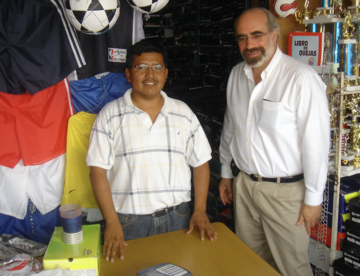
In terms of “concrete takeaways,” Branch points to the innovative digital ways credit unions in some countries have developed strategies to serve the underserved and to connect across communities. “U.S. credit unions can learn from those experiences,” he said.
Changes Around the World
Branch noted it hasn’t just been the World Council that’s changed during his time with the organization, credit unions around the world have, as well.
“When I started credit unions were really seen as social organizations in many countries, and we really struggled to have them be seen and to see themselves as financial institutions with a social function and mission,” Branch said.
As an example, he cited all of the areas of the world where a credit union(s) has helped to start “knitting credit unions back together again” but only after ensuring its own financial house was in order.
In some markets where credit unions have been able to also play a role in assisting members in selling goods, there has been a 20% increase in member net household income as a result, Branch said.
“We have tried to integrate members with other sources of greater return in the market,” said Branch. When that happens, the result is “credit unions have a very strong community identity.”
A great recent example, said Branch, are the credit unions in Puerto Rico, which has been hit by multiple natural disasters. Credit unions have responded with loans for solar power and wells, among other assistance.
“Credit unions make those communities more resilient,” Branch said. “That creates strong loyalty to the credit union.”
Branch said U.S. credit unions could also look to Australia’s credit unions, which are very advanced in payment channels, member interaction and cybersecurity, or to Korea’s, which have sophisticated technology platforms and have been very proactive in attracting younger members.
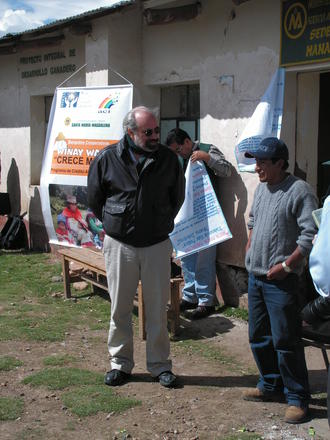
Seeing First-Hand
Prior to the pandemic, one strategy the World Council deployed to get Americans and others in the developed countries to understand the value of the work being done was to conduct working tours of various areas where it had projects operating.
“Absolutely, it does help to see where the work is being done. It’s not Paris; it’s underserved areas and villages,” said Branch. “It means a lot to (local CUs) when delegations visit. They feel connected to the international credit union system. For U.S. representatives, they see the fieldwork being done and they come back with more passion. It establishes a long-term relationships. It gives them experience and also allows them to share their skills with the international community. They see they have the same pride, the same vision.”
Dealing With Danger
But developed nations and second world countries aren’t the only places where the World Council and its representatives do their work. Often, the work is done in dangerous and unstable markets, such as Afghanistan, where Lois Kitsch did work on behalf of WOCCU, as CUToday.info reported here.
Branch was also part of a delegation that visited war-torn Libya as it explored introducing credit unions in that country.
Does Branch worry about the safety of credit unions and their members, as well as those working with and for WOCCU? Absolutely, he said.
“These are communities where credit unions are rooted. Other financial institutions leave at a time of danger, but credit unions can’t go anywhere,” Branch said. “At WOCCU, we try to provide support. We are very conscious of taking volunteers to places at risk. (Locals) take you in. They treat you like family and look to reduce risk. But I have seen my fair share of risks. I have had family in the military, so it’s not risk like that, but I have seen credit unions on the front lines and credit union people who have lost family members.”
A Global List of Accomplishments
When Branch announced his retirement plans, the World Council released a long list of accomplishments that have taken place while he has led the organization, including leading programs to:
- Reconcile post-civil war economies through credit union reactivation in the Central American nations of Guatemala, Honduras, El Salvador and Nicaragua
- Extend economic democracy through credit union systems in post-Soviet Russia, Poland and Romania
- Empower township communities through credit union services in post-Apartheid South Africa
- Build community reconciliation efforts through credit unions in post-genocide Rwanda
- Revitalize rural economies through credit union finance for agricultural crops and remote service delivery technology in Bolivia, Peru, Colombia and Ecuador
- Update credit union legislation and regulation in Mexico and Kenya to strengthen the credit union brand and protect the ability of credit unions to expand financial inclusion
- Introduce Islamic-based credit unions in post-Taliban Afghanistan
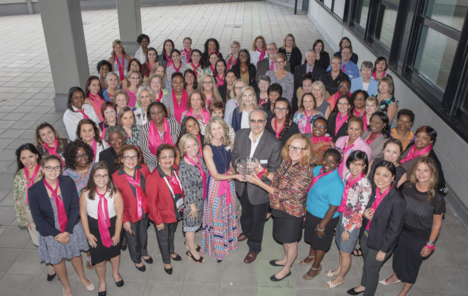
Brian Branch at Global Women's Leadership Network event.
Branch has also been instrumental in helping to launch the Global Women’s Leadership Network, which has been led by Susan Mitchell of Mitchell Stankovic and which has grown to have members around the globe.
But Branch said he isn’t exiting with his to-do list all checked off by any means:
“Certainly there are some things that are unfinished,” he said. “In Cuba, we tried to introduce credit unions, but the state controls all financial services. There are so many young people there who are looking for economic opportunities and who were very interested in credit unions. In Kurdistan, we were doing work in refugee camps with people who have suffered so much. Credit unions were a way forward. But the war escalated and we became a much lower priority.”
Travel Advice
No person who has travelled to more than 100 countries can escape being asked for their favorite places to visit, and Branch said he is no exception.
“I get asked that a lot,” he said “I don’t have any one favorite place. I have always enjoyed Mexico because I have a lot of connections there. When I did work in Bangladesh or Cambodia at different times, it was always good to be able to decompress in Australia. I have enjoyed the Solomon Islands, because I had family who fought in World War II there and it has a personal history. I enjoyed Russia after it was no longer the Soviet Union, because of its tremendous sense of history and the people who were eager to connect. I have enjoyed Ireland, but I’ve learned you can’t stay up at night and try to keep up drinking. But Ireland’s credit unions also have a tremendous ethos.”
Another favorite, said Branch, has been Poland, where credit unions emerged quickly into strong providers of financial services after the fall of communism with the support of Lech Walesa, the solidarity movement leader.
What’s Ahead
As the World Council conducts its search for a new president, Branch said his advice for his successor is to understand the World Council “is a journey.”
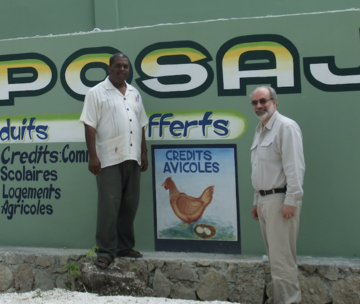
Brian Branch in Haiti.
“It’s a relationship job,” he said. “It’s about trust and diplomacy and engagement. You want to help lift people up to a higher level in a trustful way. You are part of a big international family with warm relationships. But the demands are high and there are some thorny challenges.”
The travel aspect of the job may change even after the pandemic is eventually brought under control, but there is still likely to be plenty of long plane rides.
“The next CEO will have to determine how they want to tackle that—the face to face vs. the virtual,” said Branch. “The face to face, being in the field, allows you to build a personal rapport. Going forward there is going to be lots of virtual engagement, but there will always be the face to face.”
As for himself, Branch said he hasn’t made a lot of plans, except to be face to face himself with his wife as they look to build a new home, which he expects will take about a year.
Just don’t look for Branch in an airport.
“When a lot of people retire they say they want to travel,” Branch said. “I am not one of those who needs to do that.”