

ALEXANDRIA, Va.–In what the two NCUA board members referred to as a “historic” day for credit unions and a long way from when “all this hit the fan,” refund checks will start flowing to NCUSIF-insured CUs in 2018 following the decision to close the corporate stabilization fund.

NCUA Board Member Rick Metsger even said credit unions can now “declare victory on the corporate credit union crisis.”
But the rarity of money flowing from Washington back to the people who paid it in hasn’t been enough to stifle criticism, with many objecting to the same board meeting vote to increase the NCUSIF’s Normal Operating Level to 1.39%, as CUToday.info reported here.
Following the meeting, both NCUA Chairman J. Mark McWatters and Board Member Rick Metsger participated in a Q&A with the trade press. Here is a look at what was discussed:
“My summary (at the meeting) on this closing of the TCCUSF went to the essence of what we’re trying to accomplish here,” said McWatters. “We’re faced with a situation where the equity ratio was declining. The equity ratio was trending down and it was leading to a premium for the credit union community. I thought perhaps we could take a different approach as we have this other fund, the stabilization fund, which has a lot of money in it. I discovered we couldn’t borrow funds (from the TCCUSF). So, the next idea was to merge the funds together, negating the need for check-writing by credit unions, and turning it around and (sending a dividend) back to the credit union community.
“Compare that to TARP, which was a $700-billion bailout,” continued McWatters. “Credit unions had to write checks for $4.8 billion. Credit unions fixed themselves by putting money in a pile, and borrowing $5.1 billion from Treasury, which has been repaid. So, the excess funds go back to the CU community.”
The Big Question
All that, said McWatters, is logically non-controversial. What has been controversial, he said, has been question of where to set the level of the Normal Operating Level (NOL) of the National Credit Union Share Insurance Fund.
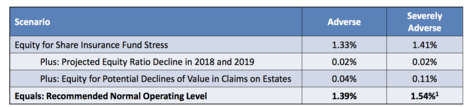
“The question is how to compute it,” said McWatters. “I did not want to fall into a situation where someone said, ‘Mark, you are just coming up with a number.’ I said to staff, ‘When you compute the numerator, tie everything back. Go to the Federal Reserve board methodology for a moderate recession and a severe recession and shock the assets.’ I asked, ‘How much extra will we need to put into the (NCUSIF) numerator?’ They did that and came back with 1.39%.”
Rick Metsger recalled that it wasn’t that long ago that there were predictions credit unions would never see a “dime” of the money they paid into the Temporary Corporate CU Stabilization Fund, and it’s been a short eight years since “all this hit the fan.”
It’s hard to believe, he said, “to think we’d be here today with a chance to close the fund four years early and not only not charge assessments, not a single taxpayer dollar was needed to resolve this. I think it’s a huge success story and a lot of people who have contributed to that, and Mark and I got in on the fourth quarter to make sure we secured the win.”
Metsger added that he finds it rather ironic that people within credit unions are now arguing over the size of their returns rather than the premiums they might be assessed.
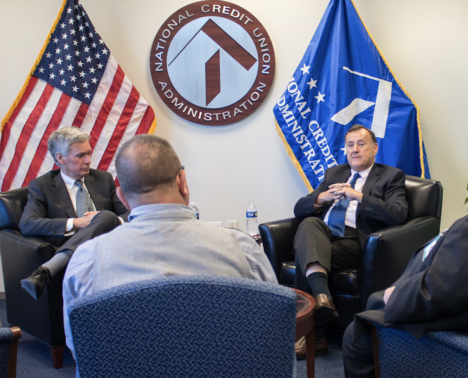
At left, NCUA Chairman Mark McWatters with Board Member Rick Metsger in press briefing following board meeting.
The Q&A
Here is how the two board members responded to other questions posed to them by members of the media:
Q: Had the agency not merged the funds and left the TCCUSIF operating until 2021, would the amount of money available to return to credit unions be different?
Metsger: I don’t see it being any different at all. We’re making an early installment. The value is still the value and the assets are being sold on the same schedule.
Q: Will there be a detailed examination every year of the Normal Operating Level of the NCUSIF?
McWatters: My term runs through August 2019. There will be (a detailed examination) as long as I’m around. After that, it will be subject to future boards. Prudence would dictate that future boards assess that. I mean how do you manage the risk to the taxpayers if you do not at least annually assess the critical component, and that is the numerator (of the NCUSIF equity ratio), relative to the risk of a moderate recession. If you don’t do that, are you doing your job? I don’t think so.
Q: Of the 662 comment letters received by NCUA, about two-thirds objected to the NOL change. In talks with CU executives, was there more support for it that wasn’t reflected in those letters, and as you discussed your position, did people see it or understand it?
McWatters: It’s a great question. I met with three credit union leagues in the last two days. They all come in and start talking about the NOL at 1.39% as being too high. And I say, ‘Let’s think about this,’ and I back up and walk them through it. I point out that our number if 1.30% was set pre-recession. How do I go before Congress and say ‘Hey, we’re sticking with this pre-recession number? No, I said we need to use a post-recession methodology. I then talk about how we came up with our number, and talk about Black Rock. We didn’t give them a number, they gave us a number. And then I talk about the decrease in the share insurance equity ratio; people keep joining and joining credit unions (and depositing funds). We’re trying to resolve that problem so credit unions don’t have to write checks.
One of the biggest things since I joined the board is transparency, and Rick is as much a part of this as I was. There is no law that says we need to propose the closing, we could have just closed it. But we said we want input. You go through this and you can give all the transparency in the world, but the question is do they read it. And often they do not. Sometimes you have to say it more than once.
Metsger: I concur. I would hear the same thing a lot: ‘I don’t understand why you need to set it at 1.39%.’ You can agree or disagree, but the reality is people get their talking points and don’t necessarily follow through with their independent evaluations. But my experience has been that when you explain it to them, they get it. Staff will look at (the equity ratio) on a regular basis. The intent is to reevaluate it.
Q: The stabilization fund is currently at a net position of $2 billion (Editor's note: Actual cash + overnight Treasuries are $1.4 billion). What about future distributions?
Metsger: There are some other (legal) cases out there, but the major cases have been settled. I think it’s fair to say there are no pots of large money out there. We are pursuing some smaller cases. The pot could get bigger, but from an arm’s length, as Black Rock has evaluated it, it’s our best prediction for 48 months from now.
McWatters: (Citing footnote number 31 in his written response, which can be found here), he said he tried “to take that $600 to $1.1 billion in future dividends and add some color to it and where it is to come from. There is also $400 million that could potentially come from the reserve to the NOL for the NCUA Guaranteed Notes if there is not a moderate recession. The collateral insuring those NGNs could decline. We could collect $200 million to $400 million on a U.S. Central note. We also could have up to $300 million in future interest on the NGNs. When you add those numbers together you get this range.
Q: Rep. Sean Duffy (R-WI) wrote a letter to NCUA earlier in September that called on the agency to "withdraw or amend" its current proposal to close the Temporary Corporate Credit Union Stabilization Fund. Have you heard from other members of Congress?
(Metsger and McWatters said they have not heard anything.)
McWatters: My (written) statement tells the entire story, and if need be, Rick and I go to the Hill and talk about it. To me, the story is fairly simple but it can be misconstrued in some ways. The methodology we used is pretty transparent.
Q: Do you anticipate the factors that contributed to a declining ratio in the NCUSIF will be ongoing and that the trend line will continue?
McWatters: CUs are growing, and I don’t’ know of a reason why they would not continue to grow. I expect the (NCUSIF equity ratio) denominator to grow. The numerator is 1% of the denominator, so the next question is what happens to the retained earnings component. What are interest rates going to do in the future? I don’t know. We don’t have the $13 billion in the NCUSIF invested all short-term. Should interest rates bump up tomorrow by 25BPs, we won’t get the benefit of that as a lot of our investments have a weighted average yield of three years. In looking at the numerator, what kind of losses to the NCUSIF might occur? There are three credit unions in New York City with lots of taxi medallion loans. What kind of losses are we going to have there? It all depends of your macro-economic view of the economy and your micro-economic view of the CU community.