


RALEIGH, N.C.–As State Employees CEO Jim Blaine prepares to step down from leading the second-largest credit union in the world, he does so after one of the most high-profile careers in the movement’s history.
Since being named CEO at age 30, Blaine has overseen asset growth from $50 million to more than $33 billion; grew branches to more than 250 when many have argued the branch is dead; created a culture that has become a farm system for CU CEOs all over the country; and has been blunt—but not “outspoken,” he says, about numerous issues.
In this, the second of a two-part series, Blaine shares with CUToday.info thoughts on his career, NCUA, what small credit unions can do to compete, and more.
CUToday.info: What have you learned about managing and leading in your career?
Jim Blaine: People don’t like to be managed. I don’t manage anyone. To me what you do is try to hire the right people, tell them the rules of the game and what you are trying to do, give them the authority they need and get out of the way.
People who want to be successful want to control their own destiny. They want to make their own decisions. Each of our branches make their own decisions.
I have talked to every new hire. I wanted to make sure we were hiring the right person—understand how they felt about life, their view of the world, their heart.
CUToday.info: SECU and Jim Blaine have built a reputation as a place where management talent develops and then goes on to lead credit unions elsewhere. How come? Deliberate?
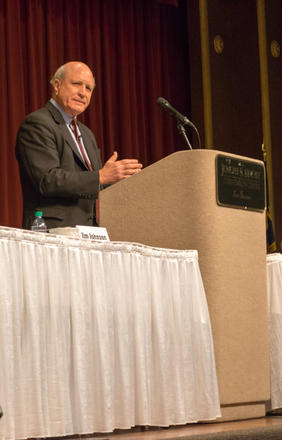
Blaine: Yes. Again, it is about hiring the right people. You hire great people who want to develop and be leaders and, sure, there is only one CEO spot, one CFO . . .
But we have always told our people that if they rise in the organization and want an opportunity elsewhere that we have the contacts and reputation to place them in a job somewhere else in the country. They know they won’t get stuck here if the opportunity to advance, at that time, is not there. We have always had that safety valve for our staff.
I think it is important for the CEO to talk to every new candidate. It is time consuming, but I got to see everyone we hired, which gave me great confidence in their abilities. So when it came time to let go of the reins and let them move on . . . It also shows our employees that the CEO is no different than they are.
When I talk to our new employees I always ask an important question. I ask that if we got in a disagreement, and at the end of the conversation I told them to do what I said or leave, would they do something they disagree with. If people tell me that I am the boss, who has more experience and that they would do what I said, I tell them that is the wrong answer. I tell them if they ever do that I will fire them. People need to stand up for what they believe in. If you think you are right you tell the truth and take the consequences. I let them know that the message from the organization is that they will always be asked to do the right thing for the member. That is the primary rule here. And, if they are ever asked by a manager they work for to do something they disagree with, they know they can call me. I believe those conversations have helped our organization through a lot of difficult situations.
I also ask our new employees who is more important in building a home, the carpenter or the architect. The right answer is both. However, if asked to choose, how do you answer that question when there is no perfect answer? You simply have to make a choice, take a side. People who can make those decisions in the gray areas, those are your best employees.
CUToday.info: You have obviously been willing to be outspoken during your career. Is that just the type of person you are, or were there issues you felt needed to be addressed and others weren't doing it?
Blaine: I disagree with the word “outspoken.” I continually see and listen to people who do not stand up, step in, when they should. If you see a car wreck do you rush to help or do you walk away. If there are economic troubles within your membership do you rush to foreclose on a mortgage, or do you try to help. It is a matter of attitude.
But I have seen a lot of people, for whatever reason, not have the courage to stand up and say what is true because there may be consequences. But to me they are denying their humanity if they don’t stand up. And what a horrible way to end up in life.
For me it has always been better to be transparent and take difficult situations head on. Because, if you don’t, problems fester.
I know it may be easier for me than others to say this, being CEO, but by telling the truth and you get fired—good. You did not want to be there anyway.

CUToday.info: Obviously, you and SECU pretty much drove this decision around CUNA "choice" and the first change in CUNA bylaws since 1934. How did all that come about?
Blaine: I don’t take credit for that. Regardless of where you sit in the credit union movement you can see a rapidly shrinking number of credit unions and an infrastructure of leagues and chapters and trade associations built up over the years to originally support 25,000 credit unions. Now about 300 credit unions control 80% of the assets. Technology has advanced, as well, so there is no reason credit unions should not be able to communicate directly with their trade association. They don’t need a filter anymore.
More than two years ago SECU asked the league and CUNA to conduct a pilot allowing choice. When that plan was not met with any favor, we chose to drop out. (SECU recently re-affiliated with CUNA following the trade association’s bylaws change allowing choice in membership between the league, CUNA or the league and CUNA. It has not re-affiliated with the league at this point).
CUToday.info: Given SECU's enormous size, are you able to see the world from the view of those $20- and $50-million CUs?
Blaine: The biggest mistake people make about this credit union is thinking we run like a big credit union. All of us are on salary. There are no incentives, no growth targets. Our goal is just to deliver great service and we know growth will come.
You hear a lot now about the importance of being local. The biggest liability can be our size, I realize that. But, in actuality, we are running 260 local credit unions. The rates and the rules are set for everyone, but each branch makes their own decisions. They have the ability to look the member in the eye and make the call, inside our rules, based on the needs of the member.
There is a liability in size if you allow the size to divorce yourself from your members. If your members don’t feel like they can call the credit union or reach the credit union, then the credit union is in trouble. Our members know they can always get in touch with the credit union, and they know they can get a hold of me.
CUToday.info: Can small credit unions compete?
Blaine: Yes. I think (a typical profile of one the best CEOs) in the movement is a female who has been working as a GM for 20 years and does everything at a $25-million credit union. A lot has to do with the leader, the membership and the board, but without question a small credit union can still compete.
The mistake I see many small credit unions making is that they want to be Bank of America. But what members really need from them is a reliable source for a personal loan, a credit card, a checking account, ATM access, and mobile. All those things are readily available at affordable prices for smaller credit unions.
Technology may be the great equalizer for small credit unions, their salvation, as long as they don’t get ahead of themselves. Stick to their knitting, do what they are good at.
Also, the fastest-growing segment of the financial market is payday lending. And these lenders are charging 800%. This is a multi-billion-dollar niche. Credit unions need to tell their communities that they will charge 18% and consumers will love us. People might be poor but they are not stupid and will recognize a deal when they see it. Just get back to your roots—these types of loans are how credit unions started out. This is not hard, but sometimes credit unions can make things too complicated.

SECU headquarters
CUToday.info: What is your view on what's ahead for credit unions? Concerns and opportunities?
Blaine: I think our reputation and the credit union difference is starting to be understood. One of the big things credit unions have not had is the local convenience, whether that is branches or technology. And I think that issue is being resolved.
But we need to decide who we are, because it is very confusing to lot of people when they look at credit unions today. They see a lot of things from us. They find a lot of inconsistencies between what we practice and what we preach.
So what about payday lending? If we are going to wear the white hats, we all have to get together an agree that affordable payday lending is a core part of our DNA.
CUToday.info: Tell us more about your family, wife kids, home, and what’s next in retirement?
Blaine: I live in the county with my wife, Jean. We live on a big farm in the middle of nowhere in Granville County (N.C.). I have five children, six grandkids, three dogs and 35 chickens. When I retire, I intend to be unscheduled for a while. And I don’t play golf.
My work has been my hobby, which I think is fortunate. It never seemed like work to me. When you become a professional you don’t do it for the money or the prestige. Successful professionals do what they do because they love what they do.
CUToday.info: So what will you do with your “hobby” gone?
Blaine: I didn’t know what I was going to do when I came to SECU, why should I be afraid of what I will do when I leave? A blank canvas is ahead of me.
I will say that I will not be a consultant. I never trusted them while I was working here and I never hired them.
Also, I believe in a clean break. When you leave a job you ought to go away. I never wanted to stay around in any role or be on the board. As I said, I will be here until a successor is chosen, which they tell me could take nine months at the longest, more likely four to five months.
We have several good internal candidates. But this is a national search. But if they find someone from inside the credit union a successor could be named much sooner.
And, right now, I think I won’t do my blog when I retire. I feel to write something like that you need to be heavily involved in credit unions, be informed. As I said, I plan to step away from the credit union and be unscheduled.