

ALEXANDRIA, Va.–Four women shared four unique and interesting perspectives on what diversity, equality and inclusion have meant to themselves and their credit union communities, with insights ranging from the danger of assimilation, to creating a supplier diversity program to how one cohort of loans is generating 12.5% yields.
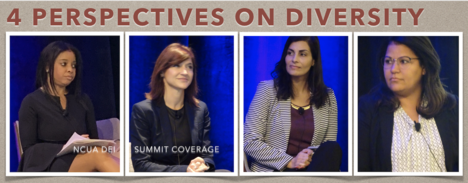
Sharing their viewpoints and experiences during NCUA’s inaugural Diversity, Equity & Inclusion (DEI) Summit here were Jill Nowacki, the former CEO of the Connecticut CU League who now leads the consulting firm of Humanidei; Miriam De Dios Woodward of PolicyWorks; Charlotte Ducksworth, the chairman of DC Federal Credit Union and the principal of BusinessBostics Consulting and partner in Commun-ET, LLC; and Angela Weekley, community inclusion manager with Veridian Credit Union in Iowa.
The discussion was moderated by Jennifer Shaub, Agile Business Transformation Lead II, with CUNA Mutual Group.
Here is a look at the questions asked and the responses from the four panelists:
Shaub: Tell us about your own journeys in the DEI space?
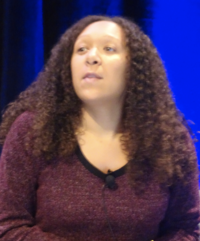
Jennifer Shaub at DEI Summit.
Weekley: We started D&I before it was a sexy term. In the 1990s, while in college, I worked at what was then John Deere Credit Union and we had diversity training then. So, we have been on this journey for a long time. It is a journey, and we did not even have a committee until 2007. In 2011 my department, Community Inclusion, was developed. I do our community outreach to underbanked and unbanked populations. We make sure to count the numbers and that our numbers count. We intentionally report to the CEO so we don’t get caught up in any one area.
Nowacki: It’s important to note I feel like I left my dream job to start Humanidei. When I got the (Connecticut) league president job there were more league presidents named John than there were female league presidents. I was the youngest president at the time. I thought, ‘Yeah, I am a pretty big deal.’ I thought it was great until I got to the point where I realized by assimilating in that role (she was not helping bring a diverse perspective). I encountered people who needed their own support and coaching, and over about six years I kept thinking someone should do something about this. I eventually realized I am someone and I could do something.
De Dios Woodward: PolicyWorks is an organization owned leagues in Iowa, California, Nevada and Ohio that started by offering compliance tools and services. My DEI journey started when I was with Coopera, which does Hispanic outreach for CUs across the country. So, it’s a passion I bring personally. Now we are looking at it from a membership diversity standpoint.
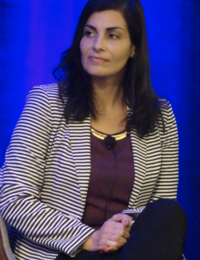
Miriam De Dios Woodward at DEI Summit.
Ducksworth: The Bank on DC program is really about the city looking at the unbanked and underbanked in D.C. and after the city saw we had some really big challenges. A significant number of individuals were using check-cashers and predatory lenders and the city was deliberate in how to deal with the issue. When we started we estimated about $15 million in fees by were being paid by D.C. residents just to access their cash.
We are one of two credit unions in D.C. that really focus on banking the youth. If we don’t start with youth, we realize we have a serious issue. It’s not just for youth in the summer employment program, but for youth 14-17. Our staff took a big initiative to create non-custodial accounts to get young people involved in accessing funds and financial literacy. It’s about how do we begin to mitigate some of the historical issues in the District and in most of our cities. We want them to understand them have a right to finance.
Shaub: Can you share some specifics about your program and some advice you would give to a credit union about reaching out and is concerned about compliance?
De Dios Woodward: Compliance is an important component. Thinking back to my work at Coopera, in working with credit unions compliance would inevitably come up. What I find is compliance can be the reason for not moving forward in reaching out to consumer groups. So, a place to start is with a different mindset around compliance. It’s adherence to rules and regulations, and there are underlying requirements that can be a starting point. There is a lot there to start with.
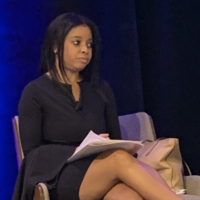
Charlotte Ducksworth at DEI Summit.
These rules can be potentially encouraging in serving diverse groups. Starting with providing products and services to new groups doesn’t have to be about a new product or service. Think about what you already offer today and how you can be more inclusive.
Second, look at the end-to-end member experience and diversity, equity and inclusion. What do people see when they encounter you? How does language impact that member experience?
And third, looking at serving members who aren’t reflective of our mainstream membership, they may not have traditional forms of identification and documentation--how can we look at non-traditional forms of information to provide them access?
Shaub: Not many credit unions have supplier-diversity programs, but Veridian does. Tell us what a supplier diversity program is, and then specifically about your program.
Weekley: When we decided to expand our leadership development in the DEI space, one thing we found was supplier diversity programs. It’s the difference between equity and equality and breaking down some barriers to allowing businesses to have the opportunity to even get to the table. So, our program allows someone from a protected class who owns a business to get to the table. Internally, if you are a manager or someone who is doing an RFP or even if you’re just bringing in lunch, you are required to look at that list and consider one of those vendors. We also have a policy of buying local whenever possible.
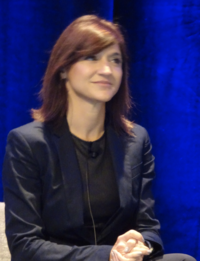
Jill Nowacki at DEI Summit.
The hard part is it has to be companywide. It’s hard to do at a credit union. How do you track it? How do you know you’re doing well? We do about 10%-15% of our spend with our diverse suppliers. But we don’t know if that’s a good number or not as we don’t have a metric to measure this against.
Shaub: Your website states financial equity is a right. What does that mean and how to you operationalize it?
Ducksworth: When you think about financial equity as a right, when we talk about it it really became about value, that everyone has a right to be valued. We had to ask why are we a credit union? What does it mean to be a cooperative? Out of that came the idea that everyone has a right to be seen and valued and to have access to financial products that can change their lives.
One way we have operationalized it is through our youth accounts, which teach young people they are valued and they have a right to save their money, to have a dream, to have accountability. For us, we also offer New American Loans for the immigrant population. That’s a critical component for us.
The other way that has been critical is it has been helpful to us as a credit union to make money, to make margin. Even on some of the D&E credit—and we are a CDFI and sometimes our delinquencies can be higher than peer, but that was a conscious decision—we have 12.5% net yield on the D&E credit. Not only that, our capitalization is over 12%.
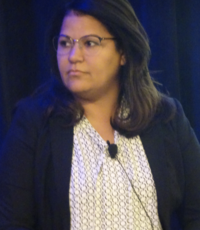
Angela Weekly at DEI Summit.
When credit unions started they were a model many were not willing to accept. If we don’t go into the next phase of shaking the foundation of what we see, then we have lost the very movement we came out of.
Shaub: What advice to you have for smaller credit unions that want to engage in a few of the best practices Humanidei speaks to?
Nowacki: I don’t think it’s important to distinguish between small and large CUs, except in one area. If a credit union doesn’t feel like it can get a board of directors that represents the community, it can be really challenging. It begins with that board of directors. One of the problems I saw was that if the board has the same people in the same seats for 40 years it can be really hard for them to see people who are different from them as future leaders. It means going outside of the traditional recruiting channels, such as the local Elks Club. It means bringing in someone who looks different from your social circle…What is your strategy when someone who comes in thinks differently? We wait for assimilation. They aren’t about checking a diversity box for you, they need to be truly valued.
Shaub: What has been a best practice for you?
Ducksworth: A best practice for us and it has kind of happened both accidentally and deliberately, I think our boardroom diversity has been a piece that has been helpful for us. We have a few Millennials, a few women, and that has meant different perspectives and different processes on the board and that has helped us to have some tough conversations. But there is also a ways to go.
I think our other best practice has been to be deliberate about financial inclusion and what the financial cooperative model is all about. It has forced us to create new services and products that we might not have had had we not thought about how we show up in the community. You can’t tell people what they need, they have to tell you.