

By Ray Birch
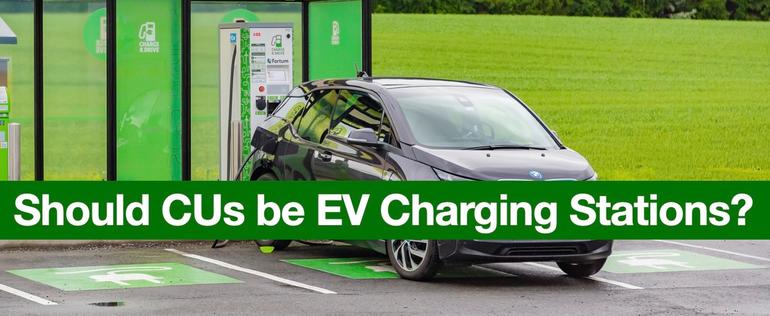
ALEXANDRIA, Va.—The nation’s banks are ahead of credit unions when it comes to installing EV charging stations at their locations, according to one expert, who believes CUs are just beginning to see the advantages of offering the opportunity to recharge include driving loyalty, new members and possibly even payments volume.
“It's a certain convenience for your employees and your members, and then even non-members. Somebody that needs to charge would go to the credit union. They would plug in for 30 minutes, swipe their card and the credit union can generate some revenue,” said Jeff Muglia, sales director at Tetto 5G, a company that offers EV charging solutions. “But we also see it as a means to help grow membership. If I go to charge and I'm sitting in your parking lot for one-half hour, why not go in and find out what other products or services the credit union has?”
Muglia said Tetto 5G does not have data that shows just how many credit unions have installed EV charging stations, but said interest among cooperatives has been growing.
“More credit union members are driving electric vehicles and will need access to charging stations,” he said. “Some of the larger banks have made a big commitment to EV charging. Chase Bank had added fast chargers at 50 branches by the end of 2023. Bank of America added 350 of by the same time.”
Revenue Generation
In addition to driving account-holder loyalty and more business to a branch, Muglia said there is revenue to be generated from the EV chargers themselves.
“There are different models. One model is just a flat-rate lease. The EV charging company is going to install one to three chargers at your credit union, and they will pay you $75 to $100 per month, on average,” Muglia said.
The other option is a revenue-sharing agreement with the charging company.
“(That means) they would take a percentage of the monthly revenue those chargers draw,” Muglia explained. “The most attractive aspect of the lease model is it’s turnkey. Absolutely no cost to the credit union. They don't pay for the chargers. They don't pay for the installation, the permits, the maintenance, the upgrades…”
The Leasing Option
The lease payment is monthly and fixed, so it's “predictable” income and it increases over time, according to Muglia.

Jeff Muglia
“Our leases start at 10 years with five-year renewals. We increase the lease rate throughout the lease so that you know you will get more income,” he said.
But with a revenue share, the credit union will incur certain costs.
“The credit union may have to do the installation of the power, the transformer that's required, the mini cell tower (for communication to and from the chargers), that type of thing,” he said.
The actual revenue share percentage is determined between the different EV charging companies and the credit union, he said, adding that, on average, one charger brings in between $100 to $300 a month.”
The cost for the electric on the lease model is paid by the EV charging company.
“These chargers are connected to the Internet and we pay for everything,” he said.
Going it Alone
But what about a credit union that opts to go it alone and installs the chargers itself in order to retain all of the revenue?
“If they just put in a charger on their own (it would be) several thousand dollars for the charger itself, and then they've got to run the underground cabling, do the permitting, the site work, the maintenance, the upgrades,” he said. “There’s a lot of money involved in the chargers, not to mention the electricity cost. If it's a Level 2 charger it runs off at 220 voltage. If it's a Level 3 (fast-charging) it runs off of 440. That could be a significant cost to the credit union, and it might take them years to recoup their initial investment.”
What Some are Considering
Muglia said that during 2023 he did speak with some credit unions that were exploring a novel way to drive business from EV chargers onsite.
“We were at CUNA’s GAC and talked to several credit unions who thought EV charging capabilities would be a great way to increase usage of their credit cards,” he said. “They thought they might have some type of a rewards program, or a points program, associated with using those EV chargers at their branches. For instance, the credit union has access to their members’ payments data and if they see them using their cards at EV chargers outside the credit union they can send them a text or message them via online banking and tell them if they charge at the CU’s charging station and spend $20 on charging, they get X number of rewards points.”
Those points, he explained, could be redeemed for charging at the credit union, or just placed in their rewards bank.
What Happening Now?
What is the current state when it comes to credit unions and EV chargers?
“It's a topic of conversation. I don't think there's been a significant number of EV chargers deployed yet by credit unions,” Muglia told CUToday.info. “The banking industry is moving faster in chargers, seeing the value in providing that additional service to their customers.”
For those credit unions considering such an installation, Muglia offered the following direction on costs and more:
- “The full installation cost varies based on the type of charger (Level 2 or Level 3), access to utilities, whether the EV charger is standalone or integrated into a Connexion Central smart hub, etc.”
- “The type of charger selected should consider how a member will use the charging station. If you consider most member visits to a branch are shorter in duration, and the average charge time is 25-30 minutes, a credit union should consider installing a Level 3 charger.”
- “Level 2 Chargers are less expensive and take up less room in the parking lot. Level 2 Chargers take longer to charge a vehicle.”
- “Level 3 Chargers are significantly more expensive and take up more room in the parking lot. Level 3 Chargers take significantly less time to charge a vehicle.”