

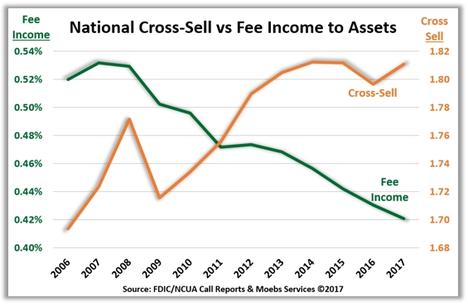
LAKE FOREST, Ill.—The greater focus on relationship pricing in the last 10 years is costing FIs significant fee income, a new report reveals, although that may be offset by the quality and number of relationships.
What is certain, however, a new analysis finds, is that banks have been better at cross selling than have been credit unions.
Before the Great Recession in 2008, fee income was at an all-time high, with effective cross selling only beginning to emerge, noted Michael Moebs, economist and CEO at Moebs $ervices.
“Since 2008, cross-selling has consistently expanded at the cost of fee income, which has fallen 20.9% from the high in 2007,” he said.
The majority of fee income includes service charges on deposit accounts, which consists mainly of overdrafts, said Moebs.
“While the dollar amount of fee income has grown, it has not kept pace with asset growth, which results in an overall reduction of fee income to assets,” explained Moebs, noting the data comes from the Moebs $ervices Study of Cross-Selling. “Relationship pricing allows a depository to max its full potential through cross selling. This also allows the consumer to take full advantage of a depository’s services. However, few depositories fully recognize cross selling comes with a shortfall of fee income.”
Transaction Pricing
Moebs noted the transaction pricing strategy focuses less on building a relationship through selling additional services, and instead relies on selling only a core product.
“The prime example of transaction pricing is to promote free checking to maximize new account potential, which then produces high interchange volume from debit card usage, as well as overdraft fees,” Moebs explained. “On the other hand, the relationship pricing strategy emphasizes cross selling multiple services to build a relationship with the consumer, and will forgo potential fee income to accomplish this strategy.”

Michael Moebs
Banks have been aggressive in moving to relationship pricing, whereas credit unions, until recently, have relied on transaction pricing, noted Moebs. On average, banks have 2.5 services per customer. Credit unions average only 1.1 services per member. When looking at the entire industry, the Moebs Study found cross-selling leads to 1.8 services per consumer. Cross-selling rates are determined by the total number of deposit and loan accounts at a depository divided by the total number of customers or members, Moebs said, adding that “another factor reinforcing the relationship pricing strategy against the transaction pricing strategy is free checking.”
“Less than half the banks, or 46%, currently offer free checking, whereas 73.6% of credit unions continue to offer free checking,” noted Moebs. “Credit unions have always believed free checking will obtain more interchange and overdraft fees.”
Two Strategies
The Moebs study shows the relationship pricing strategy or transaction pricing strategy works best depending on a depository’s approach and values. Both strategies have their advantages and disadvantages, Moebs said.
“The relationship pricing approach focuses heavily on consumer retention in order to secure the consumer for a long period of time. Transaction pricing doesn’t carry the longevity as relationship pricing does, but it brings in almost three times the amount of fee income than those who focus on relationship pricing,” said Moebs. “The bottom line is if you have the resources, do both. Offer two checking accounts: one relationship based and one transaction based to get both approaches working for you.”