

LAKE FOREST, Ill.—Despite the strong economic performance, the American consumer continues to be disengaged from retail and much of the economy, and continues to build checking account balances to record levels, a new report reveals.
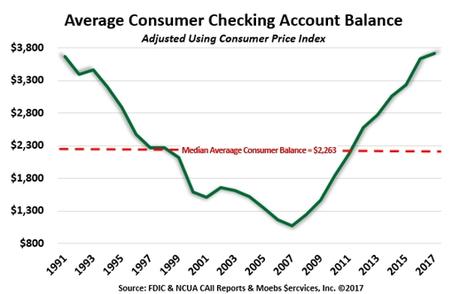
That’s a key finding from a new Moebs $ervices study that analyzed more than 12,000 depository call reports and compared findings to Federal Reserve monetary data for 2017.
“The consumer—in banks, thrifts and credit unions across the nation—keeps warehousing more checking dollars,” said Michael Moebs, economist and CEO of Moebs $ervices. “The average consumer checking balance has increased 23 of the past 30 quarters. The average Joe and Jane still are very leery of the economy. Yet, the Federal Reserve keeps raising interest rates.”
Good Times Mean Small Balances
Moebs said consumers affirm when times are good by keeping little money in checking, with the inverse typically true when the economy is struggling.
“Looking at the past 26 years. The consumer had the least amount of checking dollars in 2007, when times were good, averaging less than $1,000. Since 2008 the consumer has horded money in checking,” noted, Moebs.
Consumers today, on average, have over $3,700 in checking—the highest amount in U.S. history, said Moebs.
“And these average consumer checking balances have been adjusted for inflation, or the value of the dollar on deposit in financial institutions,” Moebs said. “The median consumer checking balance since 1991 is $2,263. Anything lower signifies the economy is doing well. Conversely any balance above the median indicates the economy is not doing well. In 2008 the consumer withdrew from the economy purchasing only what was necessary and being very selective in large purchases.”
Moebs explained that the Fed’s own money supply numbers affirm the high balances.

Michael Moebs
“M1, the monetary measures of DDA, or insured and reserved checking, at the end of 2017 stands at $2.108 trillion,” Moebs said. “Normally, M1 would have about $700 billion in checking of all types. Non-interest DDA is about 75% of all checking. Interest DDA is about 25%. In good economic times the split between non-interest DDA and interest DDA is 50% to 50%.”
Moebs sees several reasons, both on a macroeconomic and microeconomic basis, why the consumer is not fully participating in the economy:
- Wages have not increased
- Jobs are still hard to find
- Full unemployment is high at 8%
- Interest rates are low
- Fewer free checking accounts are being offered especially by the large banks, and maintaining higher balances in checking reduces the consumer’s cost of checking, including fewer overdraft fees.
Economic Barometer
It is Moebs’ view that the checking account is the barometer of the economy—and that banks and credit unions need to streamline their checking products to improve profitability.
“The Fed has testified to Congress the consumer is 70% or more of economic activity for the total economy,” Moebs said. “Checking is the financial medium of how the consumers’ economic activity is accomplished. With fiscal stimulus coming from tax reform, especially with small business, the consumer is slowly waking like a sleeping giant to stimulate economic growth. Banks, thrifts and credit unions need to trim the operational fat of their checking accounts – fewer checking account types with lower fees and be prepared to maintain what checking accounts they have with the focus to make them profitable.”