

KOLOA, Kauai–Nothing evolves in a vacuum, and that includes credit unions, which must understand how a multitude of changes interact, amplify and dampen each other. But even if they understand much of that, they’ll never accurately predict the future, according to one expert—but they can improve their forecasting.
Speaking to RochdaleParagon Group’s Volunteer Leadership Institute here, Dr. Richard Lum, CEO of Vision Foresight Strategy, offered credit unions guidance on how to build more foresight into their forecasting and stressed the changes that are affecting CUs now and will in the future aren’t likely to be driven by big, established institutions.
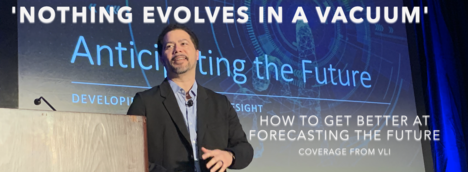
But first he offered a cautious reminder: “When we talk about the future we are influenced by the past. But what we value and see as appropriate changes over time.
“The world is in fact in the midst of a transition,” continued Lum. “Many of the assumptions, the structures and the systems we have come to rely upon are under pressure due to a whole number of changes on multiple levels: daily practice and life, infrastructure, laws, and values. There are generational changes. And all of these are going on at the same time and they are interacting.”
Despite the frequent pushback to change, Lum said change is in fact desired by many people. One big difference today: Increasingly, they are empowered to pursue the changes.
Rethinking Your Thinking
Lum is an academically trained futurist in the field of future studies, which is fundamentally concerned with trying to understand and anticipate change in society. His goal, and that of other similarly trained futurists, is to get people to “rethink what it is you want the future to look like. Most folks were desperately hoping I will walk into the room and tell them what is going to happen next—I cannot.
“True prediction is not possible. When we say prediction we mean a statement that is intended to be accurate,” he explained. “We don’t do predictions, we do forecasts, which are statements about the future that are intended to be logical.”
To that end, Lum said he is brought in by organizations to analyze high-change scenarios and mapping out how systems will change and where the wild cards might lie.
What can’t be ignored and in fact deserves special attention, according to Lum, are the notions and fringe thinking of today that should they survive will have enormous effect tomorrow.
“Emerging issues is the attempt to anticipate what might come. Often, we identify these things early on, but they’re crazy, goofy things, weird business models. Those that survive usually have a huge impact on the world around us,” he said, adding, “This is a period of genuine turbulence.”
Contributing to that turbulence are these factors Lum urged credit unions to be thinking about:
Global Context
The World Wants Change. Geopolitically, this includes the rise of China. “China doesn’t want to destroy the system, but it does want to change it. It wants to dominate many markets and next-generation technologies, and it wants to influence the governance superstructure of the world,” he said.
At the same time, there is a retreat from the American-led global order that Lum said is not historically unusual, as America has gone back and forth on whether it really wants to lead the world.
“Increasingly, many of the actors in the world today are empowered to pursue change. As much as we grew up thinking everybody else likes the world order we helped create, it turns out not so much,” said Lum. “One of the things important to understand is that today, unlike most of human history, almost any individual can be an innovator and in a meaningful way, genuinely coming up with solutions.”
The Built Environment
The Built Environment, explained Lum, refers to the Internet of Things in which sensors are plugged into every conceivable object.
“We are frantically building out this digital infrastructure. And one of the things people are using these systems for is societal surveillance. China is the poster child, but they are not the only ones. They call them ‘social stability techniques,’ and they have a strategy of selling these to cities and countries around the world,” Lum told the meeting. “It’s AI, facial recognition, and all kinds of things. It’s not just cameras, its connecting all aspects of your life.”
Totalitarian leaders have especially embraced those types of monitoring technologies, but Lum also made clear the same trends are taking place in the United States where companies—including credit unions--love the idea of real-time granular data.
“These systems and technologies as we deploy them are building the business models based on fine-tuned data models and linking it to all aspects of our lives,” he said.
The Machine World
Lum said the “Machine World” is one of the big transitions now taking place.
“It is becoming its own ecosystem of data, networks and machine learning and robotics and all kinds of things,” he said. “Many of us are competing to build out machines, such as software and AI, as well as robots. They are all connected, because they are all digital.”
He noted, for example, the autonomous car and other seemingly standalone technologies are anything but, as they are all just platforms for technology to slide across.
“We are starting to build machines that are more like us, that can process new types of information, can access what we want, and we are building them cognitively as well as physically,” said Lum. “Don’t think of AI in this one monolithic sense. Think of all kinds of machines being created for specific purposes. We are having to shift to see these machines as actors in their own right as we grant them more autonomy. They are going to exhibit the same kinds of unpredictable behaviors that we do. There are going to be lots of behaviors we can’t predict.”
Climate Change
Climate change is going to sweep up credit unions and their members as it has a huge impact on urbanization, housing, food systems, energy systems and more. “It is just going to ripple and ripple and ripple,” said Lum.
Synthetic Biology
Might the credit union need to be shut down in the future because a member created a new pathogen? Perhaps, suggested Lam.
“We now have synthetic biology; we can build synthetic organizations that nature never put into the world and we can build them from scratch,” he observed. “Some of those doing the most interesting work are amateurs, they’re kids.”
That work isn’t regulated, resources are readily available, and no training is required, which has raised fears over people intentionally or accidentally creating genetically engineered pathogens, according to Lum.
Social Worthiness as the New FICO
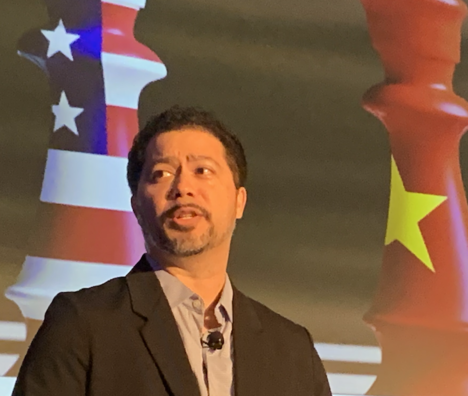
Dr. Richard Lum speaking to Volunteer Leadership Institute in Kauai.
In the future, said Lum, people can anticipate more and more groups, not just countries or big corporations, are going to have access to all the data being collected to create profiles of consumers and around how each person behaves.
“Privacy no longer exists like we knew it,” he said. “My kids don’t know a world where you can hide stuff.”
In China, he noted a social score already is factored into the rights and privileges of individuals and how they are shared or limited.
Privatized and Community-Based Governance
Today’s world in which where is an expectation that government is ever-present is an aberration, said Lum, and hasn’t been an expectation during much of history.
“The challenges from our interconnected world are wickedly complex and our governments aren’t always up to the challenge, and increasingly we are seeing people using technologies to solve local things,” he said.
Blockchain and other technologies were initially a response by people looking to disintermediate society, Lum said.
Machine Charities
Machine Charities is how Lum describes peer-to-peer financing and socially responsible investing schemes that are managed by machines, with the same technology driving the profits and investments as well as how funds are provided to charities and philanthropy.
Crossing the Chasm
While there is pressure to change, Lum said there is also always pushback. For instance, the forces against change inside credit unions include regulation, high barriers to entry, legacy infrastructure and strategy, cultural resistance and entrenched preferences.
Informing and Inspiring Developing Foresight
Lum said credit union leaders can participate in and shape the future by informing and inspiring development foresight. This can be done through an exercise in which participants map out the entirety of the range of futures.
“This is where your future business model changes, if you still exist at all,” he said. “In doing all this work we are trying to avoid the really bad stuff. You’re trying to avoid missing the big threats and big transitions and see how competitors are responding, how new competitors are emerging.
“At the same time you cannot predict the future. So none of these statements, none of this work, is an exact statement of what is going to happen,” Lum continued. “But we want to be proactive. Everyone in this room has agency. You probably have a greater capacity to make things happen than the average person in the United States. What we’re trying to do is identify issues earlier than other people.”
Reframing for Strategic Thinking
In reframing strategic thinking, Lum cautioned again to understand how history influences views of the future.
“We have to reframe, we have to see more, more than credit unions, more than financial services,” he said. “For a lot of changes we are seeing an acceleration of how fast they are coming.”
Lum urged credit union leaders to see changes in three layers:
Surface: Frequent change, usually small impact
Systems: Changes takes longer, making change is harder
Worldview: slow, long-run change
“Nothing evolves in a vacuum: you must try to understand how do things interact, amplify and dampen each other,” he said.