

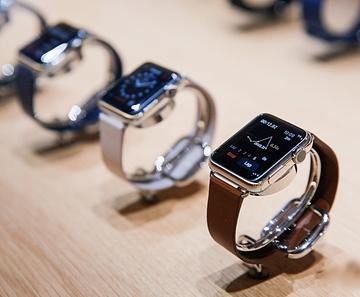
ST. PETERSBURG, Fla.—Apple Watch goes on sale next week, but don’t expect its introduction to make a significant impact on mobile payments near-term, say experts who predict the smartwatch initially won’t give Apple Pay much lift.
Analysts say it will take time for consumers to determine what they will primarily use the watch for. In addition to handling mobile payments Apple Watch monitors heart rates, connects with fitness programs, shares photos, sends and receive calls via an iPhone and a lot more.
Several experts think many consumers may decide to simply stay with their iPhone for payments and use the watch for other things. But other analysts and reviewers have suggested just the opposite, that the smartwatch will become the channel of choice for payments.
“It’s interesting that the watch’s cost is more than a smartphone but it has the same capability,” said Jeremiah Lotz, VP of digital experience and payments for PSCU here.
The watch is priced from $349 to as much as $17,000 for a version made of gold, and consumers are getting in line to buy them—as soon as Apple Watch web pre-orders were permitted April 10, the watch sold out in less than six hours.
“Cost and use case will be the determining factors—time will tell which use case people are willing to pay that amount of money for,” said Lotz. “For example, will they see it more as a fitness tool, a payments device, a way to receive notifications or something else?”

Tom Davis, CSCU
While Lotz does not think the watch will do much to lift Apple Pay transactions in the near future, it will increase transactions marginally because the watch’s payments feature can be provisioned with an iPhone 5. Currently, consumers can only use Apple Pay with an iPhone 6. But with the watch’s payment functionality managed by the phone, iPhone 5 users can set up their cards on the watch and use Apple Pay.
“This will make some difference in the number of Apple Pay transactions, but I am not sure how much,” said Lotz.
Tom Davis, senior vice president, emerging payment technology at CSCU in Tampa, Fla., contends that iPhone 5 users now being able to use the watch for mobile payments won’t do much to increase Apple Pay usage. “If you are going to buy an Apple Watch just for payments, you are better served upgrading to an iPhone 6. It costs less and offers more functionality.”
Davis thinks the mindset of consumers buying the watch will be to obtain a new device that can be used for many applications. “If you really want an Apple Watch you want it for all the things it can do, and certainly payments is part of that. However, I think the lift for Apple Pay from Apple Watch sales will be negligible.”
Sources indicated that Apple Watch brings an extra level of security to mobile payments. The phone has a heart rate monitor, which is used largely for fitness applications. But it also detects when the phone is not in contact with the users’ skin and then shuts down the watch. Users then must re-authenticate using their iPhone—which means another finger scan, and also a PIN entry on the Apple Watch.
“This is very unique,” said Davis. “This is the type of technology needed to make smart wearables more functional. I think many other smartwatch manufacturers will copy this.”
Sources who spoke with CUToday.info agreed that the future of wearable technology, and what the tech will be used for, will be determined by consumers. International Data Corporation forecasts smart wearables will top 25.7 million this year, more than five times the amount compared with last year.

Ryan Anderson, TMG
Davis believes smart wearables will become more relevant when display screens are less bulky, watches look more elegant, and screens are more pliable to be incorporated with clothing.”
“Really, things like Fitbit have caused people to say they will tag along another thing on top of their wallet and phone,” said Davis, who is unsure which Apple Watch functionality will appeal to consumers first.
Ryan Anderson, VP of product at The Members Group in Des Moines Iowa, is uncertain how much more convenient it will be to pay with a watch than a phone.
“My phone is in my hand all the time,” said Anderson. “So will waiving a watch versus a phone inspire more mobile payments transactions? That remains to be seen. And you have the cost of the phone, and you have to have an app on your phone to control the watch. This is another layer of friction.”
Apple Watch, noted Anderson, does little to overcome Apple Pay’s largest hurdle—limited acceptance at POS. “You have to have the reach at point of sale first.”
In Rancho-Cucamonga, Calif., Michelle Thornton, director of product development, CO-OP Financial Services, sees Apple Watch giving Apple Pay a slight lift.
“It is likely to boost Apple Pay to a degree, but adoption of Apple Watch is likely to be low relative to overall payment vehicles like cards,” she said.
Sources agreed that CUs enrolled in Apple Pay should remain focused on educating members on how to enroll their cards into the new payments solution and pay with their phones at POS.
But for credit unions with a membership base that is tech savvy, the organization should place wearables on the strategic roadmap.
“The question within the industry, for which we don’t yet have the answer, is ‘What is the right use case for the watch, and wearable technology in general?” said Lotz. “We will wait to see what unfolds with Apple Watch, and that will help guide us.”