

By Ray Birch
BIRMINGHAM, Ala.—The recent Supreme Court upholding NCUA’s 2016 field of membership rules means more CUs are seeking to expand their fields, especially to focus services on underserved areas, says Dennis Dollar.

The former NCUA chairman emphasized during a webinar sponsored by his company, Dollar Associates, that credit unions have been waiting for a green light from Congress to look at greater expansion.
“Since all of this has been held up in the courts for the last four years, that has created a lot of pent-up demand from credit unions to expand their fields of membership,” said Dollar. “And we have really seen that in the recent weeks following the Supreme Court decision—our phones have been ringing. Despite the pandemic, credit unions now are looking at expanding.”
As CUToday.info reported here, in June the United States Supreme Court upheld the October 2016 NCUA approval of a final rule to amend and revise the agency’s field of membership rules and regulations.
“After almost four years of uncertainty due to legal challenges, there is now clarity on what FOM options are available for credit unions,” stated Dollar. “This is welcomed news by many because, regardless of charter type. FOM policy still matters for every credit union in America that wants to grow. After all, new income requires new loans, which require new accounts, which require new members…all of which require more field of membership opportunity.”
Dollar emphasized asset size is critical to success, a point clearly displayed in credit union performance data for many years—the largest credit unions are responsible for the majority of the industry’s growth, while smaller CUs struggle with both lending and new member growth, a point regularly emphasized in CUToday.info reports.
The Importance of Scale
Digging into NCUA data, Dollar stressed the importance of scale.
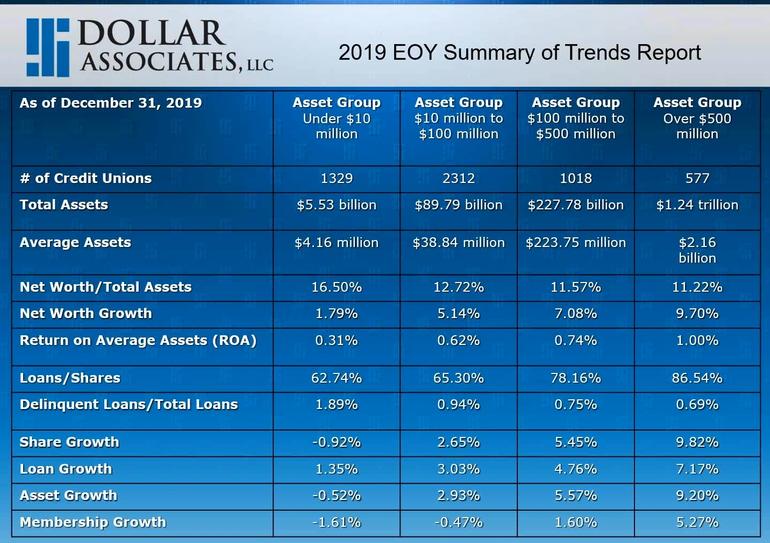
“The more scale the better the financial performance,” he reminded. “The larger credit unions are outperforming all others in every category, whatever the metric—membership growth, asset growth, ROA…” (see chart).
For instance, Dollar pointed out at the close of 2019 credit unions with more than $500 million in assets had 1% ROA, while small shops, those $10-$100 million (.62%) and under $10 million (.31%) lagged well behind.
“Where there is scale there is performance,” he said.
The New Rules
Dollar said the 2016 NCUA rules, even though their full implementation was delayed for four years by the American Bankers Association’s “dilatory” legal actions that were ultimately dismissed by the courts “almost in their entirety,” make FOM less complex and restrictive than the much tighter 2010 rules, but not as simple and expansive as the 1999 and 2003 rules had been, explained Dollar.
“They are a good balance between the more expansive federal FOM rules of 1999 and 2003 and the considerably more restrictive 2010 rules. NCUA deserves commendation for not only enacting these more modernized rules, but also for their staunch defense of them in court—a defense that was ultimately upheld all the way to the U.S. Supreme Court,” said Dollar.
While there were some great provisions to help SEG-based credit unions, among the biggest improvements in the 2016 rules over the 2010 rules are found in the area of community charters, rural districts and underserved areas—each of which are made easier to define and broader based, asserted Dollar.
The Key
“The ability to expand membership and develop a more scale-efficient balance sheet is key to credit union safety and soundness,” stated Dollar. “Of course, the bankers don’t want to see their credit union competitors be able to grow without more restrictions and limitations placed upon them. They want to see credit unions stymied in their ability to compete and build the scale necessary to do so. Essentially, that is why they went to court—it was an attempt to use the courts to try to restrict the ability of their competition to grow and build the scale necessary to compete.”
Dollar said NCUA was right to try to continue to update its FOM rules with the times, as it is a responsibility given to the agency by Congress.

Dennis Dollar
“All regulation needs to be modernized as the marketplace changes, and certainly FOM is no exception,” he said. "Some credit unions became so frustrated waiting for the court appeals to play out that they forgot how reasonably flexible the 2016 FOM rules were. Now that they have gone back and read the rules, credit unions are really examining the options.”
‘A Lot of Calls’
Dollar said his firm has received several-dozen calls in just the few weeks since the Supreme Court ruling, with almost all of the credit unions looking to either expand an existing community charter or rural district—or to move to a community charter or rural district.
“We are also getting a lot of calls about extending service into underserved areas by SEG-based credit unions, which is, for them, a great option that is somewhat easier and more expanded under these new rules,” Dollar said.
According to Dollar, the 2016 NCUA rules are good policy and offer some solid FOM expansion opportunities for many credit unions of all asset sizes.
“Some have the view, because the bankers mostly focused on the community charter provisions that the 2016 rules only benefit community charters,” said Dollar. “While there are some definite community charter expansion options under the new NCUA rules that will be very meaningful, there are also some expanded options that are worth checking out for SEG-based credit unions, those seeking to serve underserved areas and those serving largely rural populations.”
“Well-Balanced’
Dollar pointed out SEG-based credit unions can take in veterans if they have a military component, can serve entire office complexes and industrial parks without having to sign up every single business, and can expand into larger underserved areas to obtain a geographic component along with an employer and associational base.
“The rules were well balanced, totally within the letter and spirit of the Credit Union Membership Access Act of 1998 and a solid step forward from the more restrictive 2010 rules—both for community charters and SEG-based FCUs,” said Dollar.
Among the provisions that benefit community charters the most is that a community FCU can apply to serve, for the first time, a CSA (combined statistical area) if they have the financial capacity and a solid business plan to do so, said Dollar.
“A CSA is a combination of contiguous MSAs (metropolitan statistical areas) that have documented interaction with each other or an expansion of a MSA into surrounding counties that share common interaction of a community nature. Previously, under the 2010 rules, all federal credit unions were limited to a single MSA or portion thereof,” he explained.
‘Great Options’
Dollar said there are “great” FOM options for both smaller and larger credit unions in the new NCUA rule.
“Smaller credit unions can take a portion of a community and not have to stretch themselves too thin by taking on a whole MSA or CSA,” he said. “In addition, as mentioned before, smaller SEG-based credit unions can serve entire office complexes, shopping centers and industrial parks without having to sign up each individual business as a separate SEG. This is very helpful for smaller credit unions. Both larger and smaller SEG-based credit unions can apply to serve one or more underserved areas through a process that is considerably less restrictive under the new 2016 rules than it was under the 2010 rules”
The new rules are particularly beneficial for credit unions serving rural communities because, as long as the population density stays below the established rural definition of 100 persons per square mile, a rural district community can now cross contiguous state lines and have a total population up to one million, pointed out Dollar.
A Four-Fold Increase
“This new rural district provision represents a four-fold increase over the 250,000 population cap for rural districts under the 2010 rules,” Dollar explained. “That population cap increase is huge for credit unions serving rural areas where people have to drive an hour to get to a branch and may not have broadband to access bank digitally. Larger rural service areas for the lower-cost financial services that a credit union provides will literally impact the lives of millions of rural residents."
Dollar suggested the modernization of federal FOM rules will also benefit state-chartered credit unions in most states because of state parity laws—a benefit of the dual chartering system.
“In actuality, some states had a much more expansive approach to their FOM options for state charters than NCUA did for federal charters long before the new rules were adopted,” Dollar said. “Many remain more expansive even after the new NCUA rules were finalized. Of course, some other states are more restrictive than NCUA. That is the nature of dual chartering. It is, as it has long been, a state-by-state issue. There is no doubt, however, that the new NCUA rules have improved the viability of the federal charter from an FOM perspective. States with parity laws will see their state-chartered credit unions benefit from the new NCUA rules as well. FOM is one of the areas where the dynamic nature and value of the dual chartering system comes to bear in a powerful way.”