

TUSCON, Ariz.–The man who co-founded the hugely successful start-up Square had what many would consider a surprising message for credit unions here—they really shouldn’t be trying to innovate.
That is a position that runs counter to nearly every presentation made to and by credit union leaders in recent years, and yet Jim McKelvey told Co-op Solutions’ THINK 23 event there is a much better alternative for every CU unless it has absolutely no other choice. And in those cases, the payoff can be big.
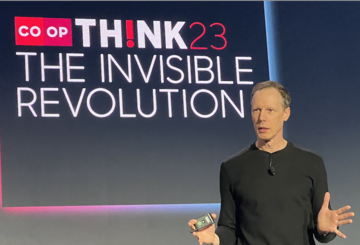
Jim McKelvey speaking to THINK.
McKelvey has one of the most diverse resumes of anyone. He was a professional (and successful) glassblower who went on to co-found (with Jack Dorsey) the near ubiquitous among small business payments solution Square (now called Block); who founded the venture capital firm Cultivation Capital; who was appointed to the board of the Federal Reserve Bank of St. Louis, who authored a book, and who then co-founded the company Invisibly, which seeks to give consumers control of their data.
The Lesson Learned
The message McKelvey shared was rooted in his experience in creating Square, which was founded in 2009.
“Everything was good,” he said of the start-up. “And then Amazon showed up and they wanted to take over our entire market. It’s hard to describe the feeling, but let’s just say the odds aren’t very good. In 2014, a startup had never survived an attack by Amazon. Amazon copied our product, undercut our price, added the Amazon brand name and they expected we would just die. What could we do?,” he asked. “The first thing we did was look for any other company that had survived an Amazon attack. There were none. We were a little startup. We all do business with Amazon. I wrote a book about Amazon. Guess where I’m selling it?”
Finding no answers, McKelvey said Square’s strategy eventually became doing “absolutely nothing.”
A Nagging Question
“And it worked. We fought Amazon for about a year and after a year they gave up. They quit. They got out of our business. They actually mailed a Square credit card reader to all of their customers,” he told the THINK meeting. “We felt great--for about a day. Because this question started nagging at me. What the hell happened? Start-ups don’t beat Amazon. And yet here we were. This question gnawed away at me. This sent me on a research quest.”

A Square card reader.
That quest, according to McKelvey, led him to hundreds of other companies in similar situations that were “attacked viciously” and which were expected to perish “but they went on to dominate their niche. It was fascinating.”
McKelvey said he discovered there is no word in the English language to describe the phenomenon, but there used to be: entrepreneur. What is today a much-used word used to describe a certain type of business that wasn’t like other businesses, he said.
Copy This Message
In his research quest, McKelvey said he came to understand that what unites all entrepreneurs is they lack access to the world’s most powerful force: “copying.”
“We’re all copies. Copying is the most powerful form of succeeding at a task that you can have,” he suggested. “It is so powerful that it is literally wired into our DNA. Copying is good. Copying works. Copying is the thing you probably should do most of the time. If you have a solution, great, but if you don’t, find someone who does and copy what they did. That’s smart.”
There is one circumstance, however, when he said copying doesn’t work, and that is when there is nothing to copy. This is a scenario McKelvey described as the “perfect problem,” a seemingly unsolvable challenge that is in fact solvable.
“If we do something new we can solve those problems. When we started Square we had no idea about this. We sort of stumbled upon it,” McKelvey said.
McKelvey explained that Square came about when he was working as a glassblower and he and other artists were losing sales due to an inability to accept credit cards or certain credit cards. At the time he had already partnered with Dorsey on a company when he called his partner and told him what he had experienced and suggested a big pivot.
A Lesson From Bob
That pivot was motivated in part, he said, by an opportunity to serve other people like another glassblower whom he said was named Bob.
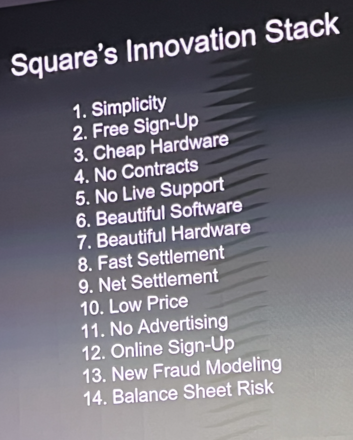
“Bob was one of these people the financial system was designed to avoid,” said McKelvey. “Bob doesn’t have access to the means of commerce I do. He was an economic outsider. So, when we built Square my goal was to build a system that could somehow accommodate Bob. We realized the entire system was designed to keep people like him out. I will tell you the profits made in processing payments for small businesses are 45x higher than the profits made from big businesses. We had to invent 14 things that had never been done before, and it was very, very difficult to copy. When Amazon tried to copy it, they had no idea we had these 14 things.”
In thinking about that experience McKelvey said he came up with the idea of the “innovation stack” (shown at right).
“I think innovation is something that is really misunderstood. We like to think of innovation as cool. It’s actually not; it’s kind of a last resort,” he said. “It’s something we are so deeply uncomfortable with we don’t do it. And when I saw this pattern at Square I saw all these other companies that had also done it: Southwest, Tesla, Bank of America, IKEA, BirdsEye.”
The Book’s Message
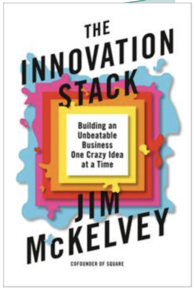
Those companies and the lessons learned are part of the focus of his book, “The Innovation Stack.”
“The message of the book…is innovation is the thing you should do if all other things fail,” he said. “Were the Wright Brothers qualified pilots? Could it be possible to be qualified pilot? The first time something is done there is no training available, no YouTube video, no conference to go to to copy your peers. My message is nobody is an expert the first time. And yet that is where progress comes from.”