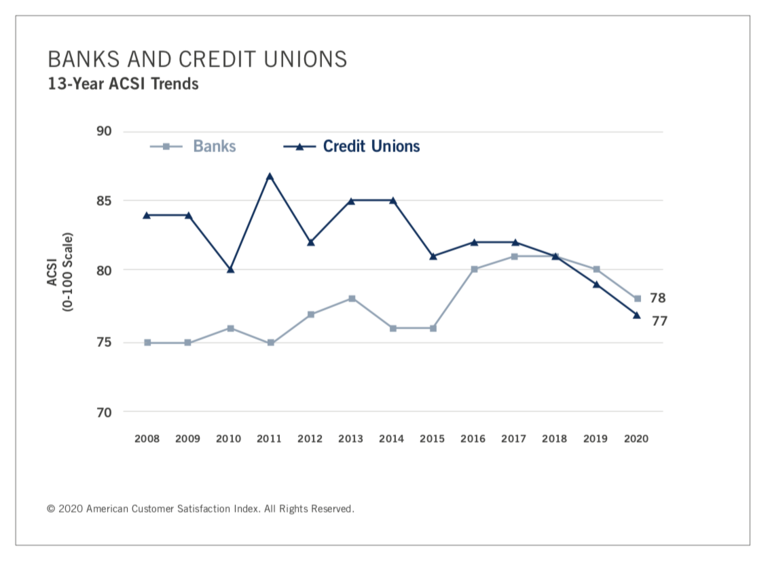
ANN ARBOR, Mich.–Credit unions have not only for the second year in a row fallen behind banks when it comes to consumer satisfaction, they also now sit at a “historic low” in one respected national survey.
Credit unions fell 2.5% to a score of 77 on a 100-point scale in the 2020 American Consumer Satisfaction Index (ACSI) conducted by the University of Michigan in conjunction with the American Society for Quality in Milwaukee and CFI Group in Ann Arbor, Mich. If there is any silver lining to be found, it is scores declined across a number of industries.

The nation’s banks achieved a score of 78.
As CUToday.info reported in 2019, one year ago credit unions fell behind banks for customer satisfaction for the first time in ACSI history. The 77 satisfaction score given credit unions by Americans in 2020 is the lowest ever and 10 points below the peak CU score of 87 in 2011.
“According to ACSI data, member satisfaction with credit unions significantly weakened during the COVID-19 pandemic—a phenomenon that did not hit banks,” the organization said. “For the six-month interview period from April to September 2020, satisfaction with credit unions is significantly lower (75) compared to the previous six months (77). Perhaps more so than bank customers, credit union members may be missing the personal touch that their institutions could more easily achieve prior to the constraints of the pandemic.”
A Slide in ‘Courtesy’
The organization said the personalized service that once set credit unions apart diminishes for a second year.
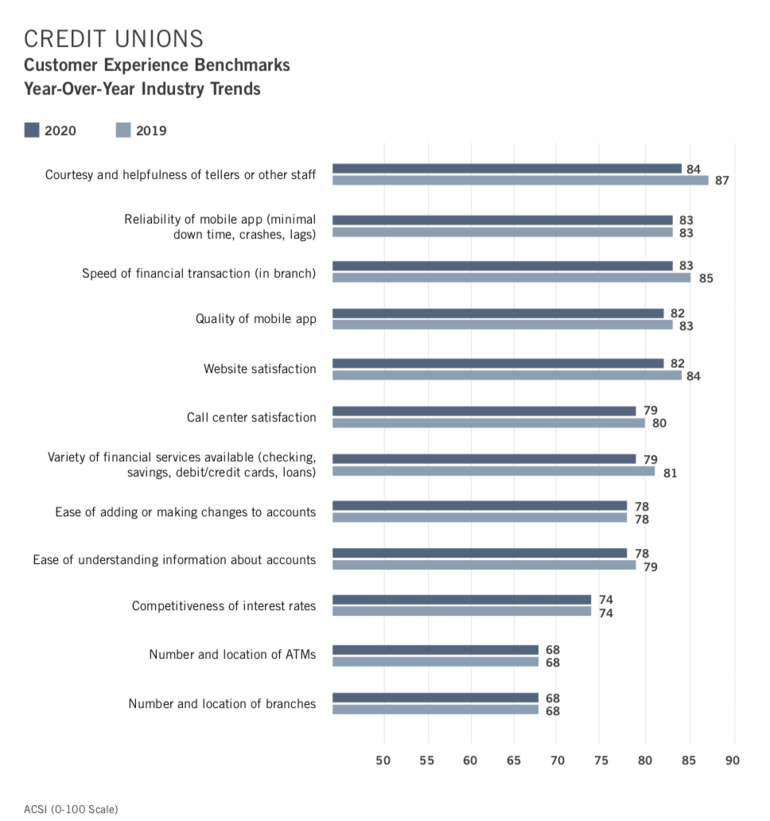
“After dropping 2% in 2019, staff courtesy slides another 3% to 84—far below the stellar score of 89 earned by credit unions in 2018,” the ACSI found. “Likewise, in-branch transaction speed erodes 2% to 83, following a 3% downturn in 2019. Banks now match credit unions for transaction speed (83) and beat them on staff courtesy (85).”
According to the ACSI:
- Credit union websites also lose ground for a second year as satisfaction wanes 2% to 82, trailing the bank industry (84). Mobile app quality (82) for credit unions slips for a second year showing a net loss of 4% since 2018. Mobility app reliability, however, is steady at 83.
- While credit unions have not gained any ground when it comes to providing more competitive interest rates, CUs are able to match banks in this area (74).
- Like smaller community banks, credit unions earn their poorest marks for the number and locations of their ATMs and branches (both flat at 68).
Overall Dissatisfaction
According to the ACSI findings, Americans have found little to be pleased about when it comes to financial services, insurance, and health care as customer satisfaction falters across the entire gamut of the industries it measured this year. Overall, the Finance and Insurance sector waned 2.3% compared to a year ago, reaching a score of 76.0 on the ACSI.
“Not a single industry escapes the downturn as banks, credit unions, Internet investment services, financial advisors, property and casualty insurance, life insurance, and health insurance all show customer satisfaction declines year over year,” the ACSI survey found.
The ACSI results are based on surveys conducted over a 12-month period from October 2019 through September 2020.
“Overlapping roughly half of the interview period, the COVID-19 pandemic upended business as usual for these sectors and accelerated the shift to online and mobile customer interfaces that was already underway, particularly among financial service providers,” the analysis found. “According to ACSI data, however, the pandemic alone did not drive the entire wave of dissatisfaction. Instead, it amplified trends already present in the earlier portion of the survey period. For some industries such as banks, credit unions, and hospitals, the negative trend goes back further as satisfaction falls for the second straight year.”
Less Satisfaction With Banks
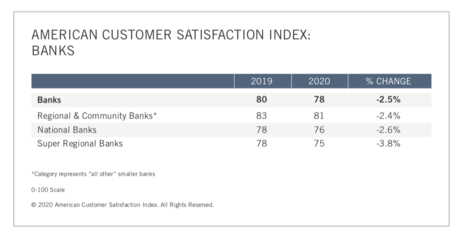
According to the Satisfaction Index, customer satisfaction with retail banks overall retreats 2.5% to an ACSI score of 78, following a smaller decline one year ago. For banks as a whole, satisfaction has not dropped down into the 70s since 2015, the analysis stated.
“The startling pattern for 2020 is the relentless wave of dissatisfaction—across both bank categories and individual firms. All institutions, both large and small, show some erosion in customer satisfaction, making the decline an industrywide phenomenon,” according to the report.
The Specific Findings
Among the ACSI findings related to banks:
- While banks closed branches temporarily when COVID-19 first hit, most have since reopened. Among ACSI survey respondents, roughly 60% report visiting a branch within the last six months, while about 70% have made use of mobile banking within the past three months. “During the period overlapping the COVID-19 pandemic from April to September 2020, bank visits decreased only slightly, with a small uptick in mobile usage. At least for now, both mobile banking and in- branch visits remain important components of the banking experience for customers,” the organization said.
- Smaller regional and community banks continue to set the pace for customer satisfaction with an ACSI score of 81, but they are down 2.4% year over year. Likewise, national banks fall back 2.6% to 76, while super regionals take the biggest hit—tumbling 3.8% to a category-low of 75. Across nearly every element of the customer experience, super regionals perform worse compared with either national banks or small community banks. “But even more revealing, super regionals show steeper declines in these customer experience elements relative to the other categories this year.”
- The 2.6% drop in customer satisfaction for national banks erases a smaller gain the category posted one year ago. In 2020, all four national banks moved backward from the record-high or near-record-high scores they posted in 2019, the report states. In addition, the range in satisfaction scores for big banks has narrowed considerably, with all four now scoring within two points of each other.
- The largest drop in customer satisfaction among big banks occurs for last year’s category leader, Citibank. With a 5% loss in customer satisfaction, Citibank drops into a tie with Chase (-3%) at 77.
- A notch below Citibank and Chase, Bank of America suffers a 3% drop in satisfaction to 75. The decline places Bank of America in a tie with category laggard Wells Fargo (-1%). In the aftermath of its fake account scandal in 2016, Wells Fargo has ranked last for satisfaction among national banks for four straight years, the report found, adding, “On the other hand, Wells Fargo shows considerably less erosion in its customer experience than the other large banks. In fact, Wells Fargo even manages to improve the competitiveness of its interest rates this year, according to its customers.”
- The bottom of the category belongs to Fifth Third Bank and KeyBank, which both posted record lows for satisfaction this year. Fifth Third Bank suffered the biggest ACSI decline among all banks, diving 6% to 73. Meanwhile, KeyBank retreats 5% to 72, the lowest ACSI score earned by a super-regional bank since 2015.
- For the bank industry overall, the customer experience has worsened across nearly every element, the report states. Staff courtesy and helpfulness remains top-rated for banks (-2% to 85), but this is the second straight year of decline. According to customers, in-branch transactions are taking longer (-2% to 83). Likewise, factors relating to service variety or accounts rate less favorably this year.
- Along with in-person customer service, mobile apps continue to do well but show signs of strain. Both mobile app quality (84) and reliability (83) slip slightly for a second year. The more mature website channel (84) also dips down a point for two years running. Call centers lag further behind as more banking goes digital (-2% to 79). As in previous years, customers want better interest rates (74), more ATMs (73), and more branches (70), the analysis found.
About the Survey

According to the University of Michigan, the American Customer Satisfaction Index (ACSI) is the only national cross-industry measure of customer satisfaction in the United States. “This strategic economic indicator is based on customer evaluations of the quality of goods and services purchased in the United States and produced by domestic and foreign firms with substantial U.S. market shares,” the organization said. “The ACSI measures the quality of economic output as a complement to traditional measures of the quantity of economic output.”