

By Ray Birch
LAKE FOREST, Ill.—The COVID-19 pandemic is driving overdraft prices lower, according to third quarter data, which also show banks are beginning to offer better OD prices than credit unions.
The key reason for falling overdraft prices: Working at home is giving people time to rethink banking, particularly checking, according to Michael Moebs, economist and CEO at Moebs $ervices, who predicts the era of the $30 average overdraft price is coming to an end.
Q3 overdraft revenue is down to $30.8 billion from $34.6 billion for the same period in 2019, the latest Moebs $ervices Overdraft Study shows. The current median overdraft price is $30, with the average being $30.49, down from $31.89 in Q2, a 4.3% drop.
“Furloughed workers and those without jobs are watching every penny. OD fees cannot be afforded,” said Moebs. “Plus, many workers have stored stimulus money in checking causing fewer overdrafts.”
A Brighter Future—For FIs
But Moebs said the future for overdrafts looks somewhat brighter—at least from a financial institution revenue standpoint. With unemployment falling to 6.7% and many workers back on the job, Moebs said he expects a slight uptick in overdraft volume.
“Plus, vaccines will stimulate the economy and overdraft activity,” he said.
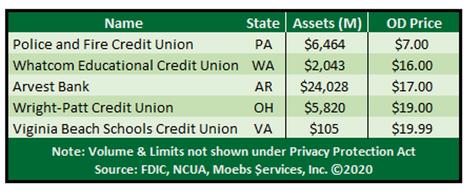
The latest Moebs $ervices Overdraft Study shows that for the first time since the firm began collecting overdraft data in 1986, more banks have an overdraft price under $20 than credit unions. Still, credit unions offer four of the five lowest overdraft prices in the nation (see chart), with $6.4-billion Police & Fire CU in Philadelphia coming in with a rock-bottom $7 charge.
“And some of these are banks with large asset sizes,” stated Moebs. “Overall, more depositories are moving to a lower OD price. Banks are now realizing low overdraft price not only benefits the customer, but also their bottom line too. All five depositories shown (see chart) have OD revenue three times the normal depository overdraft revenue level.”
How Do They Do It?
How are the top five FIs able to offer the low prices?
“These depositories show three key elements making for outstanding overdraft service,” said Moebs. “Each of these financial institutions have a price less than almost all payday lenders in the nation. Payday lenders charge $18 to $20 for a $100 payday loan. Take the price and amount offered and each of these depositories beats any payday lender in the country. This helps workers who are still unemployed and need access to short-term cash.”
Moebs pointed out the limits offered by each FI in the top five are at least double what is offered by most banks, credit unions and savings banks.
“Limit determination is risk based. The limit considers price, volume, relationship, compliance, cost, value, competition and institutional risk,” Moebs sai

Michael Moebs
d. “The limits today are not your grandma’s limits but incorporate the wide and in-depth sphere of all these risks. Banks and credit unions with $500 limits, the national average, are not helping the unemployed and hindering their own revenue.”
Moebs suggested the combination of low price and larger limits produces volume, which is more than triple national overdraft revenue standards.
“This produces a benefit these financial institutions can provide especially in these troubling times with the coronavirus,” Moebs said. “Consumers benefit knowing their payments will be accepted or won’t bounce. Banks and credit unions benefit with more revenue.”
The End of an Era
Moebs emphasized his belief the era of high overdraft fees and low overdraft limits is over.
“Soon, with the start of the third decade of the third millennium, the consumer will experience a checking account which will help them and not hinder how they conduct financial transactions,” he said. “Penalty pricing will fade reflecting a progressive approach to risk by more and more banks, credit unions and savings banks. The stigma of making a mistake in checking will be replaced with an approach allowing for errors without heavy penalties. The biggest beneficiaries will be the banks, credit unions and savings banks obtaining more revenue from more volume. 2021 will be the year overdrafts become no more than a parking ticket.”