

By Ray Birch
LAKE FOREST, Ill.—With apologies to Bob Cratchit, credit unions should hope for a little more pre-ghost-visit Scrooge this holiday season than post-ghost-visit Scrooge, according to one economist.
“As the holiday season approaches there are three choices: Christmas of dreams, Christmas of means or Christmas of Scrooges,” said Michael Moebs, economist and CEO at Moebs $ervices. “The consumer has $2.159 trillion in excess checking—dollars above normal change. Will they spend, save, or invest? The holidays will dictate the level of recession to follow and the degree of inflation or deflation.”

Moebs said the odds of the consumer spending down the $2.2 trillion in excess funds during the holidays will be affected by the still ongoing mid-term elections, as well as, potentially, Fed policy.
“The longer it takes for Georgia in the Senate and a couple of dozen House seats to determine the election outcome, the less likely the consumer will spend for the holidays,” said Moebs. “If the outcome is a deadlock (Democratic Senate and House Republican) in Washington, then the consumer will cautiously spend—but not to the extent of $2.2 trillion.”
Moebs is predicting that if consumers and small businesses do not spend the $2.2 trillion in excess funds, inflation will fall, and the consequences of a recession will be minimal.
“Conversely, if the $2.2 trillion is spent, then inflation will remain high and a long recession will happen,” suggested Moebs.
Moebs pointed out that as Fed Chairman Jay Powell sells Treasury bills and bonds at $95 billion a month, reducing the deposit monetary stock, it will take 23 months to burn off the $2.2 trillion in excess funds in consumers’ accounts.
“This will reduce the excess funds in checking about the time of the presidential election (in 2024),” said Moebs.
The Ebbs & Flows
Moebs added, too, that understanding the ebbs and flows of deposit monetary stock gives insight into the economy and the marketplace.
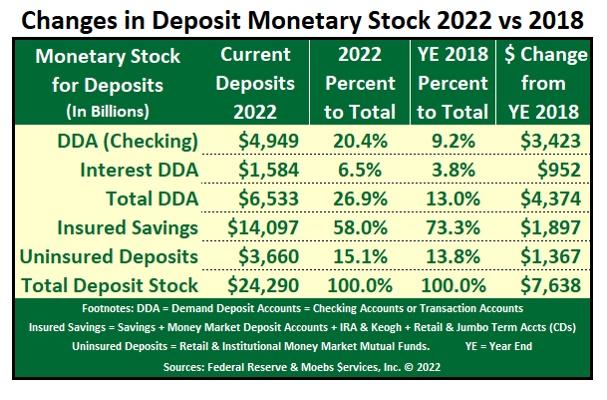
“Assessing pre-COVID numbers using year-end 2018 as the base provides answers to inflation and the degree of potential recession in 2023 and beyond,” added Moebs. “The base dollar number in total deposit stock is $24.290 trillion for 2022. At year-end 2018, this was $16.652 trillion. This is an increase of 45.9% over four years. One must go back to 2006 to get the same increase, or 12 years.
“Insured savings deposits show a decline of 15.3%. This is being hidden by the enormous increase in monetary stock for all deposits as a result of Congress approving several COVID stimulus funds,” continued Moebs. “The tool is money, and if Chair Powell would double or triple his sales of Treasury bonds, there will be a very modest recession and inflation will fall in the next six to 12 months as deposit monetary stock falls.”
The Implications for FIs

Michael Moebs
What are the implications for financial institutions? Moebs believes there are two things to watch.
“Since consumers and small businesses have excess money, depositories are chasing this money with higher rates. This drives up the interest cost for each institution and potentially lowers the net interest margin and bottom line,” said Moebs. “Fees, rates, and balances drive the price of financial services. If rates go up to get more balances, this will drive down fee revenue for fees associated with minimum balances and direct fees like overdrafts and official checks…”
As he has often told CUToday.info, Moebs said fee revenue can be maintained by lowering the fee price to stimulate volume, which increases volume and drives greater revenue.
Telling the (Holiday) Story
Moebs acknowledged it is difficult for the Fed to manage monetary policy in this environment, just as it is not easy for a financial institution to manage its deposits.
“Money has become very, very short in duration. The behavior of any consumer or small businessperson after being cooped up for two years due to the pandemic can be unpredictable—spend, or save, or invest,” said Moebs. “The holidays will tell the story as to whether the impending recession is short or deep.”