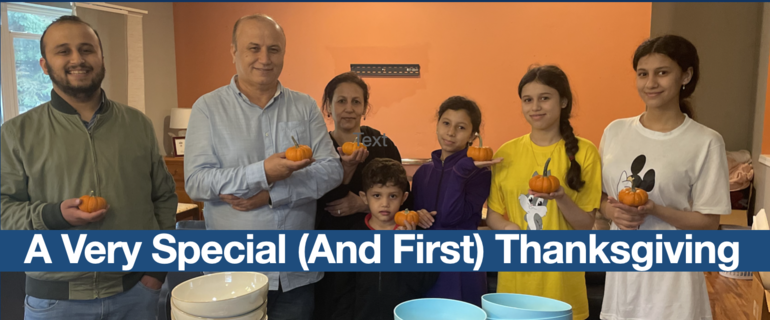
MADISON, Wis.–Thanksgiving may be a long-held traditional holiday for Americans, but few will celebrate the true meaning of the day more this year than some of the country’s newest residents–in this case, the former leader of Afghanistan’s credit unions, who escaped death threats from the Taliban and who, with U.S. credit unions’ help, is now residing in Madison, Wis., with his family. And he’s about to start a new job with a credit union.
As CUToday.info has been reporting, Bashir Khan had served as CEO of the credit union trade association in Afghanistan, the Islamic Investment & Finance Cooperatives Group, which during the time the United States had a major presence in the country was a direct member of the World Council of Credit Unions.
But the U.S. exit from Afghanistan and the rapid reemergence of the Taliban put in danger those who had worked with the Americans, including Khan, who was briefly held captive by the Taliban and who eventually had to pay a sizeable bribe to escape the country with his family.
Khan, his wife and five children found refuge in Islamabad, Pakistan, where with considerable help from former World Council of Credit Unions’ CEO Brian Branch and with assistance from the office of Sen. Tammy Baldwin (D-WI), the family finally obtained visas to come to the U.S., thanks to generous help from the Wisconsin CU League, which picked up the $20,000 tab for the airline tickets.
And now, after all that, the Khan family is preparing to celebrate its first American Thanksgiving.
As Khan told CUToday.info, it has been a “long process.”
“I am very thankful for Brian and everything he and other friends did,” Khan said.
A Long Trip to America
In early October, after some challenges related to visas for the children, the Khan family flew 1,400 miles from Islamabad to Doha, Qatar. From there, they flew another 7,100 miles to Chicago, where, due to queues going through immigration and security, they missed their flight to Madison. They finally boarded a bus for the final 150 miles to the heart of America’s dairy land and the Wisconsin capital, where their long journey in so many ways ended.
The family spent a month living in a Marriott Residence Inn before the credit union community helped them find a house to move into. During that time Branch reported that friends and former employees of the World Council drove them to a series of federal, state and county agency meetings that involved Social Security, family and child services, public health and more.
Others donated coats for the children as temperatures began falling, while the River Food Pantry provided a “generous weekly allotment of grains, meats, vegetables, breads, pizzas and pastries,” Branch said.
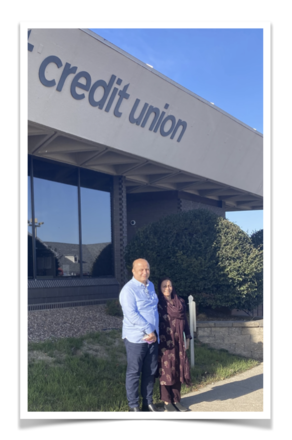
And one of the first things they did after receiving their Social Security cards was join a credit union, Branch related. Bashir and his wife, Bibi, each opened accounts at Summit CU.
As he did many times, Khan thanked “all the friends that cooperated and provided us with whatever we were needing.”
A Special Priority
Enrolling his children in school was especially important to Kahn, who had earlier told CUToday.info that his three daughters were not allowed to attend school in Afghanistan and that when it comes to women’s rights in the country, “There is nothing. They don’t respect women. They don’t allow them to work. They don’t allow them to go to school. I really want my daughters to get educated, my sons as well.”
Khan’s children are 20, 16, 14, 11, and six, respectively. With the exception of his 20-year-old son, who he said is preparing to enter college, they are all enrolled in Madison’s public schools. Branch had earlier shared that one person from Wisconsin’s CU movement had organized retired teachers to buy the school supplies required of students by each school, including notebooks, folders, pens, highlighters, erasers, markers, headphones, scissors, a ruler, calculator, water bottles and 42 pencils.
Backpacks were also purchased in the children’s favorite colors, and they began school on Oct. 2.
‘They Are Happy’
“They go to school now daily. They are enjoying it. They are happy,” Khan said. “So far, so good. Really good. We are happy to be in the United States and in Madison.”
Even while living in Islamabad, Khan said while his children were “OK,” the situation was challenging because he did not want to disclose his location and he also didn’t want the family to be moving around as they were eagerly awaiting the visas.
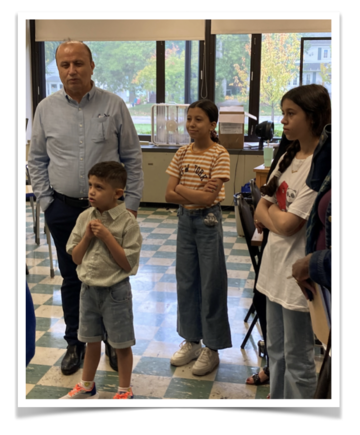
The Khan children get a tour of their new school.
He said his children have taken to their new school.
“The facilities are good. They are learning the language. They are making friends there,” Kahn said. “The teachers are very cooperative and very kind. The language is the barrier and they want to remove this barrier as soon as possible. It is a very unique experience they are having.”
Kahn said his children speak Farsi and Pashto, but are focused on learning English. “I am sure that in a few months’ time they will have learned the language,” Khan said.
He said there are other students at the school who are fluent in all three languages who are helping with translation.
It’s America. You Need a Car
Initially, Kahn said the family had some challenges because they lacked a vehicle and it was difficult to go to the market or to get out. But they now have a vehicle to use.
“Gradually, we are getting used to everything here,” Khan said.
Indeed, while his children were initially “anxious,” he said that has passed. “They have freedom. They have access to education. This is a huge difference.”
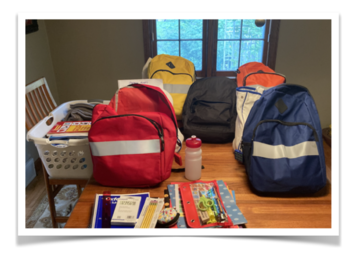
School supplies bought for the Kahn children by credit unions.
As happy as he is for his family, Khan is also happy to be going to work at Summit Credit Union, where he will work as a risk management analyst.
Another Type of Risk
Unfortunately, another type of risk has proven too much for the once vibrant CU movement in Afghanistan. Khan said he has tried to stay in touch with what is left of the credit unions in his former homeland, “But the situation there is very bad. They are closing one by one because there is no cooperation, there is a lack of funding.”
And, as he also noted previously, there is very little security and a total breakdown of the financial services system.
That is the sad news. The good news is the Khan family is getting ready for its first American Thanksgiving. And while he said they do plan to watch American football—especially his 20-year-old son who has gotten interested in the game—the Khan family will be mostly focused on what the holiday is supposed to be about.
‘I Am Very Thankful to All’
“Credit unions have helped us, 100%,” he said. “I am very thankful to all: to the credit union league, to (WCUL CEO) Brett Thompson, to the World Council of Credit Unions, to Brian Branch. I am very, very thankful to Brian because he did all those things for us. I am very thankful to all credit unions and those who helped us out.”
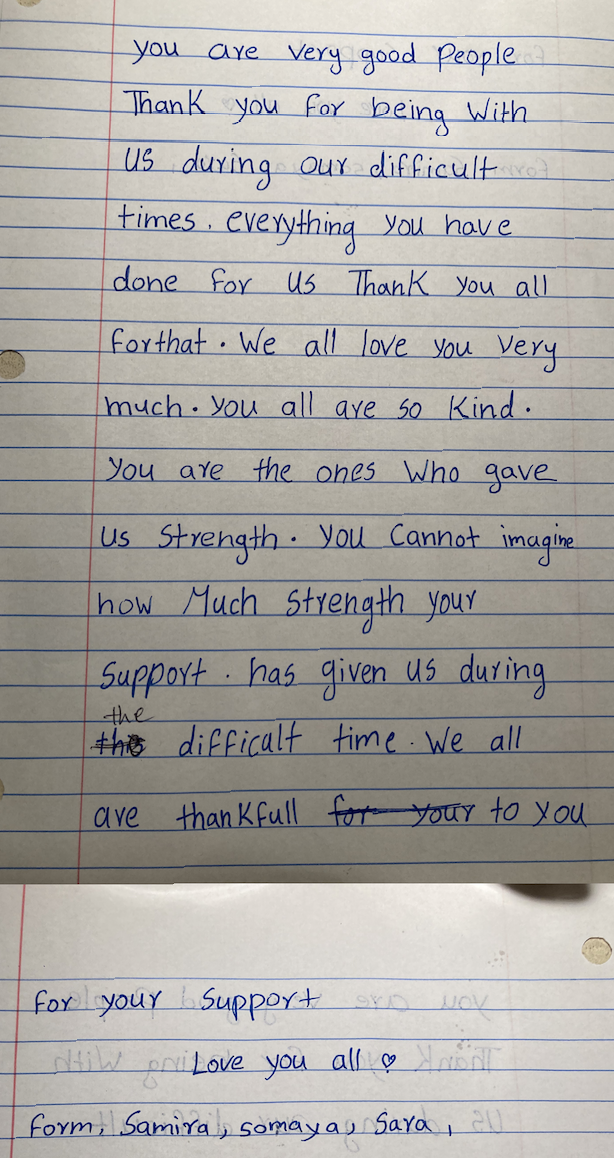
Below, a thank you note penned by three of Bashir Kahn's daughters as they practice their English.