

MONTREAL, Quebec–One of the biggest challenges to credit unions is not falling victim, as so many other brand name companies have, to their own success. And what is compounding that challenge? A 10,000-year human history of farming.
Nevertheless, credit unions can overcome that challenge by awakening their “inner hunter,” according to one analyst.

Jeremy Kutsche speaking to NAFCU conference in Montreal.
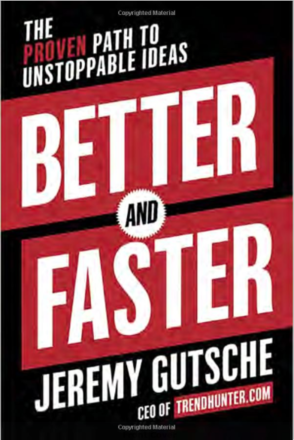
“Smart and successful companies, companies that are icons, have consistently missed out on opportunities that were in their grasp,” said Jeremy Gutsche, the founder and CEO of TrendHunter.com. Gutsche is also author of “Better and Faster: The Proven Path to Unstoppable Ideas.”
Gutsche’s goal was to ensure credit unions don’t become the kinds of fallen icons that are highlighted at credit union conferences–Kodak, Blockbuster, Smith Corona, etc.–a goal he shared in remarks before NAFCU’s annual meeting.
Gutsche noted that in the 1950s the average lifespan of a Fortune 500 company was 75 years. The average now has fallen to 15 years, and is projected to fall in half again.
“Companies are not structured to adapt; companies are structured around an insight that can then be monetized,” he said.
In an earlier career Gutsche worked in banking, helping in one case to build a business unit of more than $1 billion in revenues. But he mentioned several times throughout his remarks that he sees a strong opportunity for credit unions against banks.
“The need for a customer advocate has never been more important, and I want to help you find ways to connect with your members,” said Gutsche.
How to Build Connections
To build those connections, he said it’s necessary to see the that which is often overlooked—and that which is most often overlooked is often also most obvious.
He cited the career and life story of Robert Lang, a physicist and engineer, author of more than 80 technical publications and holder of more than 50 patents, who pivoted in his life become an expert in the Japanese paper-folding art of origami.

An origami cactus created by Robert Lang.
The skills Lang has developed in origami, which can involve complex mathematical computations to create what appear to be very simple designs, have been tapped by NASA to explore how to efficiently fold a satellite into a rocket as cargo, and by a medical device company on how to fold a heart device.
He quoted Lang as observing, “Almost all innovation happens by making connections between fields that other people don’t realize.”
Another example for credit unions, said Gutsche, is Sig Gutsche, his own father, whom he referred to as a “charismatic entrepreneur kickass dad.” From his childhood on, Sig Gustche had a long history of entrepreneurship, including owning a nightclub by the age of 16 and later becoming owner of the Canadian Football League’s Calgary Stampeders.
“My father discovered that the businesses that are successful are those that capitalize on overlooked opportunity,” said Gutsche, noting that his father made a habit of talking to thousands of people about his various businesses. “This taught me that opportunity is a riddle right in front of you. You already have the pieces, but you have to put in the effort to solve it. “
Sig Gutsche’s story is an interesting one. He came into ownership of the Calgary Stampeders after having earlier made a loan to the team’s owner. When that person got into regulatory trouble, and with the team losing money, Sig Gutsche soon found himself an owner of the CFL franchise.
“To my dad this is was an irresistible challenge,” said Gutsche. “Everyone told him not do it. In one year he had lost a lot of money and we’re selling the house. But he did things differently. He got all the players to call anyone who ever bought a ticket and asked them to come to the game. Dad also sat in every seat and tried to sit next to every fan, and asked them lots of questions about what do you like and what could we do better—and do you have any more friends you could bring?”
The result of all that: attendance grew to 35,000 fans per game from 14,000, the team won the championship Grey Cup five times, and fans even voted the owner the Most Valuable Player.
Gutsche outlined a number of traits of companies that adapt and grow. Among them:
Be Insatiable
“Competitors are lazy,” he said, “especially when you’re the credit unions taking on the banks. Push harder. Act sooner. Never give up.”
Gutsche’s father had an influence on his current obsession with teaching companies to build innovative cultures and take chances. He shared how in his childhood his father would buy hundreds of magazines and the family would flip through and look for the new innovations. Talk would then turn to, “What do you think about this idea? Could we make it better? I didn’t realize it but this would become the seed that would later become TrendHunter.com. It made me insatiable to be an entrepreneur.
“The issue is there are big opportunities everywhere, and it becomes frustrating to figure out which choice is right for you,” he told the NAFCU meeting. “I ran a half dozen businesses by age 18 in the hope of becoming an entrepreneur, but those did not work out and I went into consulting, then worked for Capital One. That let me work with other people’s money and an idea pipeline. The irony was I was working with other people’s ideas but not working with one of my own.”
That frustration led to the creation of TrendHunter.com, a forum where people can share their own ideas for businesses. It has attracted more than 100-million visitors, as well as numerous, well-known brands that are interested in gathering up grassroots ideas and concepts. From TrendHunter.com Gutsche said he has discovered six patterns that can be used to “re-look at your credit union.”
But before that “re-look” takes place, there are roadblocks to “realizing your full path.”
“The concept is that after 10,000 years as farmers, once you have things working for you, you are pre-wired to repeat whatever led to last year’s harvest,” said Gutsche, pointing to the Smith Corona Co., which invented electronic word processing, electronic dictionaries and more, but decided to stick with his bread and butter: typewriter manufacturing. “To break out of this you need to think about how to awaken your inner hunter, your culture of innovation.”
Gutsche offered the following steps for that culture of innovation:
Awaken the Inner Hunter.
The 3 traps of the farmer, according to Gutsche, are:
- Once successful, we become complacent.
- We repeat last year.
- We become protective about what got us here.
“The hunter is not complacent, but insatiable,” he said. “For you, this means instead of testing and rolling out a product, you are always looking for the new idea. It’s about not being repetitive, but curious. And instead of being protective, you must be willing to destroy. This is very difficult to get around in banking.”
Trendhunter.com
Gutsche stressed that credit unions should recognize that “100% of your organization doesn’t need to be a hunter. I want 10%. Innovation is portfolio management. You are successful because you have build successful brands and mean something in your community. I’m not saying you abandon that, especially since people hate banks. But you need to be thinking about a portion of your time being spent on new ideas.”
Credit unions, he said, are at risk due to their success.
“Your success does fuel some level of complacency,” Gutsche said. “In banking we think of that as being good, it prevents us from taking risk. But I’m not talking about putting your capital at risk. This keeps you from taking risks in how you talk to people, how you interact. It’s not about loans and risk, it’s about how you manage and inspire your team.
Insatiability Questions To Ask
- How often does your credit union experiment with ideas that might not work?
- How different would you act if you knew there as a team working 24/7 to eat your lunch?
“Once we are successful, we repeat and optimize until perfection—and irrelevance,” said Gutsche. “Smart people over-estimate control. The way out of this is to think about your own curiosity.
Curiosity Questions To Ask
- How much time do you spend hunting new opportunities outside of banking and credit unions?
- How much freedom do you and the people on your team have to experiment with high level ideas?
“To adapt, you need to let go,” said Gutsche. “In more traditional industries like credit unions, this is especially hard to do. You have to be willing to destroy.”
Destruction-Related Questions to Ask
- You must ask yourself, especially in a traditional environment, how much simpler would your business be if you started from scratch?
- How much freedom do you and your team have to stray from past success?
Gutsche said there are six ways to hunt for opportunities, which he defined as acceleration, cyclicality, convergence, reduction, redirection and divergence.
Acceleration
- Specifically, what is it you’re trying to achieve?
- How would you define your best feature?
“Is it banking services you provide?,” asked Gutsche. “No, its security, it’s comfort. So what about selling insurance, cyber protection?”
Cyclicality
- Since your last reinvention, now much have styles, tech and culture changed?
- Should you be reinventing? What do your next members think of your relevance? Do they know the difference between a CU and a bank?
“We think of innovation as the giant eureka moment, but actually innovation tends to be all these little iterations that make things better. You increase your odds of aligning to multiple trends.”
Convergence
- What other services could be combined with your offering?
- What companies could you partner with?
“Be irresistible to a specific group of people,” said Gutsche. “I can’t think of an industry where this matters more than with credit unions. You’re different. You’re a face. I understand the history of credit unions now, but why haven’t I been reminded of this throughout my life?”
Reduction
- What parts of your business do members actually care about
- If you split your work into five companies, which one would be the most valuable? I’m going to tell you they are not going to align with the banks.
Redirection
“Finance is a place where people hate and fear the offerings,” said Gutsche. “Don’t stop that unstoppable force. Re-channel it to your advantage. Redirect, refocus, reprioritize.”
Divergence
- Ask what do people hate about your industry, and in finance it’s remarkable easy.
- How could you be more customized or different from the mainstream banks?
“People don’t like to be a part of the mainstream; they like to be treated differently,” he said. As an example, Gutsche pointed to Red Bull, which has gone up against mainstream beverage companies.
“My tie-in for you is Red Bull is the credit union, and Pepsi and Coke are the banks,” he said. “You would think the banks/Pepsi/Coke would understand their customers, and they do in big data ways. But the reason Red Bull/credit unions can win is the big banks/Coke/Peopsi have too many rules and procedures, and that makes them predictable. Once you understand that it will propel you to success.”
There are patterns to be seen in all the chaos, said Gutsche, but seeing those patterns requires looking at things differently. To that end he quoted management guru Peter Drucker, who observed, “It’s not the questions that change, it’s the answers that do.”
“You are in a very different environment than when your forefathers created the credit union you are a part of today,” reminded Gutsche.
More information can be found at Trendhunter.com/secret/nafcu.