

By Ray Birch
MADISON, Wis.—Calling it a crime of opportunity, low-tech attacks on credit union ATMs—where crooks rip machines out of walls or away from their moorings with heavy equipment—are on the rise.
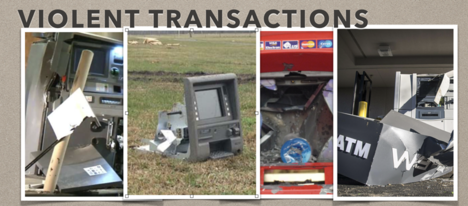
And now adding to the threat, at least in Philadelphia, is looters—brought on by the wave of protestors to the death of George Floyd—who have been using explosives to try and break into dozens of ATMs.
As CUToday.info reported, at least one person has allegedly died as the result of attempting to use explosives to rob a cash machine, while another has been arrested for selling homemade dynamite along with instructions on how to use it specifically to break into ATMs.
CUNA Mutual Group Risk Management Consultant Mike Petrone acknowledged credit unions already have enough on their hands with thieves stepping up their efforts to attack ATMs with jackpotting schemes, blowing them open with gas, and card skimming.
But now, as CUToday.info has repeatedly reported, the “smash and grab” attacks, where crooks steal heavy machinery—often a front-end loader—from a local construction site and drive to the nearest ATM to attempt to get its cash, appear to be on the rise.
“We are seeing an increase in these types of robberies,” said Petrone. “These are more common when the credit union is near a new construction site. Lots of times these crooks weren't planning on doing anything. But they have seen these crimes in the news, they see the heavy equipment, and it becomes a crime of opportunity.”
Frequent Failures
But not always a successful opportunity. The would-be thieves are often unable to get the cash, either failing to remove the machine from the credit union’s location, or hauling off the ATM in the back of a truck only to dump it later after unsuccessfully trying to open its cash dispenser.
“In the majority of those cases they destroy part of the credit union’s building, its parking lot and the ATM,” said Petrone. “Unlike crooks who hit ATMs with jackpotting schemes—getting the ATM to spit out its cash—these people are not trained professionals, so to speak.”
Helping to drive up the number of physical attacks on ATMs, according to Petrone, is simple math: credit unions are deploying more ATMs to handle routine transactions as branches focus on more high-value interactions.
“We definitely have more on-site ATMs today and in a lot of cases the ATMs are smaller and lighter with all the new technology,” said Petrone.
ATMs in rural areas are also frequent targets given the longer police response time.
Choosing the Right Type of ATM
Petrone encouraged credit unions to make the right choice in the types of ATMs they have exposed on the outside of their locations.

Mike Petrone
“These lighter ATMs that are not really designed for 24-hour use are more easily attacked,” said Petrone. “They are easier to break into, much easier to break into than those designed for 24-hour use and have an Underwriters Laboratories TL-15 rating, for example. We recommend ATMs are properly designed for 24-hour use—with different alarms, electronic protection like door contacts, motion detectors and mercury switches that detect when the ATM is being tilted. The problem is a lot of times if it's truly a smash and grab, the crooks pull the machine out quickly and they're gone before the police get there. So, we also recommend having sirens that go off when the ATM is attacked, hoping sound will drive the thieves away.”
Petrone more credit unions are responding by constructing concrete barriers to make access to the machines more difficult with a piece of heavy equipment, in addition to using much larger bolts to anchor ATMs to their moorings.
‘Not Sure This Always Gets Done’
Casey Delaney, director of business development at L. Keeley Construction, concurred, but added he’s not certain how many credit unions are taking those extra security steps.
“ATM manufacturers’ recommendations always indicate that the unit should be bolted to the concrete island or pad on which they sit,” said Delaney. “But I’m not sure if this always gets done.”
Delaney said ATM manufacturers also recommend steel pipe bollards—sturdy, short, vertical posts—be installed into concrete at each corner of the unit.
“This is intended to protect the unit from inadvertent damage but also it is as a security measure to preclude, say someone with a front-end loader from scooping up the ATM, as they first need to deal with the bollards to get free access to the unit,” Delaney said.
Delaney also recommended ATMs be placed in areas that can be easily seen from the street and are well lighted. He also recommended an external camera, in addition to the one inside the ATM.
“I’m not sure if this extra camera really serves as a deterrent to anyone, but it will help to find and prosecute someone who commits the crime,” said Delaney. “Possibly add a sign saying the area is under video surveillance.”
Another Option, But…
Using a through-wall ATM is another option that would make stealing one harder, said Delaney.
But attacks on through-wall ATMs can lead to greater damage costs, not only to the machine but to the credit union’s building, reminded Petrone.
“And as we know, the biggest cost from these crimes tends to be from damage to the building and ATM and not the stolen cash,” he said. “The price of the ATM alone can be $100,000 with all the new technology.”
GPS Tracking
Gary Walston, president of Dolphin Debit, said an important tool is fighting this crime is GPS tracking.
“This is critical means to catch these thieves when they do steal a front end loader from a worksite and tear the ATM out in three minutes and leave the site before the police respond,” said Walston. “We use a device from 3si that tracks the ATM going down the road and uses software that is installed on police dispatch computers. It really works great. We successfully prevented an attempted robbery this year in Houston using this device.”