

SEATTLE–Why should anyone join your credit union? What can you do when prospects express zero interest in becoming a member? The Gap, Tesla and Apple have some strategies on responding to those challenges.
George Blankenship, whose career includes stints with all three of those iconic, marketplace-changing brands—as well as with icons such as Steve Jobs and Elon Musk—offered insights to credit unions gathered for CUNA’s America’s Credit Union Conference here on how to achieve “even the impossible.”
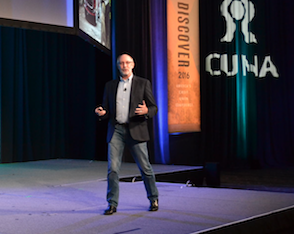
George Blankenship speaking to ACUC in Seattle.
But how did Blankenship end up in front of a credit union audience? By answering the phone one day and finding his boss, former Gap CEO Mickey Drexler, on the other end and saying he also had Steve Jobs on the phone.
“I came to realize that Steve Jobs wanted to sell computers like Banana Republic sells fashion,” said Blankenship.
When Jobs asked him to join Apple and oversee the launch of its now famous retail stores, Blankenship turned it down—which did not please the Apple CEO. He finally joined the company, meeting with Jobs for three hours every week as he oversaw real estate/retail stores for six years as the company introduced the Apple Stores around the world.
That included the introduction of the “Cube” store in Manhattan, which is the city’s third-highest grossing retailer, doing approximately $440 million annually.
'I Don't Want One'
But when Blankenship was hired by Apple the company was a long way from retail stores at which people stood in long lines to get in. In 2001, many people had no interest in Apple’s computers.
“I went and stood in computer stores for hours and watched people as they went to buy a computer. And I learned what people knew about Apple was, ‘I don’t want one.’ I had to figure out why.”
The objections to Apple, he found, included:
- Only for cult people
- No one I know uses one
- Doesn’t run Microsoft Office
- No software for it
“So we had to figure out how to turn that upside down,” said Blankenship. “We had to ambush people when they were in places where they were not thinking about buying a computer.”
When Apple opened its first two stores, one in a mall in Virginia, the other in a mall in California, the line ran out the door, through the malls and into the parking lots. And even that didn’t dissuade critics. Quoted in Business Week, Peter Burrow said of the Apple Stores: “I give them two years before they’re turning out the lights on a very painful and expensive mistake.”
“That’s when I realized you can never let anyone get in the way of doing what you know is right,” said Blankenship.
'I Must Have One'
Over the next 10 years Apple would go from “I don’t’ want one” to “I must have one” as it rolled out new computers, the iPod and the iPhone.
“I think arguably this is one of the most successful rollouts in the history of the digital world,” he said. “The fact people are buying Apple products isn’t key: the key is WHY are they buying Apple products. Why? They WANT them. That sounds simple. What makes people want Apple products? This is what you have to be thinking? Innovation, design and simplicity. People never said they wanted a tangerine computer. Steve wanted to differentiate the process. That’s the product end of things. Now you need to talk about the experience, and this is where you can come in as a credit union. Anyone can design a great space; we needed to create a great experience.”
But what is the key to that experience? Again, stressed Blankenship, who said he saved his first dollar at what today is Travis Credit Union, it’s not design or even product: it’s people.
“We have filled stores with great people and trained them well, and then we fired them up and turned them loose,” said Blankenship. “But you can’t stop there? We ask, ‘What can we do that will keep our customers coming back again and again? In your world, this would be, ‘How can we create a long-term member connection?’”
Creating The Long-Term Connection
Credit unions can create that long-term connection, according to Blankenship, by letting members “know they are important, taken care of, and you are available to help them. How did we do this? With the Genius Bar. It’s magic. It got to be so busy and such an important part of our business that we had to deconstruct it. We thought people would want to come in and ask a question and leave. But no, they wanted to stay. So we created workshops. And then people buy more stuff. Some people wanted one-to-one training, so for $99 you can come in and talk to a specialist once a week, and what happened? They buy more stuff. Think about it: we charge them $99 to come in and buy more stuff.”
Blankenship eventually left Apple and joined Microsoft for two years when it rolled out its retail outlets.
After opting to retire, Blankenship said he began receiving “spam emails” purporting to be from Elon Musk, which he deleted. He would eventually learn the emails were not Spam, and learn soon after that that Musk wanted to sell cars the way Apple sold computers. He would work with the electric car company from 2010-2013.
Tesla opened the first of what it calls its “design stores” in 2011, even before it had delivered on its very first vehicle, the Model S. And today more than 100,000 people have put up $1,000 deposits on its next model, which is several years away.
Much like Apple, Blankenship said Tesla has succeeded in doing what was long considered “impossible,” such as building an electric car that can do more than 250 miles per charge, requires just a simple plug for power, and can go from 0-60 in less than four seconds.
“That was the product end. But what if buying a car could be fun? We opened in a shopping center. This is the part you have to figure out.”
Understanding The Mission
Just as people were key at Apple, Blankenship said that, “I interviewed every single person going to work in Tesla stores to make sure they understood the mission.”
Blankenship is retired (again), but he remains actively engaged in how he sees the market developing. He believes the two areas that are ripe for innovations and disruption are healthcare and financial services.
“Think about all the things you can do to help your members today. There is one thing you have to zero in on—if it cannot be done on a phone or a tablet you will miss 40% of the population that is your target for the next 15 years.”
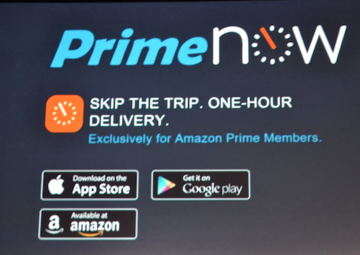
George Blankenship says Amazon is setting expectations.
That target, which for credit unions and every other provider is the 80-million strong Millennial generation (which will be 50% of the workforce in 15 years, observed Blankenship), differs in a fundamental way from earlier generations, and it’s not about technology, said Blankenship.
“What they own is less important than what they experience. For them, the 4/4 in a gated community is less important than snowboarding in the Swiss Alps,” he said. “You need to be thinking in your credit union, ‘How will I know when I am getting through to this group?’ And you will know if they take a selfie and share it with everyone.”
'Someone Is Going To Redefine You'
Beyond experiences, where Millennials are focused is on saving time, and Blankenship urged CUs to take a hard look at the time required of the various processes inside their operations. He noted the expectations of not just Millennials but all consumers are being driven by the types of retail experiences being offered elsewhere, such as with PrimeNow from Amazon. That service offers delivery of tens of thousands of items within several hours, and its app includes a graphic showing where the item is and when it is approaching.
“Who in this room can close their eyes and see innovative opportunities in your industry?” Blankenship asked the ACUC audience. When those eyes are closed he urged CUs to think about possibilities that might include drones, streaming video, geo-location and legal marijuana.
“Somebody is going to redefine your industry,” said Blankenship. “It is going to happen. There is only one question: will it be you?”