

WASHINGTON–Where does the country stand now with the COVID-19 pandemic? What’s ahead for the Summer and Fall? Will people have to prove they are vaccinated, and how? And should you send your kids away to sleepaway camp this year?
Those questions and others were addressed by Dr. Scott Gottlieb, the former commissioner of the Food and Drug Administration, during a Q&A as part of CUNA’s virtual GAC.
Posing the questions was Ryan Donovan, chief advocacy officer with CUNA. Here is a look at what was discussed and the forecast offered:
Donovan: Where do we stand in terms of our fight against COVID-19?
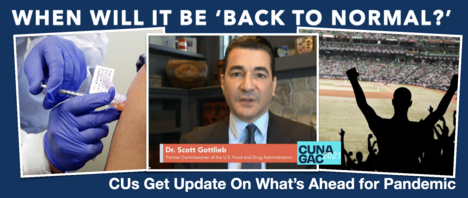
Gottlieb: I feel optimistic about where we stand with this virus. I think we’re going to see the number of infections decline. I don’t think the variants have gotten a foothold in the country, other than in Southern California and South Florida. One reason we’re seeing an (infection) trend back up is mobility is increasing and weather is getting better and people are moving around more. There is usually about a three-week lag between mobility and increases in infection.
We are vaccinating more people. There are now about 20-million doses getting into the market every week, so that’s about 12 million more people being vaccinated (as some of the doses are second shots). By the end of March we should have vaccinated about 100 million Americans and that’s going to start to have an effect.
I think you’re going to see people resuming normal activity in the summer. There is going to be uncertainty in the fall and the winter when there will be more contagious variants that could pierce prior immunity. But overall, I think infections are going to be down.
The final point I’d make is we need to start looking at the number of infections differently. Ten-thousand infections today is not the same as 10,000 infections six months ago. We have now vaccinated people in nursing homes and the proportion of the populations that are vulnerable to this infection has declined.
Donovan: Is it possible we’re trying to get back to normal too quickly?
Gottlieb: We’re going to try to return to normal too quickly--that’s what we do in this country. I think March is a difficult month. In April I think things are going to look very differently. March is the month when we need to be very cautious, but people want to go out and reengage.
I think we need to give the public some sort of measurement, and dates are a type of measurement. Even with the variants we can model this out. The CDC will have guidance on Thursday. They’re going to say if everyone is vaccinated you can get together without masks. That’s not going to fly. People who aren’t vaccinated are going to get together with people who are. I think if the guidance is too broad it gets ignored. Texas, I think, went too far in lifting everything. And telling people you can’t be with anyone who hasn’t been vaccinated is too conservative.
I don’t think we’re going to start to see a pick-up in infections until the Fall, and hopefully by then we have vaccines to cover these variants. And if we don’t, studies are looking at giving a third booster shot as an extra kick.
Donovan: President Biden appears to have brokered a deal with Johnson & Johnson and with Merck to produce more of the Johnson & Johnson vaccine, and he says there will be enough vaccine by end of May for every American who wants a vaccine. When do you see all adults will be able to be vaccinated?
Gottlieb: There’s a difference between supply and demand. The whole population isn’t going to want to be vaccinated. I think we can get at least one shot in to 100-million arms by the end of April. Of the 250-million adults in the U.S., 125 million were vaccinated last year for the flu. That’s a record. I think that’s the base case for COVID. Getting beyond that is going to be difficult.
Getting the COVID vaccine isn’t like getting the flu vaccine. COVID vaccines require a little bit of friction. I think increments beyond 150 million people is going to be challenging and we’re really going to have to make a hard push.
In terms of kids we’re unlikely to vaccinate kids below 12 this year. The vaccines are likely to be reformulated for children 12 and under for lower doses. I think there is a possibility a vaccine being authorized for 12 and above this fall and that we vaccinate high school kids this fall. Colleges are likely to require vaccination to return to college.
Donovan: You wrote in an op-ed that health preparedness should be treated as a national security issue. How might we have treated this pandemic differently?
Gottlieb: I think we need to think about public health preparedness as a national security issue going forward. We haven’t built in the resiliency or the ability to scale, or the ability to search diagnostic testing like we need to.
With respect to the intelligence agencies, there were signals that something was amiss in Wuhan. We know doctors were sending off samples for sequencing in December. That’s unusual. Those are signals we picked up.
Ryan Donovan during webinar.
This is something we are going to have to monitor. We have seen countries putting up trade and travel restrictions, which means countries might be less likely to share the information in the future.
Donovan: Purely hypothetically, let’s say you had two daughters: any reservations about sending them away to sleepaway camp? And what about going to baseball games and the ability to gather in large groups?
Gottlieb: I wouldn’t have hesitation. I think the caps are going to put in place and measures to prevent outbreaks. With baseball, you see some talking about restrictions on how many can be in a stadium. I think that will progress more slowly and the return to normal will be more gradual than it has to be.
As we get into the summer and things look good, and I think they will look good, you’re going to see more relaxation.
The next question is what do we do with vaccination status? Do you have to prove you have been vaccinated? Will there be two lines, one for people who are vaccinated and one for who are not? I could see some venues or cruise lines doing that.
The challenge is going to be owning your vaccination status. Right now, if you get the COVID vaccine the only one who knows is the state. I think you’re going to see a struggle to get all 50 states to come together on a system that would let you prove it.